
Daily Life Of Ancient Maya
A. Sutherland - AncientPages.com - All Maya regulated their lives by the sacred calendar and their belief that supernatural beings had the power to intervene in human affairs on earth.

Thatched-roofed hut in a village in Costa Maya, Mexico. Credit: raksyBH - Adobe Stock
Generally, they followed similar residential living patterns and highly respected family and lineage relations. However, many aspects of everyday life for the Maya, such as the clothing or food they consumed daily, depended mainly on their position in the social hierarchy and in what part of the country they lived.
How Did The Ancient Maya Live?
Much we know about the ordinary Maya comes from 16th-century Spanish observations that detail their daily lives. Information about the thatched-roof huts in which they lived comes from excavations.
Most Mayans lived in huts with walls woven from branches, wooden roofing covered with thatched palm straw or hay provided adequate protection from rain or snow, and walls were made of stone or mud. The Maya built their huts on low-beat earth platforms or even rocks that isolated them effectively from the ground.
Most huts had simple basic designs without stairs or sculptures, and others had one or two sets of long and wide stairs decorated along their sides with traditional sculptures.
Usually, the family (with grandparents, uncles, and aunts) lived in a one-room hut on the city's edge. A family or several families related to each other often had more houses, forming a complex of buildings with a courtyard, a dump, storage pits, and a steam room.

A typical Maya village. Credit: Guatemala National Museum of History and Anthropology
There was also a place of worship and public buildings, including a special place where the elders gathered. Even today, many Maya traditionally live in houses very similar to those where their ancestors lived.
Wealthy Maya - members of the elite - often lived in stone houses or large palaces that formed entire residential complexes.
The furnishings of huts and houses included straw mats ("petate"), hammocks, stone fireplaces ("metate"), and various types of clay vessels, baskets, and other utensils for food preparation and eating.
The Maya Worked In Agriculture and Food Production
Archaeologists estimate that the Maya society required 75 percent of its population to be engaged in food production. Men were busy hunting and fishing (fish was probably raised in canals) and worked the fields and terraces for intensive agricultural production. The main crop was maize, beans, squashes, cotton, and tobacco. The Mayans produced cocoa and honey on some farms and traded excess products.
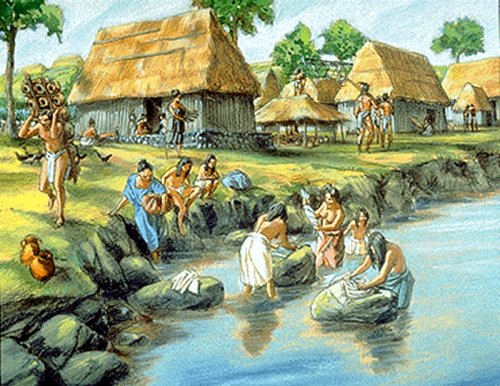
Maya women and men working. Credit: History Museum Canada
Women maintained the household, searched for fruits and mushrooms in forests, and prepared the family's food. They worked as spinners, weavers, and dyers. By producing elaborate textiles, they largely contributed to the development of the textile industry.
The farmers had turkeys, dogs, bees, and ducks in some regions. The Maya women also cultivated kitchen gardens and backyard vegetable gardens. Most Mayans only worked in the fields year-round, and during the dry season, people had other activities. Farmers repaired or made tools, worked as part-time weavers, or helped as construction workers. The remaining 25 percent included shaman priests, potters, sculptors, painters, stonecutters, merchants who delivered scarce goods in the region or particularly desired by the elite, and many others.
The ancient Maya worked hard for their families and the community, but they also had time for religious ceremonies and entertainment, including music, dancing, and playing games. Their infamous game was Pok-A Tok, which the ancient Mayans most probably inherited from the Olmecs. Pok-A-Tok was played since at least 1,400 BC by the pre-Columbian peoples of ancient Mesoamerica. Known among the Aztecs as "tlachtli," Pok-A-Tok was an essential part of their political and religious festivals.
See more: Ancient History Facts
The game had a religious meaning, and for winners playing, it symbolized victory over death. It was also played sometimes just for fun as pure entertainment.
Illegitimate Children Were Not A Problem With Marriage
Men in their 18-20s could marry, and in the case of women, the age was usually at least 15. The marriage could be dissolved when the woman was infertile or not a virgin – in the latter case, it was up to the husband. Illegitimate children were not a problem to marriage among the ancient Maya; however, the husband needed to know about them. The husband did not want to have at home an unfaithful wife, and it was her punishment. The husband had to live with his wife's parents and was obliged to help his father-in-law work on the farm for about six years.
Burial Of The Loved Ones
Deceased ancestors were usually buried beneath the family house floor, where they lived their entire lives. Even after death, the loved ones were still present and included in the daily lives of their families. Also, ancestors could influence their descendants or mediate between the living and the gods.
The ancient Maya believed that unhappy or dishonored ancestors could negatively influence their families by inflicting diseases from the underworld.
Written by – A. Sutherland - AncientPages.com Senior Staff Writer
Updated on January 28, 2024
Copyright © AncientPages.com All rights reserved. This material may not be published, broadcast, rewritten or redistributed in whole or part without the express written permission of AncientPages.com
Expand for referencesReferences:
Robert J. Sharer, Daily Life in Maya Civilization
Scarborough Vernon L. The Mesoamerican Ballgame
Gillings T. Last Game For The Gods
More From Ancient Pages
-
 Rare Viking Artifacts Hidden Beneath The Ice Discovered By Archaeologists In Norway
-
 Starkad The Viking – Legendary Norse Hero Who Was Both Blessed And Cursed By Gods
-
 Graveyards Of Ancient British And French Giants Revealed In Old Documents And Journals
-
 Code Of Nesilim: Ancient Laws Of The Hittites
-
 Eurasian Horse Riders Played Ball Games 3,000 Years Ago – Leather Balls Found In Graves Reveal
-
 Judahite Shrine Of Biblical Arad Reveals Ancient Use Of Cannabis And Frankincense
-
 Ancient Egyptians Observed Algol’s Eclipses – Cairo Calendar Analyzed
-
 Who Was The Sapa Inca?
-
 Ancient Great City Of Napata In The Kingdom Of Kush
-
 On This Day In History: Reginald Walter Bonham Was Born – On Jan 31, 1906
-
 Micro-CT Scans Revealed: It Wasn’t Egyptians’ Falcon-Headed Deity But Malformed Human Baby
-
 On This Day In History: King James I Of Scotland Was Assassinated – On Feb 21, 1437
-
 Roman-Germanic Mythical Kneeling Figure With A Human Head And Snake’s Body Unearthed At Stuttgart’s Excavation Site
-
 Mystery Of The Boxgrave Humans – Fossils In The UK Reveal How Ancient Europeans Were Connected
-
 Unique Gungervaa Shrine With Three Tiny Silk Scrolls Examined With X-Ray
-
 8th Century Sculpture Of Lord Vishnu Belonging To Pandya Dynasty – Unearthed
-
 Famous Bayeux Tapestry May Solve The Planet Nine Mystery
-
 A Rare Find In Ancient Timorese Mud May Rewrite The History Of Human Settlement In Australasia
-
 More Than 10,000 Artifacts Unearthed At The Birthplace Of Texas
-
 World’s Oldest Human Statue Discovered At Karahan Tepe, Turkey

