
Antonine Wall: Impressive Roman Frontier Built By Empire’s Three Legions In Scotland
A. Sutherland - AncientPages.com - The Hadrian Wall lost its importance when Roman Emperor Hadrian's successor, Antonius Pius (138 - 161), launched a successful military campaign in southern Scotland early in his reign and began constructing the Antonine Wall.
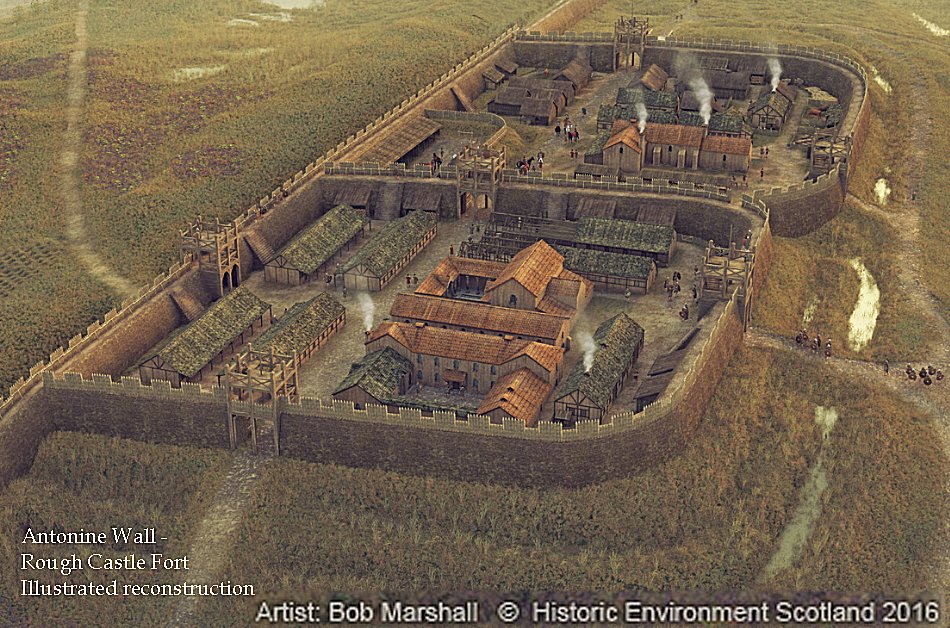
Image credit: Artist Bob Marshall - Historic Environment Scotland 2016
The Romans started to build the Antonine Wall in Britain only fifteen years after the
construction of Hadrian's Wall was completed. It is known that the famous Hadrian's Wall was built for both military and economic needs.
The Wall would also prevent raiders from the north from destroying the strategic Roman base at Corbridge in Northumberland.
The Antonine Wall was constructed by another second-century emperor even further north of Hadrian's Wall. The unrest from the north must have been palpable to dictate the construction of such massive formations.

From 155 to 157 CE, the Brigantes revolted in Scotland. They were ancient Britons who, in pre-Roman times, controlled the most extensive section of what would become Northern England -
The Antonine Wall's ruins are less visible than those of the Hadrian's Wall. It is mainly due to the hazardous building material - turf- used to construct the Wall. However, it is evidenced by the construction of foundations that the Romans planned to erect a stone wall.
The soldiers of the Second Augusta, the Sixth Victrix, and the Twentieth Valeria Victrix legions (also responsible for the building of Hadrians Wall) began to construct the Antonine Wall in AD 142 at the order of Roman Emperor Antoninus Pius.
The structure that runs across what is now the Central Belt of Scotland, between the Firth of Forth and the Firth of Clyde, was the Roman Empire's northernmost frontier barrier.
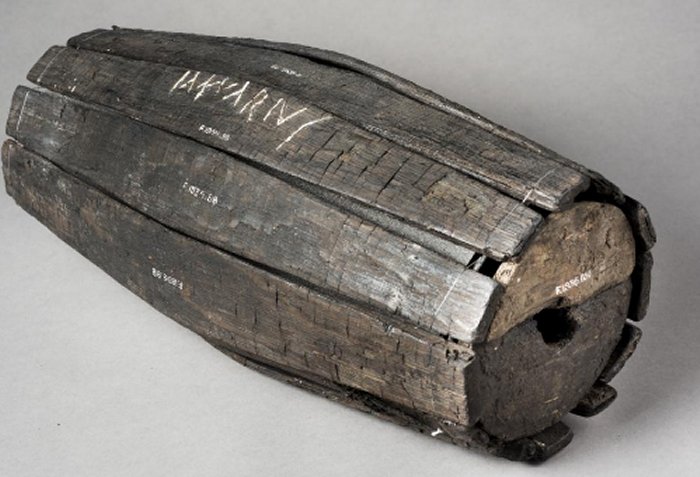
A wooden barrel, with the owner's name, scratched into it. Image credit: Hunterian Museum
The work took about 12 years to complete. These legions erected stone slabs on completion of their work and are the records of the length of the Wall they completed, the emperor's name, and the legion's name.
The slabs are unique because no similar slabs are known from any frontier of the Roman Empire.
Originally six forts were planned (Carriden, Mumrills, Castlecary, Bar Hill, Balmuildy, and Old Kilpatrick), with several fortlets built in between. Later, these fortlets were abandoned, and the next ones were constructed.
The Antonine Wall (named after the Roman emperor Antoninus Pius) was an impressive barrier with a height of 4 meters, 4.3 meters wide, with a large ditch on the north side for reinforcement of defense and a network of roads on the south side for the efficient movement of troops. It was 63 km (39 miles) long, with 19 forts every 3.3 km.
 Left: Found at Carleith, Dunochter, before 1699. Translates as " For the Emperor Antonius Augustus Pius, Father of this country, the Second Augustan Legion completed 3271 feet (of the wall)" Greyish buff sandstone; Right: Unknown provenance - donated to Glasgow University in 1695; Translated as "For the Emperor Caesar Titus Aelius Hadrianus Antoninus Augustus Pius, Father of this Country, a detachment of the Twentieth Valerian and Victorius Legion; Image credit: University of Glasgow, Scotland
As early as 162 AD (only eight years after its completion), the Romans from this line were forced to retreat to the south again and return to the older fortification - Hadrian's Wall - after it was strengthened.
Unfortunately for the Romans, the Wall was abandoned, recaptured a year later, and finally, entirely abandoned by 164 CE.

Left: Altar to ‘the Spirit of the Land of Britain’. © Hunterian Museum; Right: Tombstone of Verecunda © Hunterian Museum
Archaeological excavation conducted in the ruins of the Wall revealed many Roman artifacts, both military and domestic. When the Romans abandoned a fort, they usually buried many possessions they did not wish to salvage and take with them. They did not want them to be used by local people.
Except for decorative slabs, the Romans also left altars, tombstones, personal possessions, and building materials, which were well-preserved, well-buried, and, therefore, never touched by robbers.
Written by – A. Sutherland AncientPages.com Staff Writer
Updated on April 18, 2023
Copyright © AncientPages.com All rights reserved. This material may not be published, broadcast, rewritten or redistributed in whole or part without the express written permission of AncientPages.com
Expand for referencesReferences:
Harper W. The Antonine Wall (Defenders of Rome, Book 4)
More From Ancient Pages
-
 Teutonic Knights – Facts And History About The Christian Military Order
-
 On This Day In History: Knights Templars’ Jacques de Molay Burned At The Stake – On Mar 18, 1314
-
 Unique Headstones Of Kela Mazin Cemetery In Kurdistan Are Probably 3,000 Years Old Or Much More
-
 Crypto-Hieroglyphs Deciphered – Previously Unknown Message Discovered On The Luxor Obelisk In Paris
-
 How Was A Viking King Elected And What Was Expected From Him?
-
 Parthian Jar Burial Dated To 247 BC – 224 CE Unearthed In Iran’s Kurdistan Province
-
 On This Day In History: ‘Principia Mathematica’ Monumental Work Published By Isaac Newton – On July 5, 1687
-
 Viking Age Mass Grave Reveals Gruesome Discovery At Historical Village Of Repton, England
-
 Intact 1,800-Year-Old Roman Sarcophagus With Unexpected Treasures Found In France
-
 Pancho Villa: Mexico’s Robin Hood – A Ruthless Bandit Or A Hero?
-
 On This Day In History: Mayan King Bird Jaguar IV Assumes The Throne – On May 3, 752
-
 Large 1,500-Year-Old Winepress Unearthed In Area Once Known For Wine production.
-
 Who Was The The Mysterious Lady Of Bietikow And What Had She In Common With Ötzi Iceman?
-
 Early Toilets Reveal Dysentery In Old Testament Jerusalem
-
 Unknown Ancient World Discovered Beneath East Antarctic Ice Sheet
-
 Ancient Desert Mystery – Did Thousands Vanish Without A Trace Because Of An Ominous Prophecy And Revenge?
-
 Archaeologists Refute Claims That A Comet Destroyed Hopewell Culture
-
 Early Twelfth-Century Castle Walls Unearthed Outside Gloucester, England
-
 Menes – Legendary First Monarch Probably Under Different Names Who Unified Egypt
-
 Huge 40-Meter Long 16th Century Tunnel For Looting Was Exposed Inside Tower Tomb

