
Ishtar Gate, The Eighth Gate Of The Inner City Of Babylon
A. Sutherland - AncientPages.com - The Ishtar Gate was constructed by the Babylonian King Nebuchadnezzar II circa 575 BC.
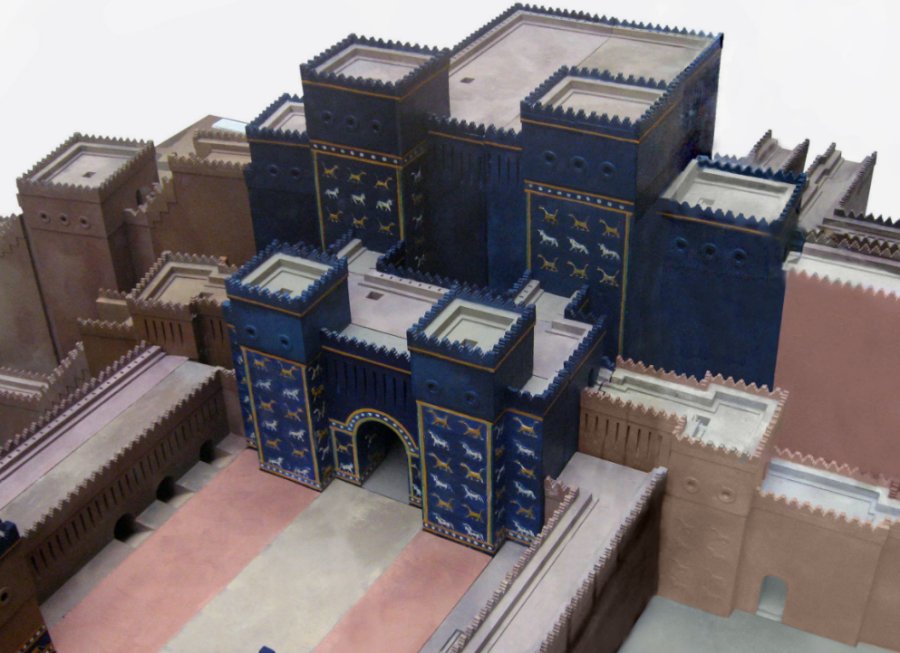
City model of the main procession street (Aj-ibur-shapu) and Ishtar Gate in Babylon. Model at the Pergamonmuseum. - Public Domain
This enormous burnt-brick entryway was located over the main thoroughfare in the ancient city of Babylon (now in Iraq). Built about 575 BC, it became the eighth fortified gate in the city.
The Ishtar Gate was more than 38 feet (12 meters) high and was decorated with glazed brick reliefs, in tiers, of dragons and young bulls.
The gate itself was a double one, and on its south side was a vast antechamber. Through the gatehouse ran a stone- and brick-paved avenue, called the Processional Way, a major road in which burned bricks and carefully shaped stones were laid in bituminous mortar.
It has been traced over a length of more than half a mile.
In his book "Babylon: Mesopotamia and the Birth of Civilization", Paul Kriwaczek, Paul writes:
"Beyond E-Sagila and Etemenanki, visitors to Babylon passed through another gate to enter the adjoining quarter: ‘From the Grand Gate to the Ishtar Gate is called Ka-Dingir-ra’, says the itinerary. Ka-Dingira is Sumerian for the Akkadian Bab-Ilum, Babylon, interpreted as meaning Gate of God; perhaps this area was the original nucleus of the urban foundation.

The reconstruction of the Ishtar Gate in the Pergamon Museum in Berlin. Image credit: - source - CC BY 2.0
Thus Eridu, the original locus of Mesopotamian culture, and Babylon, its final and most glorious expression were here symbolically united in facts on the ground.
The Ka-Dingir-ra quarter contained the most spectacular of Nebuchadnezzar’s urban-renewal projects: his own magnificent palaces, the processional way, its walls magnificently decorated with glazed-tile lions, leading to the Marduk temple through the magnificent 18-meter-high Ishtar Gate with its crenelated bastions, their glittering blue façades adorned with bulls and dragons in white and ochre, and bearing a long inscription by the king himself:
This street of Babylon had become increasingly lower, I pulled down the gates and re-laid their foundations at the water table with asphalt and bricks.
I had them remade of bricks with blue stone on which wonderful bulls and dragons were depicted. I covered their roofs by laying majestic cedars lengthwise over them. I fixed doors of cedar wood trimmed with bronze in all the gates.

This is the so-called inscription plaque (or building inscription) of the Ishtar Gate appears. The cuneiform inscriptions of the whole text read, "I (Nebuchadnezzar) laid the foundation of the gates down to the groundwater level and had them built out of pure bluestone. Upon the walls in the inner room of the gate are bulls and dragons and thus I magnificently adorned them with luxurious splendor for all mankind to behold in awe." These glazed bricks were found near the main Ishtar Gate during the German excavations of the area, 1902-1914 CE. Neo-Babylonian period, circa 575 BCE. From Babylon, Iraq. Pergamon Museum, Berlin, Germany. Image credit: Osama Shukir Muhammed Amin FRCP(Glasg) - CC BY-SA 4.0
I placed wild bulls and ferocious dragons in the gateways and thus adorned them with luxurious splendor so that Mankind might gaze on them in wonder..."
The sides of the street were decorated with brick lions passant. It has been estimated that there were 120 lions along the street and 575 dragons and bulls, in 13 rows, on the gate.
Not all of these reliefs were visible at the same time, however, for the level of the street was raised more than once; even the lowest rows, which were irregularly laid, may have been treated as foundation deposits.
The site was unearthed by the prominent German archaeologist Robert Koldewey, whose excavation of Babylon lasted from 1899 until 1917. The remnants of the original gate and Processional Way have been housed in Berlin’s Pergamon’s Museum since that institution’s founding in 1930.
Iraq reconstructed the thoroughfare at one of the higher levels but since the 1990s has actively sought the return of the original gate and associated artifacts.
Written by – A. Sutherland AncientPages.com Staff Writer
Copyright © AncientPages.com All rights reserved. This material may not be published, broadcast, rewritten or redistributed in whole or part without the express written permission of AncientPages.com
More From Ancient Pages
-
 Slaves In The Aztec Empire Had Much Better Rights Than In Any Other Ancient Society
-
 The Thunder Stone: World’s Largest Monolith Moved By Man
-
 Mysterious Havering Hoard – Largest Ever Bronze Age Hoard Discovered In London
-
 Collection Of 59 Well-Preserved 26th Dynasty Coffins Unearthed In Saqqara Necropolis, Egypt
-
 Bryggen Inscriptions Reveal Viking Runes Were Used As Modern SMS – Short Message Service In The Norse World Was Popular
-
 Late Neolithic Italians Mastered Complex Metal Technologies – New Study
-
 Native Americans’ Visions Of Distant Explorers May Unravel Some Ancient Mysteries Of North America – The Arrival – Part 1
-
 Roman-Era Female Statue Dated Back To 1,800 Years Ago Unearthed In Anemurium, Türkiye
-
 Battle Of Himera: New Study That Contradicts Historical Accounts
-
 Kingdom Of The Vandals: A People In Search Of A Home
-
 Mysterious 4,000-Year-Old Table-Like And Unique Dolmen Discovered In Galilee Hills, Israel
-
 Saint George: Knight Warrior Who Refused To Denounce His Faith And Died A Martyrs Death
-
 On This Day In History: Treaty Of Worms Signed Between Great Britain, Austria And The Kingdom Of Sardinia – On Sep 13, 1743
-
 Legend Of The Eight Immortals Who Know The Secrets Of Nature
-
 Unique 2700-Year-Old Papyrus With Inscription In Paleo-Hebrew Acquired By Israel From U.S
-
 The Mystery Of Serpent Worship
-
 Yenikapı Shipwrecks – A Unique Historical Treasure That Sheds Light On Ancient Ship Production
-
 Xochicalco: Stunning Ruins Of Sacred City Linked To Maya and Aztecs Civilizations
-
 Oseberg Ship: Amazingly Well-Preserved Viking Burial Ship
-
 On This Day In History: Foundation Stone Of The Royal Greenwich Observatory In London Was Laid – On August 10, 1675


