
Wyoming Discovery Reveals Odd Jurassic Squid Preserved For 160 Million Years
Jan Bartek - AncientPages.com - Researchers in Wyoming, U.S., have uncovered two rare fossils of a Jurassic squid-like species that lived about 160 million years ago.
The species, called Wyoteuthis linsterorum, is an ancient cephalopod known as a belemnite and is related to today’s squid and octopus. Its thick, barrel-shaped skeleton makes it the largest belemnite found so far.
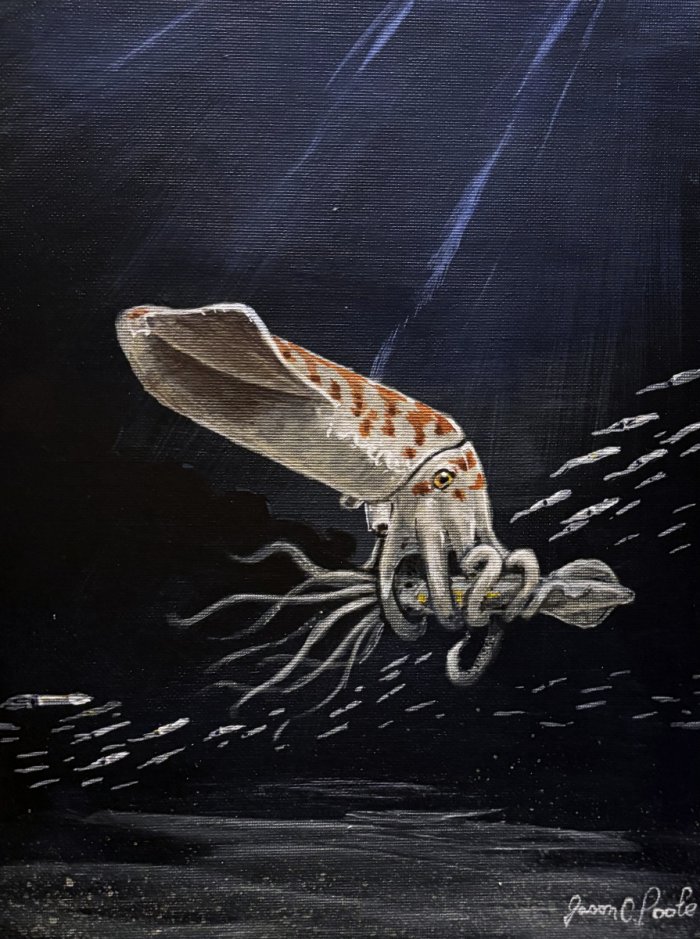
Illustration of Wyoteuthis linsterorum by Jason Poole. Credit: Jessica Lippincott
An international team from the U.S., U.K., and New Zealand, including Dr. Dean Lomax from the University of Manchester, shared their findings in the journal Papers in Paleontology.
Belemnites are some of the most common fossils in the world and are known for their bullet-shaped remains, called a rostrum or guard. Millions have been found in Wyoming’s Sundance Formation, which was once an inland sea covering the western U.S.
Co-author and Wyoming paleontologist Jessica Lippincott said people in Wyoming often call these fossils "squid butts."
The Chunkiest Belemnite Ever Discovered
Most belemnites found in Wyoming are bullet-shaped and usually measure between 5 and 10 centimeters long (2 to 4 inches) and 1 to 2 centimeters wide (0.4 to 0.8 inches). The new species, however, has a broad, barrel-shaped rostrum about 10 centimeters long (4 inches) and up to 6 centimeters wide (2.4 inches), making it the thickest belemnite ever recorded.
Researchers think the living animal would have grown to about 60 centimeters (24 inches) long, including its arms.
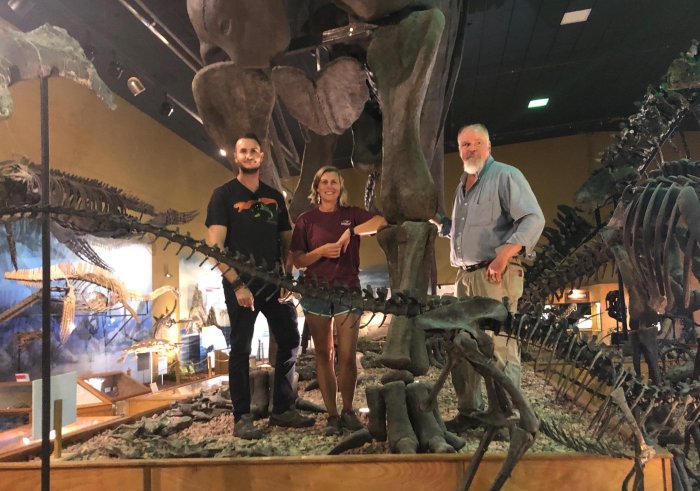
The research team including Jessica Lippincott, Dr. Dean Lomax and Bill Wahl, at the Wyoming Dinosaur Center. Credit: Dr. Dean Lomax
Bill Wahl, a paleontologist from Wyoming and co-author of the study, started the research after noticing that this belemnite "stuck out like a sore thumb." He brought together an international team, including belemnite expert Alexey Ippolitov from Victoria University of Wellington in New Zealand, to study the fossils.
The team used CT scans to study the fossils without damaging them. The scans revealed internal features that showed the animal belonged to an ancient belemnite family thought to have gone extinct millions of years ago. He was "deeply surprised" to find a fossil from such a well-studied group that was so different from earlier discoveries. He pointed out that after more than 200 years of belemnite research, discoveries like this are extremely rare.
Ippolitov explained, "A possible explanation is that their relatively large size gave them an advantage when hunting co-occurring smaller belemnites of the genus Pachyteuthis. Modern squid, after all, are hardly picky when it comes to prey: they readily hunt not only other species of cephalopods, but sometimes even their own kind."
30 Years In The Making
The discovery took almost 30 years. In the late 1990s, Dr. Burkhard Pohl, who founded the Wyoming Dinosaur Center, found the first specimen after spotting a very large belemnite. The fossil was left unstudied until 2019, when fossil collector Cliff Linster found a second specimen near Ten Sleep, Wyoming, and donated it to the Wyoming Dinosaur Center. With these two fossils, scientists finally had enough evidence to identify and officially describe the new species.
Honoring A Fossil Collector's Legacy
Wyoteuthis means "a squid from Wyoming," and the species name linsterorum honors Linster and his family. Linster discovered one of only two known specimens and donated it for scientific research.
Lippincott said, "After years of fossil-hunting in Wyoming and collecting countless Pachyteuthis belemnites, this specimen is unlike anything I have seen. It shows that we continue to discover new fossil species, and that rockhounds and invertebrate fossil collectors can also contribute to science."
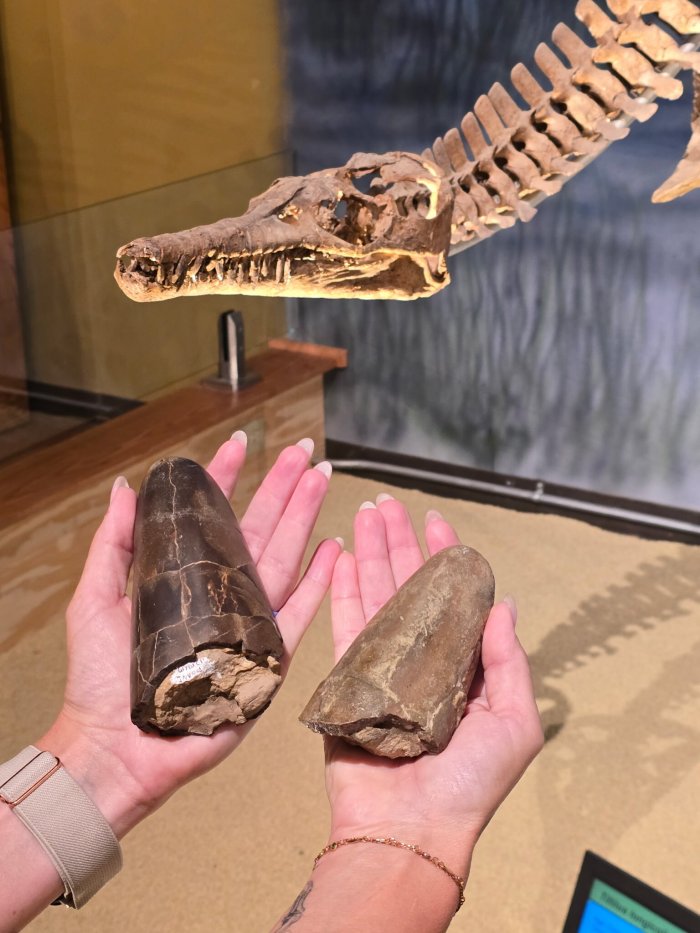
Wyoteuthis linsterorum holotype on left, paratype on right. Credit: Jessica Lippincott
Linster passed away in June this year. He was aware that researchers were studying his significant discovery and looked forward to its formal description. The Linster family is well known for remarkable fossil finds, including the dinosaur Bambiraptor.
Co-author and British paleontologist Lomax, an honorary research fellow at The University of Manchester and an 1851 Research Fellow at the University of Bristol, excavated dinosaurs with Linster and his wife, Sandy, as a teenager.
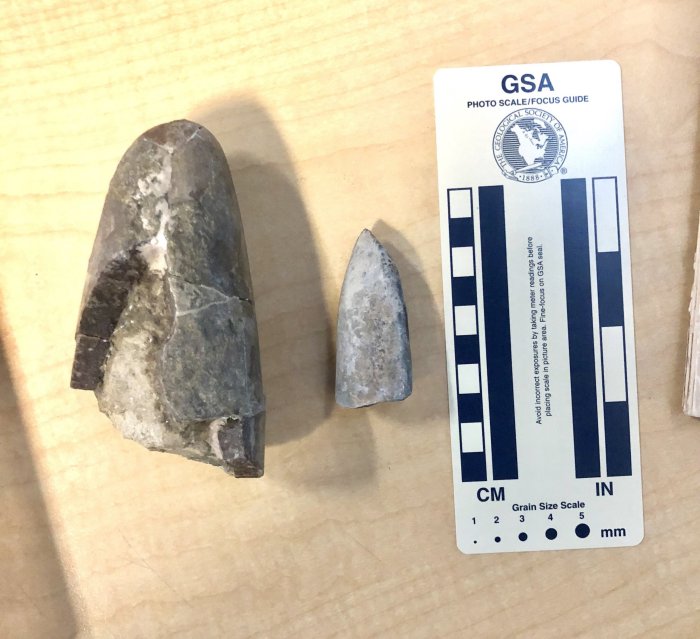
Wyoteuthis linsterorum paratype with common Pachyteuthis example for size comparison. Credit: Jessica Lippincott
He said, "I met Cliff and Sandy in 2009, when I spent a week digging up a dinosaur bonebed on their property in northern Montana. I have fond memories of that dig, listening to Cliff share his passion for fossils, including this belemnite. I'm honored to help name this fossil after Cliff. It's bittersweet that he didn't get to see it published, but it's wonderful that we can immortalize him and his family name in the history of paleontology.”
See also: More Archaeology News
"The find is incredibly rare, which might be due to some ecological adaptations to the environment at the time. Perhaps its rarity is a result of narrow specialization."
Lomax is also the author of the recently published book, "The Secret Lives of Dinosaurs," which highlights Wyoming fossils, and he has spent time collecting fossils and excavating plesiosaurs and ichthyosaurs in Wyoming's Sundance Formation.
Both specimens are on display at the Wyoming Dinosaur Center in Thermopolis, Wyoming, U.S.
Written by Jan Bartek - AncientPages.com Staff Writer
Source: University of Manchester
More From Ancient Pages
-
 Buried Time Capsule In Cave Reveals Previously Unknown Ancient Population Linked To North America
-
 Millennium Old Dice Found In Vadnagar, Gujarat, India
-
 7 Magnificent Thracian Gold Bracelets Found In Romanian Forest By Amateur Archaeologist
-
 Huge Viking Burial Discovered Beneath Streets Of Dublin
-
 80,000-Year-Old Bone Tools Discovered In South Africa Sheds New Light How Homo Sapiens Evolved
-
 Rare 2,300-Year-Old Tomb Of Greek Courtesan Found In Jerusalem Burial Cave
-
 John Dee’s Magical Mirror Used To Contact Spirits Can Be Traced To The Aztecs
-
 2,000-Year-Old Lost City Of Bassania Described By Roman Historian Livy Investigated By Archaeologists
-
 Breakthrough: Oldest Egyptian DNA Extracted From Individual Who Lived During The Age Of The First Pyramids
-
 3,000-Year-Old Stone Scarab Seal Depicting A Pharaoh Discovered In Israel
-
 1,300-Year-Old Art Mystery Solved By Scientist
-
 Ancient Atlantean Sculpture Discovered At The Mayan Chichen Itza Archaeological Site
-
 Evidence Of A Large Roman Industrial Hub Near Sunderland In North East England Uncovered By Archaeologists
-
 First 5th Century Mosaic Found Near Cirencester Once The Second-Largest Roman-British Town In England
-
 What Can New Method Radiocarbon 3.0 Reveal About The Interaction Between Homo Sapiens And Neanderthals?
-
 Luna Settlement: First Multi-Year European Settlement Identified In Pensacola, Florida
-
 Intriguing Fossil Found At The Azmaka Site Could Rewrite Human Evolution, Scientists Say
-
 Early Hominins Walked Farther And More Efficiently – New Study
-
 8,200-Year-Old Needles Unearthed In Turkey’s Izmir
-
 Grave Of Scythian Amazon Warrior Wearing A Golden Ceremonial Headdress Discovered In Voronezh, Russia

