
First Detailed Academic Study Of East African Maritime Traditions Shows Changes In Boatbuilding
Jan Bartek - AncientPages.com - The first detailed academic study of East African maritime traditions shows changes in boatbuilding techniques but the continuing use of wooden vessels by fishers.
Researchers have used photogrammetry technology to document the watercraft using the Zanzibar Channel, on which so many livelihoods depend.
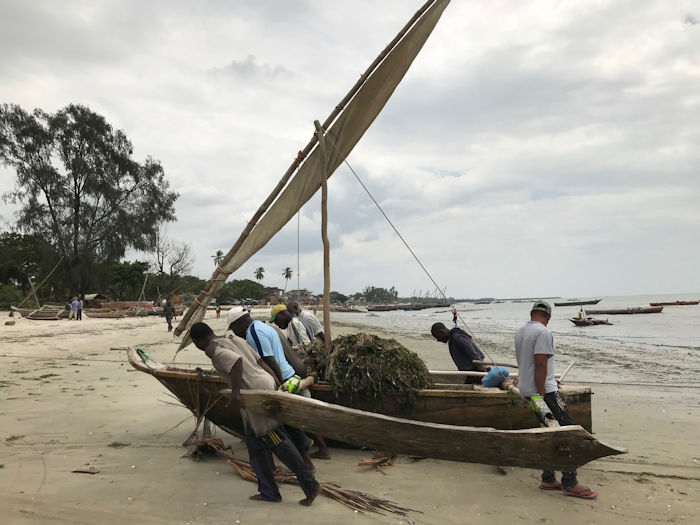
A ngalawa. Credit: Lucy Blue
Large local vessels—the mtepe, dau la mtepe, and even the larger jahazis—have long left the Zanzibar Channel because of the development of modern transport infrastructure, the end of the mangrove-pole trade, and the changing political economy of the wider Indian Ocean.
Experts have recorded how boat builders are using newly available propulsion technologies—the outboard, and to a lesser extent, the inboard engine.
But their work also shows that high numbers of small fishing vessels still use the Zanzibar Channel. The small-scale artisanal fishing sector is buoyant, largely reflecting population growth, leading to falling stocks and soaring catch rates in inshore waters.
Experts conducted surveys in 2018 on Unguja, the principal island of the Zanzibar archipelago, and in 2019-2020 in Bagamoyo, mainland Tanzania to show the range of wooden fishing and cargo-carrying woodcraft in the region.
Scholars had warned the wooden watercrafts in East Africa would decline and disappear. The large oceangoing vessels of the monsoon trade—connecting Somalia, southern Arabia, the Arabia-Persian Gulf and South Asia—have been absent for more than 50 years.
Fishers use the ngalawa for a variety of types of net and line fishing depending on the season and the size of the fish. In the prawn season, at the end of the kaskasi (northerly) monsoon, they sometimes use their vessel simply as a means of reaching estuarine shallows, where they disembark and use a fine hand-held net to catch small prawns.
The mashua ndogo is rare—researchers encountered only two, one each in Bagamoyo and Mlingotini—because of the size of tree needed and particular skills required in joining the logs, but also because it is considerably more expensive to make than other dugouts.
The boti la mtando, ngwanda, and diminutive dingi represent a relatively recent innovation in both boatbuilding and fishing method in the Zanzibar Channel. They have outboard engines and portable electric generators to enable new fishing techniques, based around seine-netting and purse-seine netting and the use of artificial light to attract fish at night. Such equipment also place fishers in potential conflict with regulators over fish-stock conservation: Some fishers themselves also express concerns about its impact.
The research was carried out by John P. Cooper and Alessandro Ghidoni from the University of Exeter, Lucy Blue from the University of Southampton and Elgidius B. Ichumbaki from the University of Dar Es Salaam. It is published in the International Journal of Nautical Archaeology.
Dr. Cooper said, "We met fishers, seamen and maritime officials with clear opinions about and curiosity towards the historical and cultural dimensions of their watercraft; many expressed an unsentimental willingness to dispense with what they saw as cumbersome and limiting technologies, such as the sail, for more enabling ones, such as the outboard motor, should their personal economic circumstances allow.
"Equally, fishers are aware of the limitations that the dugout ngalawa and mtumbwi, for example, place on their fishing range and catch. What keeps all the wooden watercraft of the Zanzibar Channel in play are the material and technical affordances available to their makers and owners, and the economic possibilities they enable.
The fate of these craft no doubt depends on such critical factors as national forestry management policies and the price of timber, the economic competitiveness of fiberglass and metal boats (both rarities today), the regional management of fish stocks, and the alternative livelihood opportunities open to an increasingly educated younger generation. It would take a particular nautical luddite to condemn a practitioner's abandonment of the vessels described above in pursuit of a better life."
The study was published in the International Journal of Nautical Archaeology
Written by Jan Bartek - AncientPages.com Staff Writer
More From Ancient Pages
-
 Surprising New Insights Into Use And Increased Production Of Pottery At The End Of The Last Ice Age
-
 On This Day In History: Knights Templars’ Jacques de Molay Burned At The Stake – On Mar 18, 1314
-
 On This Day In History: King John Of England Died – On Oct 19, 1216
-
 48,000-Year-Old Tooth That Belonged To Neanderthal Child Found In Northern Italy
-
 Ancient DNA Reveals: Iberian Males Were Almost Completely Replaced Between 4,500 And 4,000 Years Ago
-
 Mysterious Ancient Egyptian Royal Tomb Sheds Light On Little-Known Abydos Dynasty
-
 First Facial Reconstruction Reveals What Denisovans May Have Looked Like
-
 Mysterious Jawbone May Represent Earliest Presence Of Humans In Europe
-
 Riddle Of Brazilian Atlantis – Strange Discovered Rocks The World Forgot About
-
 Race To Save Magnificent Underwater Stone Age Paintings Hidden In The Cosquer Cave
-
 Beer ‘Chicha’ Helped To Keep Peruvian Wari Empire Stable – New Study
-
 Non-Royal Elite Burial And Deciphered Hieroglyph Reveal Privileged And Hard Life Of Maya Ambassador
-
 16 Dead Sea Scrolls Fragments Are Forgeries – U.S. Bible Museum Says
-
 Ancient Temple Complex Dated To Nanzhao Kingdom Unearthed In Southwest China
-
 Celestial ‘Fashion’- Minoan And Mycenaean Rings Revealed To Be Of Extraterrestrial Origin
-
 Viking Ship Burial Detected By Georadar In Norway
-
 New Theory On “Dry Moat” At The Pyramid Of Pharaoh Djoser
-
 Rare 13,000-Year-Old Artifacts And Paleoindian Camp Uncovered in Connecticut Shed New Light On The First Ancient People In America
-
 New Denisovan Fossil: Extinct Humans Inhabited Tibetan Plateau For 160, 000 Years – Study
-
 3,000-Year-Old City Of Tralleis Under Greek-Roman Influence Investigated By Archaeologists

