
Odysseus’s Homeland Revisited: Why Ithaca Was Not An Island
Jan Bartek - AncientPages.com - Recent research challenges the long-held belief that Homer’s Ithaca was an island. In their paper, “Was Homer’s Ithaca an Island?”, Professor James Diggle CBE of Cambridge University and Professor John Underhill of the University of Aberdeen present strong evidence that overturns a central assumption in Homeric scholarship.
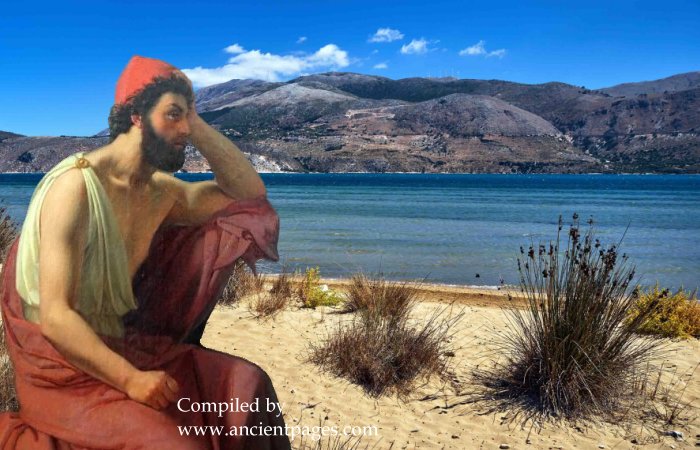
Background: Credit: University of Aberdeen - Left: Odysseus by Ditlev Blunck, 1830, Public Domain- Image compilation AncientPages.com
“Homer has many opportunities to call Ithaca an island,” says Professor Diggle, “but he never does so.”
Professor Diggle cites several examples from the texts:
- Rather than using ‘island’ (νῆσος/nisos), Homer and his characters consistently refer to Ithaca as ‘land’ (γαῖα/gaia), ‘native land’ (πατρίς/patris, πατρὶςαἶα/γαῖα/patrisgaia), or ‘country’ or ‘domain’ (δῆμος/dimos), even though ‘island’ would fit the poem’s metre.
- Homer frequently uses the phrase “δῆμος of Ithaca,” such as when Odysseus returns home after his ten-year voyage:
Then the seafaring ship approached the island.
On Ithaca there is a bay of Phorcys,
The old man of the sea: in it, two headlands…
Odyssey 13.95-97 (trans. Diggle, 2005)
While this translation may suggest Ithaca is an island, Diggle notes that Homer actually writes, “In the δῆμος of Ithaca there is a bay of Phorcys,” meaning “In the domain of Ithaca there is a bay of Phorcys.” This wording indicates that Ithaca is part of the island the ship approaches.
Professor Diggle concludes that the texts show Homer understood Ithaca as part of a larger island, specifically the Ionian island of Kefalonia. Odysseus is also described as the leader of “the gallant Cephallenians.”
In Search of Odysseus’ Homeland: Rediscovering Ithaca
With Christopher Nolan’s film adaptation of the Odyssey set for release on July 17, interest in Homer’s poems is rising, along with renewed attention to a major Homeric mystery: the location of Odysseus’ homeland, Ithaca.
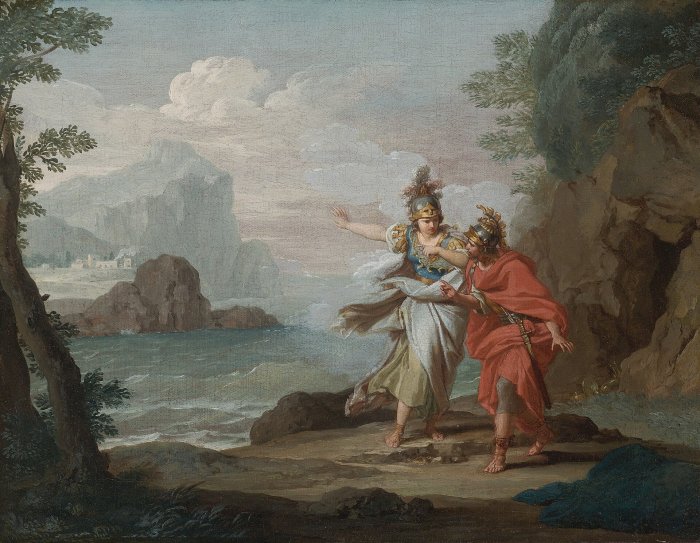
Athena appearing to Odysseus to reveal the Island of Ithaca. Painting by Giuseppe Bottani (1717–1784), Public Domain
For more than twenty years, Professors Diggle and Underhill have worked with a team investigating Robert Bittlestone’s proposal that Paliki, the western peninsula of Kefalonia, was the true Ithaca, rather than the modern island of Ithaki.
In the Odyssey, Odysseus describes his homeland to the king of the Phaeacians. Ithaca, he says, faces west, is low-lying with several islands nearby: Zacynthos, Same and Doulichion:
Around are many islands, close to each other,
Doulichion and Same and wooded Zacynthos.
Ithaca itself lies low, furthest to sea
Towards dusk; but they [the three islands just mentioned], apart, face dawn and sun.
Odyssey 9.23-26 (trans. Diggle, Antigone)
Modern Ithaki is mountainous and faces east, while Paliki is low-lying and faces west. Zacynthos and Same are clearly identified as modern Zakynthos and Kefalonia. The location of Doulichion remains uncertain, but if Paliki is Ithaca, then modern Ithaki may correspond to Doulichion, as some early maps suggest.
In Odysseus Unbound (Cambridge University Press, 2005), Robert Bittlestone, along with Professors Diggle and Underhill, used geographical, topological, and textual evidence from the Homeric poems to support the hypothesis that Paliki was Ithaca. Bittlestone identified possible sites on Paliki for all major locations described in the poems, including Odysseus’ palace, the nearby harbor, and the bay of Phorcys.
Assuming Ithaca was an island, Bittlestone recognized that his hypothesis required Paliki to have been an island during the Late Bronze Age, around 1200 BC.
He proposed that Paliki was once separated from Kefalonia by a marine channel, which was later filled by rockfalls and landslides caused by earthquakes in this highly tectonic region.
He was led to this idea by the Greek geographer Strabo, who, in the first century AD, wrote of Kefalonia:
“Where the island is narrowest it forms a low isthmus, so that it is often submerged from sea to sea.”
(trans. HL Jones, Loeb)
Bittlestone proposed that a marine channel once crossed the isthmus connecting Paliki to the rest of Kefalonia, but it was partially filled by landslides.
Professor John Underhill led twenty years of geological research on this hypothesis. As detailed in the Antigone paper, the evidence shows that the Paliki peninsula was not an island in the Late Bronze Age. This finding prompted Professor Diggle to re-examine the Homeric texts.
Regarding Strabo, Professor Underhill states that geoscientific evidence indicates he described an overland watercourse, with rivers flowing north and south from an upland lake or marsh at the highest point of the Paliki isthmus. These streams still occasionally flow today after heavy storms.
Paliki — The Likely Site Of Ancient Ithaca?
With evidence that Paliki was a peninsula during Odysseus’s era and Ithaca was a low-lying, west-facing region of Kefalonia, the argument for identifying Paliki as Ithaca is further strengthened.
See also: More Archaeology News
“We are confident”, say Professors Diggle and Underhill, “that an elegant explanation has emerged that unifies the geoscience, the Homeric texts and Strabo and is entirely consistent with Robert Bittlestone’s founding idea of Odysseus Unbound – that Paliki is the location of Homer’s Ithaca.”
Recent excavations by the Ephorate of Antiquities for Kefalonia and Ithaca at newly discovered Early Bronze Age sites on Paliki, including Livadi Marsh—the proposed site of Odysseus’s harbor—provide further evidence that Paliki was a significant Bronze Age location.
Source: University of Aberdeen
Written by Jan Bartek - AncientPages.com Staff Writer
More From Ancient Pages
-
 Missing Piece Of A Linguistic Puzzle: Ancient DNA Identifies The Originators Of Indo-European Languages Spoken By 40% Of The World
-
 Surprising Hidden Links Between Ancient Alphabets Uncovered by Researchers
-
 Decoding The Mysterious Medieval Pearl Manuscript
-
 Previously Assumed Turkic Origin Of The European Huns – Refuted; They Had Ancient Siberian Roots
-
 Secrets Of 160,000 Ancient Texts Kept In The Abbey Library Of St. Gall May Soon Be Unlocked By AI
-
 Codex Washingtonianus Contains A Passage Not Seen In Any Other Biblical Manuscript
-
 Origin Of Indigenous Languages – Kinships Of Tupí-Guaraní Language Family In S. America
-
 Hidden For A Millennium: Ancient Forbidden Book Found In Monastery Library By Devoted Book Seeker
-
 Historians Examine Secret Archive And Uncover A New Untold Story Of The Illuminati Order
-
 New Insights Into The Dawn Of The Indo-European Languages
-
 Deciphered Ancient Clay Tablets Reveal Semi-Mythical King Gilgamesh May Have Existed
-
 Why Human Languages Can Be Likened To Branches On A Tree And Help Finding A Single Common Ancestor
-
 Oldest Known Sami Manuscript Discovered – It’s Undeciphered And Written By An Unknown Author
-
 North America’s First Languages Originate From Siberia
-
 Long-Lost Page From Archimedes Palimpsest, One Of The World’s Most Famous Ancient Manuscripts, Re-Discovered
-
 Riddle Of The Indo-European Language – Which Of The Two Hypotheses Is Correct?
-
 Has A Herculaneum Scroll Solved The Mystery Of Plato’s Death?
-
 Accelerating Loss Of Language Diversity – World’s Largest Grammar Database Reveals
-
 Secrets Of Maxims Of Ptahhotep – Ancient Egyptian Wisdom Is Still Relevant Today
-
 DNA Study Suggests Human Language Emerged 135,000 Years Ago

