
Red Cinnabar Discovered In 2,000-Year-Old Grave In The Chervony Mayak Cemetery, Ukraine
Jan Bartek - AncientPages.com - The Chervony Mayak burial ground is a significant part of an archaeological complex located on the right bank of the Dnipro River in Ukraine’s Kherson Region.
This site is associated with the Late Scythian culture, which flourished in the area from the second to mid-third centuries AD. The cemetery was first discovered and excavated by O.V. Bodianski in 1975, with further investigations carried out by Е.А. Symonovich (1976–1977), O.O. Gei (1986–1988), and a team from the Archaeology Institute of the National Academy of Sciences of Ukraine under O.V. Symonenko’s leadership.
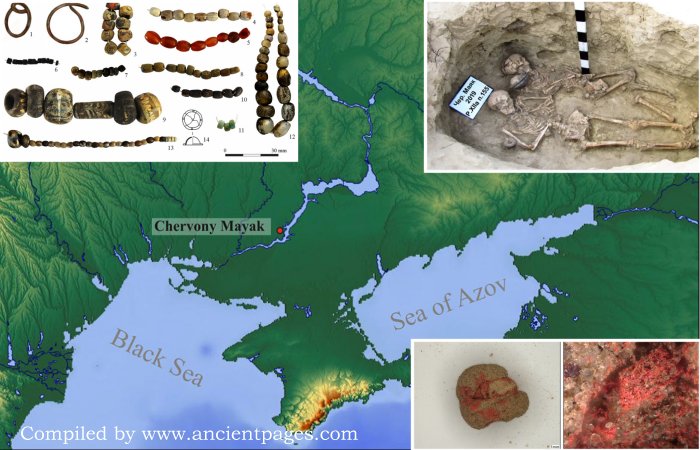
Location of the Chervony Mayak burial ground, Kherson Region, Ukraine. Credit: Dzneladze O, Sikoza D, Symonenko O, et al. Image compilation AncientPages.com
To date, research conducted by various institutions has revealed 177 graves at Chervony Mayak. Notably, archaeologists led by Professor Oleksandr Symonenko of Kyiv’s Institute of Archaeology identified vivid red cinnabar lumps in three graves containing women buried around 2,000 years ago. The presence of this toxic pigment suggests that Late Scythian communities may have used cinnabar to slow decomposition or neutralize microbes during burial practices.

Grave 155, where three lumps of cinnabar were discovered. Credit: B. Polit
Individuals of this culture engaged in skeletal burial practices using pit, niche, and catacomb graves. Mass burials were also observed; certain graves contained as many as twelve bodies arranged in layers, while a notable site on the Crimean Peninsula featured the collective interment of at least 125 individuals.
First Documented Case Of Cinnabar Use By The Late Scythian Culture
A study published in Antiquity, conducted by researchers from Maria Curie-Sklodowska University, Jagiellonian University, and the University of Warsaw, presents new findings on the use of pigments by the Late Scythian culture. Through detailed analysis, scientists confirmed that the pigment is cinnabar—a mercury sulfide known for its vivid red color and toxicity.
This discovery marks the first documented case of cinnabar use in the Late Scythian culture, as confirmed by archaeometric analysis.
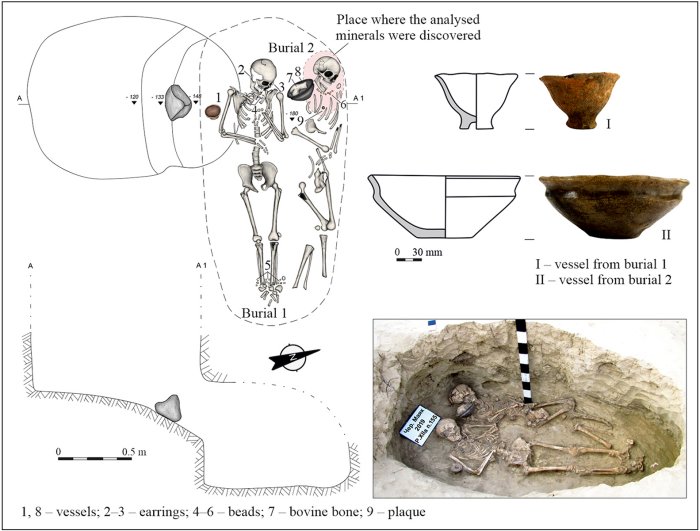
Layout of grave 155, with detail of the two vessels from burials 1 and 2. Credit: Dzneladze O, Sikoza D, Symonenko O, et al.
Red substances are typically recovered from Late Scythian graves as small lumps deposited near the bodies, though the number of specimens ranges from 1 to several.
“Pigments of various shades of red have been discovered in graves attributed to the Late Scythian culture, but they are rarely subjected to archaeometric analysis using specialized equipment. We were very fortunate to have assembled an international team with the appropriate samples for analysis, the appropriate equipment, and the necessary knowledge,” said Beata Polit, PhD, from Maria Curie-Skłodowska University, Science in Poland reports.
Burial Chamber Of Two Women
The burial chamber contained two women, one aged 18–20 and the other between 35–45 years old. Archaeologists discovered three lumps of cinnabar near the skull and upper chest of the older woman. Additional items found in the grave, such as vessel fragments, bronze earrings, and beads, help date the burial to between the 1st century and the first half of the 2nd century CE.

Ornaments from grave 155. Credit: Dzneladze O, Sikoza D, Symonenko O, et al.
Researcher Polit observed that both women were interred within a short time frame. Notably, after her initial burial near the entrance, one woman's body was later moved closer to the wall of the chamber. The small lumps of cinnabar placed near her skull and ribs are consistent with common funerary practices in which red pigment played a specific role.
Why Was Red Cinnabar Used?
Although scholars have yet to determine the exact reasons for the use of cinnabar in Late Scythian graves, its deliberate placement suggests that it held ritual significance.
"In funerary contexts it is probable that sulphide-based pigments played a purifying, germicidal role. Yet, it is possible that the small number of lumps recorded in graves indicates a function related to symbolic protection. The pigments found in containers might have been used as cosmetics or paint ingredients," the researcher write in their study.
Some archaeologists propose that sulphide-containing pigments like cinnabar may also have served as antibacterial agents during burial rituals.
“In order to bury another deceased person, the grave had to be opened, and the burial chamber undoubtedly contained various microbes, some of them very harmful. This was accompanied by a strong, unpleasant odour. It is possible that, in the context of graves to which more bodies were added, the pigment could have been used to neutralize bacteria or slow down the decomposition of the body. This, of course, is just one hypothesis,” Polit said.

The analysed cinnabar sample (photographs by A. Kurzawska).
She added that in some graves, the limited number of pigment lumps could indicate symbolic or protective use. “Pigments sometimes found in containers or shells may have served as cosmetics or paint ingredients. People of that time certainly realized, intuitively or based on experience, that certain minerals, plants and other substances could be harmful to the body, but I do not think they had scientific knowledge of their toxicity,” Polit explained.
See also: More Archaeology News
"The red pigment from grave 155 at Chervony Mayak is identified as cinnabar, as opposed to ochre or realgar. These results highlight the vital role of archaeometric analyses in examining and correcting the interpretation of mineral substances discovered at some archaeological sites. The application of such analyses is still rare, and further discussion of the function and provenance of pigments can proceed only with additional analyses and when the reference database is extended," the scientists conclude.
The study was published in the journal Antiquity
Written by Jan Bartek - AncientPages.com Staff Writer
More From Ancient Pages
-
 Colchester Vase Offers ‘Startling’ Evidence Of Gladiator Fights In Roman Britain
-
 Nicholas Owen ‘Little John’ Who Paid Highest Price For His Ingenious, Camouflaged Places To Hide
-
 Artifacts Discovered In Ancient Florida Sinkhole Can Re-Write History Of North America
-
 Mysterious Skeletons Of A Tall Unknown Race Discovered In California – Who Were These Beings?
-
 Message In A Bottle Thrown Overboard In Germany 132 Years Ago Was Found In Australia
-
 Lost Ancient Dragon City Of The Xiongnu Empire Discovered In Mongolia
-
 Thousands Of Cannonballs Discovered In Southern India
-
 600-Year-Old Axe Heads Used In The Battle Of Grunwald Found in Poland
-
 Burnt Food Remains In Neolithic Cooking Pot Sheds Light On 5,000-Year-Old Food Preparation
-
 On This Day In History: Historical Scandal Took Place In France – On July 31, 1451
-
 Inscription On Pokotia Monolith Reveals Sumerians Visited Peru Thousands Of Years Ago
-
 Huge Mitchell’s Log Reveals When The North American City Cahokia Experienced Political And Economic Zenith
-
 Ancient Mystery Of The Village Where All Residents Vanished Overnight
-
 Wasabi Plant Can Save Ancient Bio-Deteriorated Papyrus
-
 Did The Biblical Magi Bring Jesus Gifts With Healing Properties?
-
 Mysterious Leaden Sarcophagus Found Under Notre Dame Will Be Opened
-
 Paleoindian Ochre Mine Found In Submerged Caves In Mexico’s Yucatan Peninsula
-
 Ancient Mystery From The Age Of Taurus And The Murdered Astronomer – Evidence In The Arctic ? – Part 2
-
 Mount Ararat Was Once Located By The Sea – Study Of Palm Leaves Reveals
-
 Cave 53 In Qumran Region In Judean Desert Reveals More Secrets

