
Symbolic Silver Necklace Depicting Mesopotamian Goddess Ishtar Discovered In The Ancient City Of Amos
Conny Waters - AncientPages.com - Ishtar, known in earlier Sumerian tradition as Inanna, was a prominent Mesopotamian goddess associated with love, fertility, and war. Her worship spanned thousands of years across the Ancient Near East, leaving a lasting impact visible in ancient art, sculptures, and artifacts.

Credit: AA. Image compilation by AncientPages.com
Recently, archaeologists working at the ancient city of Amos in Mugla, southwestern Türkiye, uncovered an intricately crafted silver necklace believed to depict Ishtar alongside two of her well-known symbols: a lion and an eight-pointed star. Both motifs are widely recognized as representations of the goddess.
Powerful Ancient Symbols
The eight-pointed star, also known as the octagram, holds diverse meanings depending on the cultural or spiritual context in which it appears. In Judeo-Christian symbolism, the octagram is often associated with new beginnings. In contrast, in the Babylonian tradition, the eight-pointed star represents the goddess Ishtar and is associated with the planet Venus. These varying interpretations highlight how a single symbol can carry different significance across cultures and belief systems.

A silver necklace, thought to represent the goddess Ishtar and adorned with a lion figure and an eight-pointed star, has been discovered at the 2,200-year-old Amos ancient city in the Marmaris district of Mugla, Türkiye. This find provides valuable insight into the region’s historical and cultural significance. Credit: AA
For thousands of years, the lion has served as a powerful symbol across ancient civilizations. Often associated with power and royalty, lions appear in prehistoric cave paintings and on artifacts from ancient Sumeria and Egypt dating back to 3000 B.C. Their image is also prominent in monumental architecture, such as the impressive lion gates of Hattusha, the capital city of the Hittite kingdom. In the Near East, lions were commonly viewed as guardians.

Goddess Ishtar on an Akkadian seal, 2350–2150 BCE. Credit: Sailko - CC BY 3.0
One notable example is the Ishtar Gate in Babylon—constructed around 575 BC by King Nebuchadnezzar II. This grand entryway was built from burnt bricks and adorned with striking blue-glazed tiles featuring rows of bulls, dragons, and imposing lions. The gate was named after Ishtar, a Mesopotamian goddess associated with love and war, further highlighting the symbolic significance of lions in ancient art and architecture throughout history.
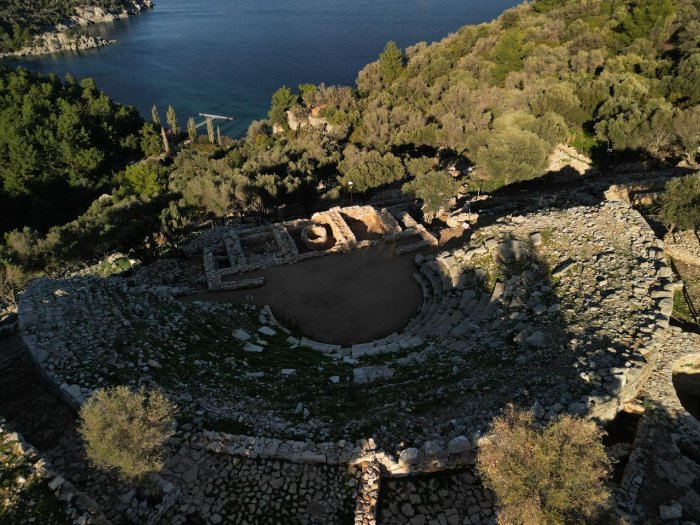
The ancient city of Amos. Credit: AA
The discovery was made at Asarcik Hill in Marmaris district—a site dating back 2,200 years—where excavations have been ongoing under the direction of Assoc. Prof. Mehmet Gurbuzer from Mugla Sitki Kocman University’s Department of Archaeology. According to the excavation team, these motifs suggest that the necklace served not only as a decorative item but also held symbolic or ritual significance.
Amos Was An Ancient Strategic Port
Professor Gurbuzer explained that this find highlights Amos’s historical importance as a center for cultural exchange and economic activity. He noted that advanced cultural elements from the Near East began to spread into the Mediterranean through trade and military connections during the 7th century BC; Amos served as a strategic port city, interacting with major civilizations.
Amos first gained scholarly attention after G.E. Bean’s excavations in 1948 revealed ancient land lease contracts—evidence pointing to its organized economy over two millennia ago. The recent discovery adds new insight into Amos’s cultural landscape by reinforcing its significance beyond economics.
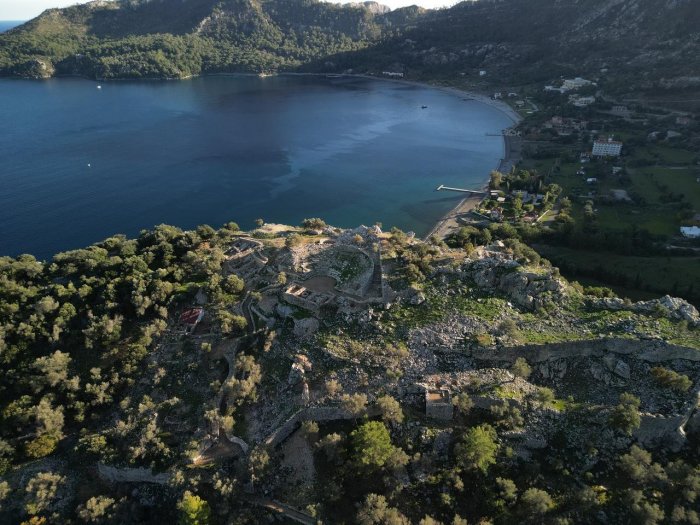
Aerial view of the ancient city of Amos. Credit: AA
Situated on Asarcik Hill overlooking the coast, Amos is recognized for its strategic harbor and for its interactions with various ancient civilizations along trade routes, where goods and ideas were exchanged. Early finds like this necklace help fill important gaps in our understanding of Amos's past role as both an economic hub and a site where beliefs intersected.
See also: More Archaeology News
The site received official excavation status by presidential decree in 2022; current work is part of Türkiye's "Heritage for the Future" project led by local institutions such as Marmaris Chamber of Commerce and Marmaris Municipality, along with private sponsors. Excavations have continued year-round since resuming in 2021.
In 2025, fieldwork included landscaping around the theater orchestra area, excavations in the residential zone, and clearing vegetation near the Apollon Samnaios Temple, with plans to continue these efforts into 2026, focusing on residential structures and temple areas, according to Professor Gurbuzer.
Source: Anadolu Agency
Written by Conny Waters - AncientPages.com Staff Writer
More From Ancient Pages
-
 The Tuli Mummy: Botswana’s Only Ancient Mummified Human Body Discovered So Far
-
 3,500-Year-Old Stone Inscribed With A Curse Against The City’s Governor Discovered In Jerusalem
-
 Ancient Mystery Of The Menorah – Enigmatic Sacred Object With Complex History
-
 Troll Cross – Protection Symbol Believed To Ward Off Evil Powers
-
 5,000-Year-Old Building And Ancient Artifacts In Mesopotamia Shed New Light On The Beginnings Of Civilization And The Uruk Metropolis
-
 Four Roman-Era Brooches And A Ring Found In The Borki Forest, Poland
-
 Spectacular Discovery – Scientists Decipher Previously Invisible Texts In Ancient Manuscripts
-
 On This Day In History: ‘Lady With The Lamp’ – Florence Nightingale Was Born – On May 12, 1820
-
 Aztec Treasure: ‘Yew Of Gold’ Found 39 Years Ago Originates From Spanish Plunder During ‘Sad Night’ In 1520
-
 New System Will Give Stone Age Skeletons And Mummies Unique Names
-
 Researchers Use 21st Century Methods To Record 2,000 Years Of Ancient Graffiti In Egypt
-
 Flying Objects Were Present In Ancient Skies
-
 Drone Reveals 3,000-Year-Old ‘Mega Fortress’ Dmanisis Gora In The Caucasus Mountains Is Much Larger Than Previously Thought
-
 Oldest Known Human-Made Nanostructures Found In Ancient Artifacts In Tamil Nadu
-
 Blame The Neanderthals For Your Lower Back Pain – Scientists Say
-
 Hydra Greek Monster: Fearsome Multi-Headed Dragon That Inhabited Swamps Of Lerna
-
 Mystery Of The Blue Blood Gods: Why Did They Have A Different Blood And Skin Color?
-
 Mireuksa Pagoda: Largest And One Of The Oldest Of Korean Pagodas
-
 Mesopotamian God Nabu Inscribed The Human Fates Determined By The Gods
-
 On This Day In History: Germany Invades Poland – On Sep 1, 1939

