
42,000-Year-Old Shell Jewelry Workshop Unearthed At The Paleolithic Site In France
Conny Waters - AncientPages.com - The discovery of the oldest shell jewelry workshop at the Paleolithic site of La Roche-à-Pierrot in Saint-Césaire, Charente-Maritime, offers significant insights into ancient craftsmanship. This site, dated to at least 42,000 years ago, features an assemblage that includes red and yellow pigments.
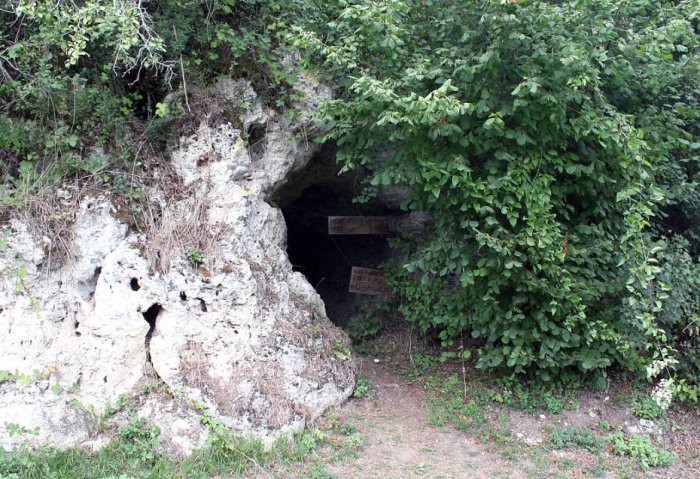
La Grotte des Fées archaeological site (Allier, France), type site of Châtelperronian culture. Image credit: CC BY-SA 4.0
It stands out as a unique find in Western Europe and may be linked to the Châtelperronian culture that marks the transition from the last Neanderthals to the arrival of Homo sapiens in Europe.
This study, primarily conducted by scientists from the CNRS, the University of Bordeaux, the Ministry of Culture, and the University of Toulouse 2 Jean Jaurès, represents a significant breakthrough. It sparks intriguing discussions about the mobility of prehistoric populations and potential interactions between diverse human groups during this pivotal era in prehistory.
Between 55,000 and 42,000 years ago, Europe experienced a significant transformation as the last Neanderthals were gradually replaced by groups of Homo sapiens. These modern humans arrived during their most recent migration out of Africa, marking a crucial period in human history.

Microtomographic post-processing and virtual reconstruction of aLittorina obtusata shell from La Roche-à-Pierrot (Saint-Césaire, France), broken during post-depositional events. Bottom left: Red and yellow pigments from the same area.; Right: Microscopic views of the modifications observed on Littorina obtusata : perforations made by pressure (ae, g, h), pigment staining (f, h). © S. Rigaud & L. Dayet
Such findings enhance our understanding of early human cultural practices and their use of natural materials for adornment.
The Châtelperronian culture, a significant prehistoric industry found in France and northern Spain, is a focal point of archaeological research. It is acknowledged as one of the earliest industries of the Upper Paleolithic era in Eurasia. However, there is ongoing debate regarding whether its creators were Neanderthals or Homo sapiens.
Recent excavations at La Roche-à-Pierrot, carried out by scientists from the laboratory From Prehistory to the Present: Culture, Environment and Anthropology (CNRS/Ministry of Culture/University of Bordeaux), led to significant discoveries. The research team uncovered pierced shells and a variety of pigments, which are believed to be associated with the Châtelperronian culture.
According to the researchers involved in the excavations, the absence of wear traces on certain perforations and the presence of unpierced shells indicate that this was a genuine workshop for the manufacture of ornaments.
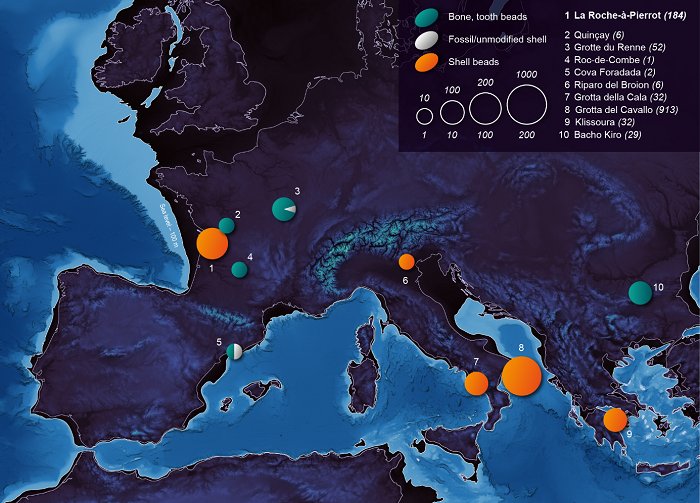
Map of Europe illustrating the categories of raw materials used for personal adornments from archaeological contexts of the early Upper Paleolithic, pre-Aurignacian period. Note the regional particularity of La Roche-à-Pierrot, Saint-Césaire, where shells were used for the manufacture of adornments. © Archéosphère
Analyses reveal that these shells originated from the Atlantic coast, which was approximately 100 kilometers away at the time, while the pigments came from over 40 kilometers away. These long distances indicate the presence of exchange networks or significant mobility of human groups. Other remains found at the site include typical Neanderthal tools and remains of hunted animals, such as bison and horses, highlighting the diversity and complexity of human occupations during this period.
These discoveries are truly groundbreaking, marking the first instance where an early Upper Paleolithic industry has been documented alongside shell beads in Western Europe.
The ornaments and pigments uncovered provide compelling evidence of a significant surge in symbolic expression during this era. This period is characterized by practices of ornamentation, social differentiation, and identity affirmation—traits typically associated with Homo sapiens. Such findings not only enrich our understanding of human history but also underscore the profound cultural advancements that occurred during this time.
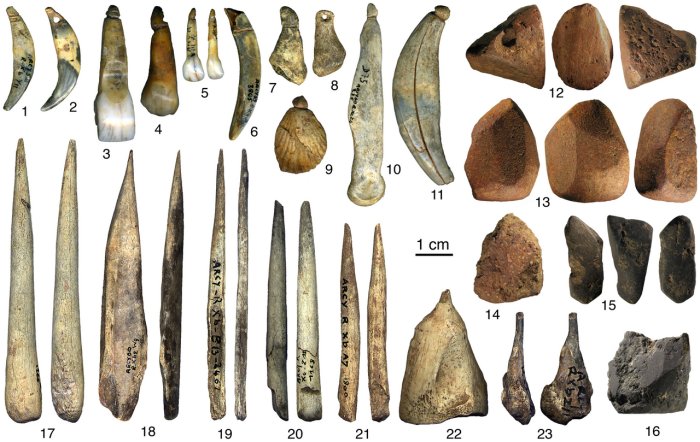
Châtelperronian stone tools (above) and ivory tools and jewellery (below). Image credit: François Caron, Francesco d'Errico, Pierre Del Moral, Frédéric Santos, and João Zilhão - source
The findings shed new light on the cultural variability of the period and suggest that the authors of the Châtelperronian were influenced by, or even belonged to, a first wave of Homo sapiens who arrived in the region at least 42,000 years ago.
See also: More Archaeology News
Saint-Césaire remains a unique laboratory for understanding the dynamics of prehistoric settlements and the interactions between Neanderthals and Homo sapiens. The site was occupied by different groups of humans for nearly 30,000 years,
In Saint-Césaire, in Charente-Maritime is located an ancient prehistoric rock shelter, La Roche à Pierrot, Discovered in the 1970s, La Roche à Pierrot is famous for having revealed a Neanderthal skeleton, dubbed "Pierrette." At 36,000 years old, it is the most recent skeleton of its kind found in France.
Since 1976, excavations on this site have continued to provide valuable information thanks to the revision of old collections and new analysis and excavation methods implemented since 2013.
Written by Conny Waters - AncientPages.com Staff Writer
More From Ancient Pages
-
 Unraveling The Mystery Of How Our Ancestors Created The First Spoken Words
-
 Ancient Mexicans’ Precise Solar Observations Fed Millions – Remarkable Farming Calendar Invented
-
 Mystery Of The Sandby Borg Massacre Deepens – Unexplained Disappearance Of Women
-
 Looted Green Coffin Of Ancient Egyptian Priest Returned To Egypt From US
-
 Brain Development Differs Between Neanderthals And Modern Humans – New Study
-
 40 Elite Graves Of Men, Women And Children Unearthed On Danish Island Of Bornholm
-
 Why Didn’t Pythagoras And His Followers Eat Beans?
-
 Amazing 2,000-Year-Old Engraved Roman Gems Discovered Near Hadrian’s Wall
-
 Florentine Codex: Remarkable Manuscripts About Life Of The Aztecs
-
 Table Manners And First Code Of Correct Behavior Were Introduced In Egypt 2,500 B.C. By Ptahhotep
-
 Mysterious Lost Ancient Civilizations Of Minnesota And Wisconsin – Puzzling Archaeological Discoveries
-
 When And Why Was Yakuza, The Japanese Mafia Founded?
-
 Terahertz Imaging Reveals Hidden Inscription On Early Modern Funerary Cross
-
 Rare Fossil Of A Dog-Sized Horned Dinosaur From ‘Lost Continent’ Identified By British Scientist
-
 The Perplexing Story Of The Seven Continents And The Seven Mysterious Races – Distant Past – Part 1
-
 Secret Ancient World Buried Under The Vast Takla Makan Desert
-
 Galileo Galilei’ Long-Lost Letter Reveals His Attempt To Fool The Inquisition And Make Science Independent From Religion
-
 Rare Ancient Dacian Stonemason’s Toolkit Discovered In Romanian Forest
-
 Extraordinary Gold Pendant With Cross Re-Writes Anglo-Saxon History – It’s One Of The Oldest Symbols Of Christianity Ever Found In East Anglia
-
 Why Are Medieval Manuscripts Full Of Doodles Of Snail Fights?

