
How Henry VIII Accidentally Changed The Way We Write History
AncientPages.com - In 1534, King Henry VIII infamously broke away from the Catholic Church, becoming the head of the Church of England. Following this, two lesser-known acts were passed, the Suppression of Religious Houses Act 1535 and the Suppression of Religious Houses Act 1539 (also known as the “two Acts of Dissolution”).

Portrait of Henry VIII - After Hans Holbein the Younger (1497/1498–1543). Walker Art Gallery
These acts were the legal instruments of what is now known as the dissolution of the monasteries, a long process throughout which the hundreds of priories, convents, friaries, and other religious houses which fell under the English monarch’s rule saw their holdings confiscated by the Crown. In doing so, Henry unwittingly set in motion a series of events that would forever change how scholars of English history would access the primary sources used in research.
Because monasteries had served various roles throughout history, the dissolution had wide-ranging consequences. It changed the landscape of England, with religious buildings slowly entering private hands – but it also changed the scholarly landscape.
Many of Britain’s early historians came from monasteries (often in the form of chroniclers), including Gerald of Wales, Bede the Venerable and Roger Bacon. As record-keepers, they also preserved the primary sources that continue to be studied by researchers today.
Manuscripts, like the religious houses’ other possessions, slowly changed hands in the decades following the dissolution. The king took several manuscripts for himself and more were taken and hidden by former members of the orders, or local inhabitants. Likely thousands disappeared.
The extent of the loss, while difficult to estimate, was extensively researched by Anglo-Saxonist and palaeographer (historical handwriting analysis expert) Neil Ripley Ker in his book, Medieval Libraries of Great Britain which was first published in 1941. This research is now available as a continually updated database through the combined efforts of current scholars.
Where did the manuscripts go?
Over the past decades, bibliographical research has shown that some were gathered by local, and often little-known, collectors. As for the rest, the writings of contemporary antiquaries (the people interested in the material remains of the past) provide precious information on what existed before the dissolution took place, how much disappeared, and how.
From 1533, English poet and antiquary John Leland undertook the arduous task of inventorying the most important manuscripts from the monastic houses, listing his work to date in a then-unpublished address commonly known as the Newe Yeares Gyfte, in 1546. Meanwhile, Leland’s associate John Bale compiled a Summary of the Famous Writers of Great Britain, founded upon Leland’s work and first published in Latin in 1548, for which the preparatory notes survive in Oxford’s Bodleian Library.
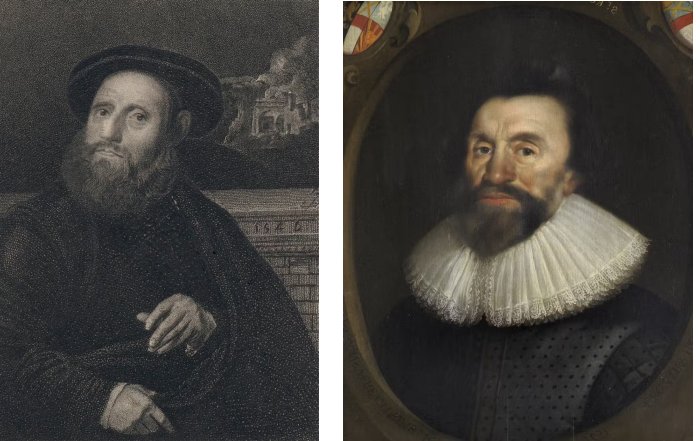
Left: John Leland by Thomas Charles Wageman (1824). National Portrait Gallery; Right: Robert Cotton by Cornelis Janssens van Ceulen (c. 1629). Trinity College, Cambridge
Bale’s preface to the Newe Yeares Gyfte tells us that many of the manuscripts ended up cut up for use as candlesticks or boot polishing cloth, some were sold to foreign nations, and many to book binders.
Such recycling had already taken place in the past. The membrane (treated animal skin, also known as parchment or vellum) from which most manuscripts were made could be reused to make new books, notably as binding material, and also had less obvious but not less useful afterlives. It would continue for many years to come, too. Notably, one of the copies of the Magna Carta allegedly had to be rescued from a tailor’s shop in 1629.
The Magna Carta in question found its way into the collection of antiquary Sir Robert Cotton. Like other collectors before him, Cotton sought to preserve the witnesses of British history, in particular, the now-dispersed monastic manuscripts. His collection still survives today, as the Cotton manuscripts became one of the foundational collections of the British Library.
The dissolution itself came at a turning point in historical methods. The 16th century saw the spreading through England of a new intellectual movement coming from Italy, where it had begun over a century earlier: humanism. Renaissance humanism was concerned (at first) with the study of the classical world, eventually producing a new culture of learning involving the re-evaluation of historical sources (including the aforementioned manuscripts).
On the continent, this often involved consulting the texts in the monasteries themselves. In England, where the monasteries no longer existed, these sources found their ways into the hands of the scholar-collectors who wished to use them, like Matthew Parker and Cotton.
Neither Parker nor Cotton limited themselves to gathering these documents. Their libraries were the centre of research circles, which used, edited, and sometimes published original manuscripts using another continental creation – the printing press. While antiquaries were not necessarily historians, and have generally been considered more interdisciplinary, their work facilitated historical research through both the preservation and the dissemination of primary sources.
Historical research has evolved a lot since the 16th century. The sources saved from destruction or dispersion at the time of the dissolution have been read, re-read, translated, studied, and contextualised in many ways since the days of the early antiquaries.
Henry VIII may have never intended to endanger these manuscripts. However, it is indisputable that the dissolution had a profound effect on English and indeed British scholarship, marking the minds of budding humanistic historians, and giving them unprecedented access to original documents.
Besides its impact on the historiography of its time, the dissolution could have drastically changed the sources we continue to use. Without the preservationist impulse of collectors, the surviving manuscripts may have well disappeared into tailor and cobbler shops, never to be seen again.
More than just a story of loss and destruction, the dissolution is also the story of efforts, both big and small, collective and individual, to preserve a country’s heritage in a time of great change and uncertainty.
Provided by The Conversation
This article is republished from The Conversation under a Creative Commons license. Read the original article.
More From Ancient Pages
-
 Change Of Burial Tradition Among The People of Early Medieval Europe
-
 Ezekiel’s Secret Ancient Knowledge About Lost Worlds – Thought-Provoking Theory Examined
-
 Amazing Archaeological Discovery In Washington Confirms Thousand-Year-Old Legend
-
 Lost Villa Of First Roman Emperor Augustus Found At Somma Vesuviana In Southern Italy
-
 World’s Oldest Recorded Solar Eclipse Re-Writes History Of Egyptian Pharaohs
-
 Immigrants In Prehispanic Cancun Were Treated Just Like Maya Locals
-
 Archaeologists uncover new Yup’ik artifacts near Quinhagak, Southwest Alaska
-
 Oldest Giant Dinosaur Species Discovered In Argentina
-
 230,000-Year-Old Human Remains Discovered In Eastern Africa – Rewrite Ancient History
-
 On This Day In History: The Peace Of Etaples Signed Between Kings Of France And England – On Nov 3, 1492
-
 Why We Celebrate Saint Lucy’s Day – The Bringer Of Light And Patron Of The Blind
-
 On This Day In History: Battle Of Vinegar Hill Took Place – On June 21, 1798
-
 Ancient Egyptian Temple, 30 Mummy Cards, 85 Tombs And Surveillance Points From The Era Of Ptolemy IIIs Discovered In Sohag
-
 Coventry’s Mysterious Ogham Stone Displayed At Herbert Art Gallery And Museum
-
 Outstanding Unfinished Ancient Marble Carving Of A Lion’s Head Found Near Selinunte, Sicily
-
 Hoard Of Roman Bronze Coins Turns Out To Be Offering For Safe Crossing
-
 Hidden Details Discovered In Picasso’s Painting The Crouching Woman
-
 LIDAR Discovers Mysterious Maya Underground Chamber In The Rainforest
-
 3,400-Year-Old Cuneiform Tablet Excavated In Old City Of Alalah
-
 Evidence For Milk, Meat, And Plants In Prehistoric Kenya And Tanzania

