
For The Ancient Maya, Cracked Mirrors Were A Path To The World Beyond
AncientPages.com - Some people fear that breaking a mirror can lead to seven years of misfortune. The history of this superstition may go back to the ancient Greeks and Romans, who ascribed mysterious powers to reflected images.

The Maya used mirrors as channels for supernatural communication. In this image, a supernatural creature speaks into a cracked, black mirror. Credit: K2929 from the Justin Kerr Maya archive, Dumbarton Oaks, Trustees for Harvard University, Washington, D.C., CC BY-SA
As a scholar of the Indigenous religions of the Americas, I know that the ancient Maya had a different take on cracked mirrors. During the first millennium C.E., the Maya used such mirrors – in cities from southern Mexico to western Honduras – as channels for supernatural communication rather than as cosmetic accessories.
Mirrors and magic
Rather than being made of glass, most ancient Maya mirrors were dark pieces of polished iron ore, glued together as mosaics on a piece of slate or wood. Maya nobles wore mirrors on their backs, displayed them on thrones and set them inside tombs.
Using hallucinogens, these nobles stared at their reflections, seeking mystical experiences. The cracks between the pieces resulted in fractured, distorted reflections – through which it was believed that people could talk to divine beings. The nobles hoped to find wisdom in the lands beyond mirrors, which they associated with gods, ancestors and other spirits.
Artists often portrayed these spirits as fantastic beasts and chimeras in paintings and sculptures. Sometimes, they portrayed nobles talking to the chimeras; at other times, they represented these beings as brokers for conversations with ancestors and gods.
These conversations took place in dreams, trances and hallucinations, often between two beings using mirrors. Maya artists represented these conversations as wondrous and terrifying – or even whimsical.
The Yaxchilan lintels
The most detailed interactions between gods and mortals are portrayed in sculpture at Yaxchilan, in the Mexican state of Chiapas.
Inscriptions show that in the eighth century, its ruler dedicated a building with three front doors. In place of the wooden beams – lintels – fitted across the top of each door, there were ones made of stone. These lintels formed a triptych describing various events in the life of the king and his wife, including an audience with their patron god.
This building in Mexico, now known as Structure 23, has unfortunately been stripped of its original sculptures.

A ceremony on Yaxchilan Lintel 24. © The Trustees of the British Museum, CC BY-NC-SA
The first two – Lintels 24 and 25 – are on display at the British Museum; the third – Lintel 26 – is in the Museo Nacional de Antropología in Mexico City. In both these museums, the lintels hang on the wall. In the Classic period, however, they would have been seen from below.
Conjurers
Words and images on Lintels 24 and 26 describe what was believed to have happened before and after an audience with a god. The images on Lintel 24 show the ruler holding a flaming torch while his wife engages in a painful rite: She pulls a thin, obsidian-studded rope through her tongue. These fragments of cooled lava, believed to be spiritually charged in the religions of ancient Mexico, would have resulted in the loss of vast amounts of blood – shown on Lintel 24 in the form of droplets around her face.
Her blood also drops into a bowl filled with paper, destined to be lit on fire by the king. Lintel 26 shows the aftermath, with the king and queen standing together. Still bleeding, the queen hands her husband a ceremonial helmet and prepares him for battle.
Although visually arresting, the actions on these lintels take place within the confines of the mundane world. The action on Lintel 25, however, takes place somewhere else. Texts on this lintel describe a chain of conjuring events resulting in the appearance of the patron god of the city.
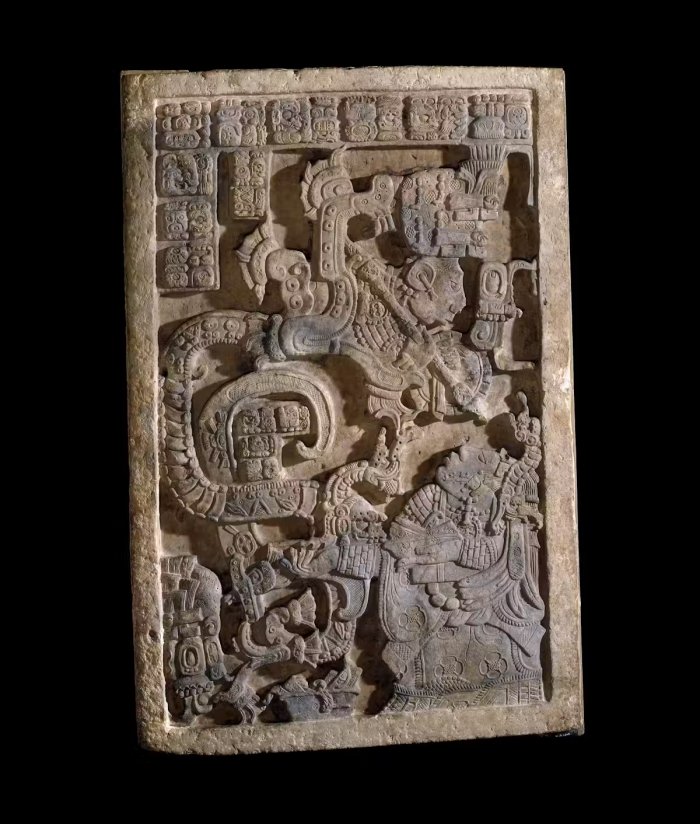
The engravings on Lintel 25. © The Trustees of the British Museum, CC BY-NC-SA
Visually, Lintel 25 pushes the boundaries between the real and the fantastic. The images show smoke rising from a bowl, and in the smoke a large, skeletal snake appears. The snake has two heads, through which the god is traveling – from his realm to the queen’s. Once he may have been a real person, mummified after his death, but here he is a deified warrior god emerging from the mouth of a snake. Lintel 25 shows him removing his mask while the queen balances a skull on her arm. She gestures into the smoke and looks up.
Like many conjuring texts, Lintel 25 implies that she was looking for guidance from the dead – but the sculpture does not reveal what was said. There is, however, one more surprise: Most of the text on Lintel 25 is written backward and was probably designed to be viewed with a mirror by ancient Maya conjurers, diviners or oracles.
Architecturally, part of the text would have been outside the door’s threshold. That part is written left to right, as was normal in ancient Maya inscriptions. But as soon as a visitor crossed the threshold and looked up, everything would have changed.
The words and images were backward because the visitor was believed to have passed from the human world into supernatural space.
Interactive stories
Lintel 25 is one of a handful of mirror-image inscriptions that were designed as interactive experiences, where ancient visitors could figuratively travel to the land beyond the looking glass.
Standing below Lintel 25 with a mirror would enhance that travel experience: Visitors could see what gods saw (the backward inscription) and what humans saw (the normal inscription) at the same time.
By staring into their cracked mirrors, visitors could straddle the boundary between humanity and divinity.
Ironically, despite our modern emphasis on interactivity, mirror-image inscriptions and other Maya sculptures are today presented more like Renaissance paintings – still images hung on a wall – than the doors to other worlds that some of them were.
Visitors do not get to see the wondrous, terrifying and whimsical world of the supernatural as the ancient Maya intended. Perhaps if they did, a cracked mirror would inspire wonder rather than fear.
Provided by The Conversation
This article is republished from The Conversation under a Creative Commons license. Read the original article.
More From Ancient Pages
-
 Albert Pike’s Masonic Prophecy About The Three World Wars
-
 Rare 2nd Temple-Era Etchings Of Menorah And Cross Discovered In The Judean Hills
-
 What Are The Unusual Giant Spherical Stones Discovered In Eastern Türkiye?
-
 5,000-Year-Old Building And Ancient Artifacts In Mesopotamia Shed New Light On The Beginnings Of Civilization And The Uruk Metropolis
-
 Tiny Points Made By Homo Sapiens 54,000 Years Ago Found In Mandrin Cave
-
 Apkallu – Seven Antediluvian Sages Created By God Enki – Were They The Watchers?
-
 Ancient Human Remains A The Sima De Los Huesos Site Investigated
-
 Zombie-Like Creature In Sami People’s Beliefs: A Frightening, Dangerous Entity That Should Be Avoided At All Costs
-
 Legendary Johnny Appleseed Who Planted Apple Trees Across North America
-
 Stunning Ancient Lod Mosaic With Message Of Approaching Danger To The Ship At Sea
-
 LIDAR Discovers Two Remarkably Large Sites In The Amazon And Evidence Of Early Urbanism
-
 What Can Ancient Toilets Teach Us About Maya Life And Tamales?
-
 Has The Mystery Of The Hobbits Finally Been Solved?
-
 King Sanakht: Mysterious Ancient Egyptian Pharaoh Was A ‘Giant’ – Scientists Say
-
 Unravelling The Mystery Of Apollonius Of Tyana – Was He A Superhuman?
-
 Sarcophagus Of The Amazons: Etruscan Coffin With Paintings Of Dynamic Fighting Scenes Of Greeks With Amazons
-
 On This Day In History: The Lumière Brothers Presented Their First Film In Paris – On Dec 28, 1895
-
 Mysterious Ancient Star People Of The Secret Power
-
 LIDAR Will ‘Map’ The Ground Surface To Reveal New Picture Of Ancient Native American Culture
-
 Black Granite Statue Of King Amenhotep III Accidentally Recovered

