
Ancient Wooden ‘Coptic Dolls’ May Have Been The Ancestors Of Today’s Barbie Dolls
Conny Waters - AncientPages.com - For as long as anyone can remember, children loved to play with various toys, but kids living a long time ago did not have parents who could walk into a shop and buy something entertaining. Yet, there is archaeological evidence our ancestors did take the time to carve and build things their children could play with. Sometimes, archaeologists uncover ancient artifacts that may have been used for a number of purposes.
Ancient figurines made in the image of humans were often used during ritual ceremonies or as burial gifts, but could some of these human-like figures have been toys, too?

Dolls from excavations in Ramla: (1) Miniature articulated doll; (2) Cloth doll head; (3) Flat articulated doll; (4) Flat articulated schematic doll; (5) Unarticulated schematic doll; (1-5) scale 1:1; (1) Color image courtesy of the Museum of Ramla. © Israel Antiquities Authority
The Term Coptic Dolls
"These bone figurines were first recognized as a homogenous artifact group by Joseph Strzygowski in 1904, although earlier mentions exist. In his volume “Koptische Kunst”, he described 13 “puppen” from the Cairo Museum and was the irst to suggest they were toys rather than cult figurines.
Not all researchers agree. Strzygowski concluded a pre-Islamic origin and dated the dolls between the 4th and 12th centuries. A fragment with a religious Christian Greek inscription, supporting his pre-Islamic origin thesis, was in a group of figurines which he had purchased in Cairo in 1900-1901 for the Kaiser Friederich Museum. Some of these were published later by Sir Leonard
Woolley (1907) and Oskar Wulf (1909).
Although Strzygowski never actually used the term “Coptic dolls,” it was already attached to them by Woolley, and continues to be used even today. This is probably because Strzygowski, and Gayet before him, published them in volumes titled “Coptic Art.” 1
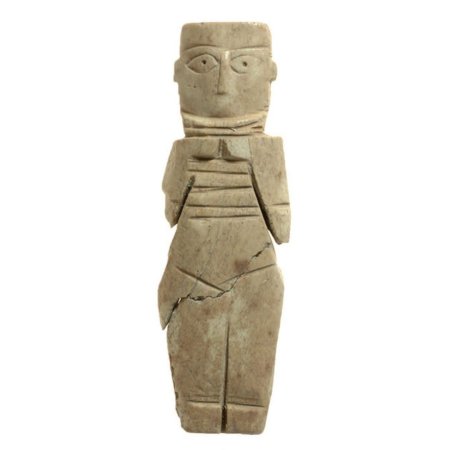
In the Early Islamic period (7th to 11th centuries CE), a unique type of figurine with human-like characteristics, made of bone, began to appear. Ariel Shatil, an Israel Antiquities Authority archaeologist specializing in dolls and figurines, sheds light on these intriguing artifacts.
"Some researchers speculate that these figurines served as toy dolls, while others suggest they might have been fertility figurines. What is particularly fascinating is that no two dolls were identical; each possessed distinct features, even if they shared the same concept. These dolls appeared in the Early Islamic period, over a period of about two or three centuries, after which they mysteriously disappeared from the scene," Shatil explains.
Shatil continues, “Moreover, distinct regional styles emerged. For instance, in the northern part of the country, the figurines had more schematic features, and they were crafted from flat bones such as animal ribs and adorned with dots and circles.
By contrast, in the southern part of the country and in the desert, the figurines were more human-like and realistic. Most of the figurines are depicted naked, without clothes, but there is a group of figurines wearing garments. The exact purpose of the figurines—whether fertility symbols to encourage procreation or simply toys—remains a subject of debate.”
The picture shows a figurine with schematic features, reflecting Egyptian characteristics, dating to the Abbasid period, uncovered in the excavations carried out next to the Western Wall precinct in Jerusalem. Credit: Israel Antiquities Authority
Originally crafted in the region of Iran and Iraq, one wonders how these figurines found their way to this area. Following the Muslim conquest of the country, artisans were brought in to construct and decorate palaces. Alongside the monumental art displayed in these palaces, these same artisans introduced or crafted these figurines, producing them in considerable quantities as they gained popularity within all social classes.
See also: More Archaeology News
“Although predominantly made of bone, there are also ivory figurines, possibly belonging to wealthier families,” Ariel observes. “But, by the end of the eleventh century, these figurines disappeared from the scene, probably due to restrictions imposed in accordance with Islamic law.”
Written by Conny Waters - AncientPages.com Staff Writer
Expand for references- Ariel Shatil - Bone figurines of the early Islamic period: the so called "Coptic dolls" from Palestine and Egypt, Institute of Archaeology, Belgrade
More From Ancient Pages
-
 New AI Technique Will Help To Decode Long Lost Languages Of Ancient World
-
 Huge Maya Stucco Mask Unearthed At Ucanha Site In Yucatan
-
 Unique Statue Of Roman Emperor Trajan Unearthed In Ancient City Of Laodicea,Turkey
-
 Rare Statue With A Ka Symbol And A Dwarf Sphinx Discovered In Egypt
-
 Vikings Brewed Beer With Heated Stones – Old Tradition Popular In Germany, Finland And Baltic States
-
 Archaeologists unearthed artifacts in a 3,700 year-old mine factory
-
 Giant Thousand-Year-Old Urns Discovered In The Amazon City Of Fonte Boa
-
 Rare Coins Found In A Dead Sea Cave Offer First Solid Evidence For The Maccabean Revolt 2,200 Years Ago
-
 Evidence Reveals Ancient Saudi Arabia Had A Complex, Thriving Society, Contradicting Notions Of A Struggling Population In Barren Lands
-
 Ancient Pottery Reveals Prehistoric Europeans’ Cuisines Were Surprisingly Complex
-
 Were Mysterious Giant Ancient Mustatils In Saudi Arabia Used For Ritual Purposes?
-
 Medieval Warhorses Were Pony-Sized And Much Smaller Than Previously Thought
-
 Ancient Wooden Spade Found Under Melting Ice In Norway – Archaeologists Urge Hikers To Stay Alert
-
 Huge Unknown Ancient Lost World Discovered Inside Giant Sinkhole In China
-
 Collapse Of Akkadian Empire Strongly Related To Catastrophic Climate Change
-
 Mysterious Tunnel Found Under Saxon Palace Ruins In Warsaw, Poland
-
 On This Day In History: Anders Celsius, Swedish Astronomer And Mathematician Was Born – On Nov 27, 1701
-
 2000-Year-Old Room With Frescoes Discovered In Central Rome, Italy
-
 30 Ancient Skeletons May Finally Unravel The Secrets Of The Dead Sea Scrolls
-
 On This Day In History: Battle Of Sinop Took Place – On Nov 30, 1853

