
Unearthing South Australia’s Oldest Known Shipwreck: The Bark South Australian (1837)
Conny Waters - AncientPages.com - The Australian National Maritime Museum (ANMM) and non-profit Silentworld Foundation have continued ongoing archaeological investigation of the wreck of South Australian, with recent research from a combined team of experts published in the journal Historical Archaeology.
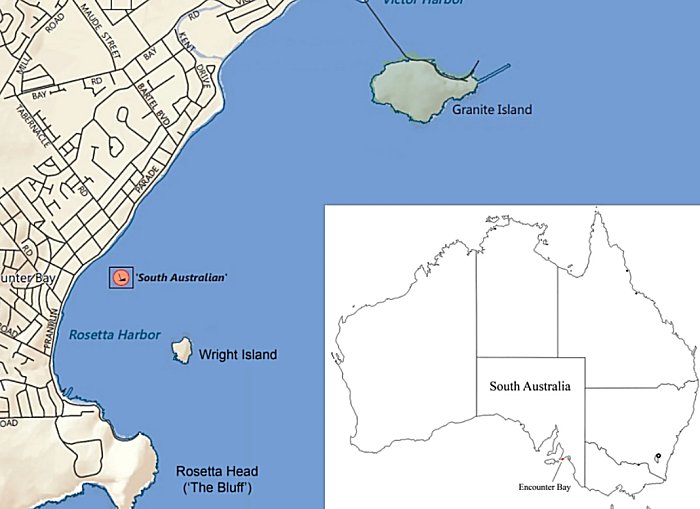
The South Australian is South Australia’s oldest known European shipwreck. The English barque, wrecked in in 1837 in Encounter Bay near modern-day Victor Harbor, has drawn keen interest since its discovery in 2018. The wreck site project team includes members of the ANMM, Silentworld Foundation, South Australian Maritime Museum, South Australia’s Department for Environment and Water, Flinders University, and MaP fund.
Originally a postal packet called Marquess of Salisbury, which delivered mail between England and far-flung outposts of the British Empire from 1820, the vessel later operated as a British naval packet, named HMP Swallow, before being procured by the South Australian Company, which re-named the ship South Australian.
The ship was designed to carry a huge amount of sail on a relatively small hull for maximum speed. While it transported approximately 80 immigrants to the new colony, its primary function was as a ‘cutting-in’ vessel, or flensing platform, where blubber was removed from harpooned whales as part of the shore-based whaling industry at Encounter Bay.
While loaded with whale oil and readying for departure to Hobart, South Australian was caught in a south easterly gale and wrecked on 8 December 1837.
There were no fatalities, and the ship ultimately broke up and was forgotten until the 1990s, when it was the subject of two unsuccessful shipwreck surveys conducted by the South Australian government. Data collected during these expeditions and archival information helped the research team to establish a new search area that led to South Australian’s discovery in April 2018.
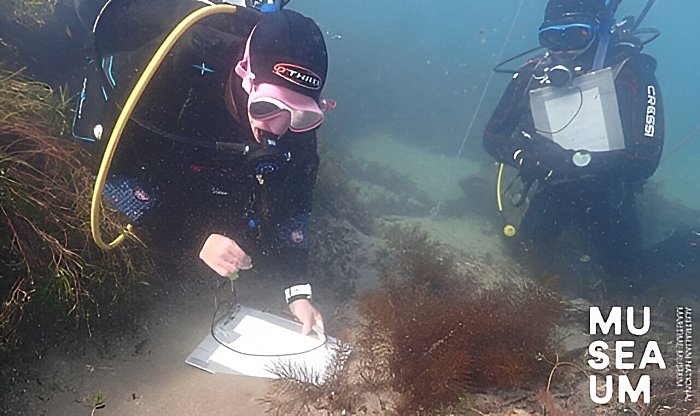
Credit: Australian National Maritime Museum
Remnants of the ship exposed above the seabed included timber framing and hull planking, copper keel bolts, and fragments of glass and pottery.
Covid-19 travel restrictions interrupted further visits to South Australian for two years, but in 2022 maritime archaeologists from the ANMM and an archaeological conservator from the Silentworld Foundation, accompanied by volunteers, returned to continue work at the site. Photogrammetric 3D recording was carried out in conjunction with site mapping. The team also conducted a comprehensive conservation assessment to determine the wreck site’s level of preservation and suggest strategies for its continued protection.
Ongoing work at the site has included comprehensive documentation of exposed hull components and targeted recovery of at-risk diagnostic artefacts. A small selection of objects was also mapped in place and recovered.
The items include a gun flint, decorated ceramic fragments, ship’s fasteners, glass bottles and a whetstone used to sharpen tools. All are currently undergoing conservation.
‘South Australian’s historical and archaeological significance cannot be overstated. As South Australia’s oldest recorded European shipwreck, and one of its earliest immigration vessels, it has the potential to enhance our understanding of the state’s initial colonisation and occupation—including the establishment of extractive mercantile activities, such as shore-based whaling and interactions between European colonists and Aboriginal people," Dr James Hunter, ANMM’s Curator of Naval Heritage and Archaeology, and an Associate Lecturer of Archaeology at Flinders University, concluded in the article recently published in Historical Archaeology.
‘Similarly, the site’s distinction as one of only two (former) 19th-century British sailing-packet shipwrecks to undergo archaeological scrutiny brings an international dimension to its significance. While a sizable percentage of South Australian’s surviving fabric remains buried, recent seabed changes are uncovering the site at an alarming rate. This has reinforced the need for additional investigation and inquiry and underscores the urgency with which site stabilization efforts should be adopted and enacted.’
While weather and water visibility impeded efforts to complete the 3D photogrammetric survey of South Australian in late-2022, imagery from this and prior surveys has since been used to generate a digital 3D model of most of the site.
This in turn will form the basis of a virtual reality experience currently under development at Germany’s University of Applied Sciences, Kaiserslautern. South Australian is also the subject of a graphic novel based on research and archival sources, including the original logbook, which will bring its story to vivid life for new audiences.
The team’s work continues, and they aim to conduct further archaeological investigation of South Australian and finish the photogrammetric survey during the latter half of 2023.
The Historical Archaeology article is Open Access and can be viewed at the following link.
Written by Conny Waters - AncientPages.com Staff Writer
More From Ancient Pages
-
 Human Footprints Dating Back 800,000 Years Discovered In Norfolk UK
-
 Longstanding Cultural Continuity At Oldest Occupied Site In West Africa – New Study
-
 Two-Million-Year-Old DNA Opens A ‘Game-Changing’ New Chapter In The History Of Evolution
-
 Geomagnetic Fields Reveal The Truth Behind Biblical Narratives
-
 Tiny Paper Scraps From ‘Queen Anne’s Revenge’ Shed Light On Reading Habits Of Blackbeard’s Pirates
-
 Archaeologists Discover Long-Lost Scottish Monastery Of Deer And Solve An Old Manuscript Mystery
-
 Secrets Of An Unusual And Mysterious Medieval Danish Axe Revealed By Scientist
-
 Monumental Fortification That Protected The Kings Of Jerusalem Unearthed In The City Of David
-
 World’s Oldest Tattoos Discovered On Egyptian Mummies Re-Write History Of Tattoos
-
 Fatocuriosos.club Guilty Of Hundreds Of Copyright Violations Is Stealing Content Daily From AncientPages.com
-
 Scientists Attempt To Solve An Ancient Greek Volcano Mystery
-
 Inscription At Aquae Calidae Sheds Light On Last Years Of Ancient Thrace’s History
-
 Underwater Stone Age Village Habonim North Found Off Israel’s Carmel Coast Thrived During Climate Change
-
 1.5-Million-Year-Old Hand Axes And Hundreds Of Ancient Artifacts Found In The Iraqi Desert
-
 On This Day In History: Edgar Allan Poe Known For Tales Of Mystery And Macabre Was Born – On Jan 19, 1809
-
 3,000-Year-Old Stone Scarab Seal Depicting A Pharaoh Discovered In Israel
-
 Pyla-Koutsopetria: Complexity Of Ancient Fortifications Of Pyla-Vigla, Cyprus – Explored
-
 Stunning 3,400-Year-Old Palace Of the Kingdom Of Mitanni Discovered Thanks To Drought
-
 Hidden 15th-Century Text On Medieval Manuscripts – Discovered By Students
-
 Gebel El Silsila: Remains Of Long-Lost New Kingdom Temple Found

