
Ancient DNA Reveals The Earliest Evidence Of The Last Massive Human Migration To Western Europe
AncientPages.com - Nomadic animal-herders from the Eurasian steppe mingled with Copper Age farmers in southeastern Europe centuries earlier than previously thought.
In a new study published in Nature, researchers used ancient DNA to gain new insights into the spread of culture, technologies and ancestry at a crucial juncture in European history.
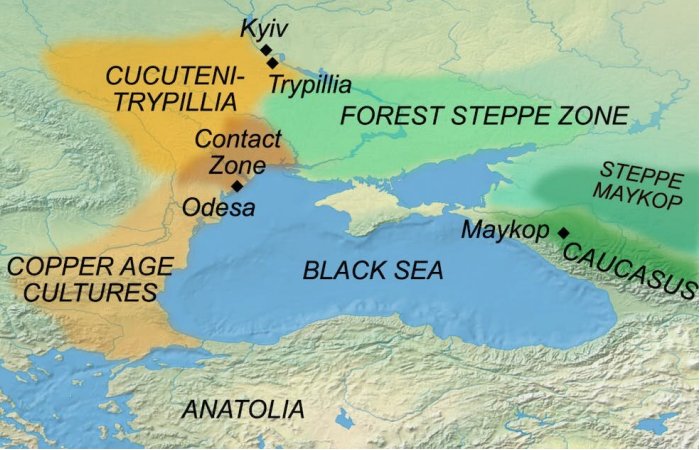
The area around Odesa was a ‘melting pot’ of cultures and ancestries. Credit: Penske et al. (2023), Author provided
How ancient DNA can help us understand change
Humanity's archaeological record reveals massive changes in cultural practices and technologies.
However, it is not always clear how these changes moved between different groups of people. It can happen either by a spread of ideas (such as through trade), or through the migration of people.
In Europe, there have been two major migrations in the past 10,000 years.
First, there was an expansion of early farming groups from Anatolia around 9,000 years ago. This was associated with the introduction of farming practices and animal husbandry, a more sedentary lifestyle (permanent housing) and the wide use of pottery and new types of polished stone tools.
Second was the expansion of steppe herders from the Eurasian Pontic Steppes around 5,000 years ago. This is associated with the spread of pastoralism and dairying technologies, a different type of ancestry and possibly some of the Indo-European languages.
In this new research, we studied the interaction between farming and pastoralist groups from the steppe from a new angle by analyzing the genomes of 135 individuals from southeastern Europe and the northwestern Black Sea region, who lived between 4,000 and 7,000 years ago.
We uncovered previously unknown and significant genetic changes in the people living in these regions. We also found the presence of steppe ancestry in the contact zone in the northwestern Black Sea region around 5,500 years ago, some 500 years earlier than previously assumed.
The Copper Age in southeastern Europe
Southeastern Europe played an important role in the spread of farming across Europe after early farmers from Anatolia arrived around 9,000-8,000 years ago. Approximately 1,000 years later, easy access to copper, gold and salt led to the development of many flourishing settlements in parts of today's Bulgaria and Romania.
Settlements on the Black Sea and major rivers such as the Danube thrived through contact and trade with surrounding areas. Similarity in material culture visible in the archaeological record across a wider region indicates a period of social and political stability of approximately 500 years, between around 6,200 and 6,700 years ago.
Ninety-five of the ancient genomes we analyzed were from this period and region, and this cultural similarity and stability is reflected in the absence of major genetic differences.
A new era and a melting pot of human interaction
Following this period of stability, many Copper Age settlements were abruptly abandoned around 6,000 years ago. For almost the next 1,000 years so few people lived in southeastern Europe that the period is often referred to as "the dark millennium." The reason for this is not fully understood, but it is likely due to the depletion of resources due to unfavorable climatic conditions.
Instead, large settlements of several thousand houses emerged further north in parts of what are now Moldova and Ukraine. Located on the western end of the forest steppe zone, these mega-sites were associated with the Cucuteni-Trypillia culture.
Here, during a period called the Eneolithic spanning from 5,200 to 6,500 years ago, the region around today's Odesa became a "melting pot" of human interaction. Numerous cultural influences appear in the archaeological record, including the waning Copper Age cultures and the Cucuteni-Trypillia culture.
Interestingly, the resulting style of pottery and other artifacts at the mega-sites showed influences from two additional groups. First, from nearby groups that could be traced to the steppe region east of Odesa. Second, from the distant Maykop culture of the North Caucasus, a mountain range east of the Black Sea.
The steppe groups practiced a different way of life, called nomadic pastoralism. Where farmers lived on and worked the same piece of land, nomadic pastoralists kept moving to find fresh pastures for their large herds of animals.
On top of this very different lifestyle, they also carried a distinct genetic profile called "steppe ancestry."
A surprising discovery
By analyzing the genomes of 18 ancient individuals from the Odesa region from this period, we could see genetic evidence of the many cultural influences observed by archaeologists.
In addition to the previously observed Copper Age ancestry, we detected new genetic contributions from individuals from the forest steppe regions, and the North Caucasus. This new ancestry and its appearance in western Europe had been uniquely associated with the spread of a later cultural group known as the Yamnaya.

Characteristic jewellery, weapons, tools and pottery from the melting pot area around today’s Odesa. The pottery combines characteristics from numerous cultures of the area. Credit: I. Manzura (2020), History Carved by the Dagger: the Society of the Usatovo Culture in the 4th Millennium BC
This was a huge surprise. We didn't expect to see signs of this ancestry until at least 500 years later, when the Yamnaya arrived.
These findings show there was not only a cultural exchange between the different groups. There must have also been biological interactions of many genetically distinct people coming together in this contact zone as early as 5,400 to 6,500 years ago.
Due to this "melting pot" the Eneolithic was characterized by a number of innovations. Technologies such as wheels, wagon transportation and improved metal-working spread quickly into western Europe and Central Asia.
A mosaic of ancestries
We also analyzed 21 individuals from the Early Bronze Age, approximately 4,000–5,300 years ago. In eight of these individuals we observed the expected westward expansion of steppe pastoralists, this time associated with the Yamnaya culture.
This final migration brought with it the last part of the modern Western European gene pool, likely emerging from the preceding period of contact and exchange that we identified. However, the remaining 13 individuals retained the genetic signature from the preceding Copper Age. These findings indicated a coexistence of these genetically distinct peoples.
Our study of genetic data over time reveals a highly dynamic picture of human prehistory in southeastern Europe. As more ancient DNA data becomes available, so too will more chapters of this story.
Written by Adam "Ben" Rohrlach, Mathematics Lecturer and Ancient DNA Researcher, University of Adelaide, SPhD Student, Max Planck Institute for Evolutionary Anthropology
Provided by The Conversation
This article is republished from The Conversation under a Creative Commons license. Read the original article.
More From Ancient Pages
-
 Helmet Of Meskalamdug – Sumerian King Of The First Dynasty Of Ur
-
 Mythical Place Where Gorgon Medusa Dwelled And Was Killed May Have Been Found By Archaeologists
-
 Riddle Of The Old ‘Cursed’ Car – Supernatural Forces Or Unusual Coincidences?
-
 Dance Was A Gift Of The Gods To Ancient Greeks
-
 Prince Madoc In North America: New Evidence Or Persistent Myth?
-
 Strange Case Of The Italian Doppelganger – Collision Of Parallel Timelines? Part 2
-
 The Parthenon Marbles Evoke Particularly Fierce Repatriation Debates – An Archaeologist Explains Why
-
 Deciphered 2,200-Year-Old Rock Inscription Tells Of An Ancient Journey To The Mythical Land Of The Gods
-
 Mystery Of Ancient Sarcophagi In Egypt
-
 Famous Viking History Questioned After Professor Reveals Hidden Motive
-
 Seven Times People Discovered The Americas And How They Got There
-
 Mystery Of The Hidden Wooden Hieroglyphic Tablets And The Unknown White Bearded Men – The Vatican – Part 1
-
 Ancient King Who Built A Mysterious Underground City Illuminated By Artificial Lights As Hiding Place
-
 The Curse Fell On King Midas And His Gold Desire Became A Nightmare
-
 Ancient Native Americans’ Encounter With The Star People – An Otherworldly Rescue?
-
 Riddle Of The Ancient Sarcophagus And Its Strange Properties – Can Science Solve This Mystery?
-
 Chonchon ‘Tue Tue’ Bird With Human Head Brought Bad Omens To Places It Haunted In Beliefs Of Mapuche Indians
-
 Never-Before-Seen Object Found In The Skull Of Powerful Ancient Ruler Raises Many Questions
-
 Remarkable Viking Puzzle – The Forgotten Story Of Ivar The Boneless And Ímar
-
 Dolmen de Soto: Unique Millennia-Old Underground Structure Remains A Puzzling Enigma

