
Khopesh Sword – Symbolic Weapon Of The Pharaohs And Emblem OF Egyptian Deities
Angela Sutherland - AncientPages.com - Among many ancient weapons, we find their most unusual shapes.
One such weapon is the bronze khopesh, a sickle-shaped sword, usually described as a kind of sword-ax, widely used among warriors in the ancient Near East from 3000 BC to about 1300 BC.
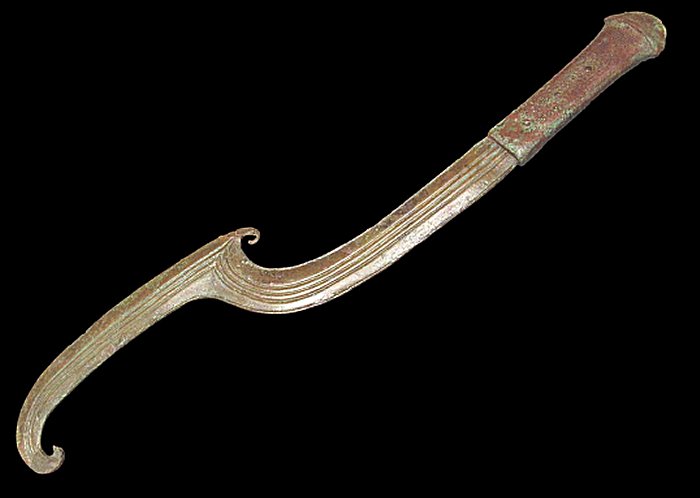
Harpe-AO 4354 - khopesh / archaeological artifact - circa 2000 BC. Image credit: Rama- CC BY-SA 3.0 FR
The khopesh weapon was prevalent among Babylonians, Phoenicians, Egyptians, and many other ancient cultures. There is "a remarkable similarity of a type of sword from Benin in West Africa" and the khopesh sword. 1
The khopesh is mainly known from Egypt and, for the first time, is in the sources of the XVII dynasty as the weapon of Pharaoh Kamose, the last king of the 17th dynasty (c. 1630–1540 BC). In manufacturing this weapon, the Egyptians learned from the Canaanites or took it directly from the invading Hyksos, along with other military innovations.
In many depictions, the khopesh represents an emblem of the Egyptian deities and a symbolic weapon of the Pharaohs. Some khopesh were discovered in royal graves, such as the two examples found with Tutankhamun.
In her book "Warfare and Weaponry of Dynastic Egypt," Rebecca Dean writes that "while the ax remained an important weapon throughout the Eighteenth Dynasty, it at times appeared to be gradually replaced with the sickle sword - the khopesh."
 Relief of Ramses III at Medinet Habu, Theban Necropolis, Egypt. The Pharaoh is using the Khopesh Sword. Credit: I, Rémih - CC BY-SA 3.0
The author describes the weapon's blade as "wedge-shaped (widening at the back) with the cutting edge on the outer edge, as in the case of the scimitar blade, and functioned as a long and thin, almost ax-like weapon. Typically, the weapon is 50-60 cm (20–24 inches) long, but also smaller specimens are found. Its sharpness concentrates only on the outside portion of the curved end." 2
Technically, the khopesh is distinguished from other weapons by its considerable penetration. Its weight was approximately two kilograms, and the unique shape allowed the warrior to choose the way to attack in different conditions.
Khopesh Evolved From Epsilon Axes
The khopesh evolved from the epsilon or similar crescent-shaped axes used in warfare.
Dan Howard writes in his book "Bronze Age Military Equipment" that "the khopesh shows" the probable evolution from the epsilon ax (not the sickle). The epsilon ax was likely the ancestor of the khopesh. Cutting typologies were more common in Egypt, but they also used piercing axes." 3
The khopesh's blade's blunt end edge effectively served as a stick and hook. The inside curve was used to trap an opponent's arm or pull his shield out of the way.
The handle is separated from the barrel by a slight thickening, which forms a barrier directly protecting the hand from a blow. A straight handle with an extended or bent head helps to strengthen the grip.
 Bronze Khopesh sword from the time of Ramses II. Credit: Aoineko - CC BY-SA 3.0
These weapons changed from bronze to iron in the New Kingdom period between the 16th century BC and the 11th century BC, covering Egypt's Eighteenth, Nineteenth, and Twentieth dynasties.
In ancient Egypt, the word khopesh (perhaps derived from "leg" ("leg of beef") because of their similarity in shape. The hieroglyph for ḫpš ('leg' or (kh.p.sh = 'knee') is found as early as the Coffin Texts (c. 2181–2055 BC).
Weapon Smiths Worked Hard To Devise This Sophisticated Not Commonly Used Elite Weapon
Many weapon smiths worked hard for a very long time to produce a long sword that was both resilient and capable of taking a hard edge so that it could be used effectively for striking and thrusting. One solution was the bronze khopesh that "despite its odd shape, was widely used in the Middle East, and subsequently evolved into such swords as the Greek "machaira" and the Ghurka "kukri," traditionally associated with the Nepali-speaking Gurkhas of Nepal and India. 2
The earliest known depiction of a khopesh is from the Stele of Vultures, showing King Eannatum of Lagash with the khopesh in his hand; this would date the khopesh to at least 2500 BC. There are other depictions of the khopesh, too.
 Bronze Egyptian Khopesh with the name of Pharaoh Ramses II. Louvre Museum.
One of the earliest is on a Mari cylinder seal. At Byblos and Shechem, a Canaanite city mentioned in the Amarna letters and the Hebrew Bible's first capital of the Kingdom of Israel dated to a century later.
Except for battles, the khopesh also represented one of the emblems associated with the most important deities of ancient Egypt and symbolized the magical weapon of the Pharaoh.
In art, this sword of Egyptian warriors - was a sign of victory over enemies.
In addition, in this role, the weapon also appears in Egyptian mythology and astronomy. As stated in the hieroglyphs, the ancient Egyptian star deity Mesechtiu originated from the constellation Khopesh (Big Dipper). The Egyptian god Mesechtiu is later mentioned in the Book of the Dead.
The khopesh came out of use about 1300 BC; however, nomadic tribes called Shasu (Bedouins) used it during the 19th dynasty.
Written by – A. Sutherland - AncientPages.com Senior Staff Writer
Updated on January 22, 2023
Copyright © AncientPages.com All rights reserved. This material may not be published, broadcast, rewritten or redistributed in whole or part without the express written permission of AncientPages.com
Expand for references- Bondarenko, Dmitri M., and Peter M. Roese. "Benin Prehistory: The Origin and Settling down of the Edo." Anthropos94, no. 4/6 (1999): 542-52
- Rebecca Dean, "Warfare and Weaponry of the Dynastic Egypt",
- Dan Howard, "Bronze Age Military Equipment"
BLAIR, CLAUDE. "METALS IN THE SERVICE OF MARS: ARMS AND ARMOUR." Journal of the Royal Society of Arts 129, no. 5304 (1981): 764-81.
More From Ancient Pages
-
 Ancient Mysteries Of Wisconsin – Great Forgotten Prehistoric Events Shed New Light On History Of North America
-
 Nearly 7,000 Years Ago, Dortmund Airport’s Area Was Inhabited By Early Farming Society For Centuries
-
 Archaeologists Uncover A 20,000-Year-Old Secret That Rewrites The Ancient History Of North America Forever
-
 Astronomically Aligned Pyramidal Buildings Of America’s Oldest City Reveal How Its Builders Apprehended Space And Time
-
 Viking Children Were Buried With Extremely Sharp Knives – Afterlife Tools To Be Used In Valhalla?
-
 Scotland’s Oldest Tartan On Display For The First Time!
-
 Brown Hares And Chickens Were Seen As Gods Not Food In Iron Age Britain
-
 Daily Life Of Priests And Priestesses In Ancient Egypt
-
 Rare 13,000-Year-Old Artifacts And Paleoindian Camp Uncovered in Connecticut Shed New Light On The First Ancient People In America
-
 Surprising Discovery: Massive Cemetery Built 5,000 Years Ago Near Lake Turkana, Kenya
-
 Mysterious 1,800-Year-Old Roman Marble Inscription Found In The Ancient City Of Aigai Deciphered
-
 Hidden Ancient Underground Tomb Discovered In Petra May Solve The Mystery Of The Nabataean Kingdom
-
 Tyrannical Tarquin The Proud: The Seventh And Last King Of Rome Was Banished
-
 Prophetic Dream Revealed Priceless Ancient Treasure That Was Later Stolen Or Destroyed – Was The Discovery Too Dangerous?
-
 10,000-Year-Old DNA Offers Insights Into South African Population History
-
 Pharaoh Ramses II’s Sarcophagus On Display For The First Time In 50 Years
-
 Ancient Secrets Of The Masters Of Mu – Keepers Of Sacred Knowledge – Part 2
-
 House Of Dragons – Stories And British History That Inspired The Beasts Of Westeros
-
 Historians Search For A Frightening Ancient Underground Secret In One Of Tampa Bay’s Cities
-
 Discovery Of Fortified Villages And Earthworks Re-Writes Ancient History Of Amazon

