
Shengavit Of Kura Araxes Culture: One Of Armenia’s Historical Sites Inhabited Since At Least 3200 BC
A. Sutherland - AncientPages.com - One of the most prominent historical sites of Kura Araxes (Uraxes) culture, dating from 3400 BC to 2000 BC, is the Shengavit settlement, located just beyond the suburbs of the city of Yerevan, Armenia.

The Kura-Araxes culture (3400-2000 BCE). Although the Kura-Araxes people were less aggressive and more sedentary, they also underwent a significant expansion, first west to Anatolia, south to the Fertile Crescent, and east toward the Iranian plateau to Pakistan, where they would have influenced the Indus Valley Civilisation.
The area of modern-day Shengavit has been inhabited since at least 3200 BC, probably, late Neolithic 3500-3000 BC). The site was excavated and relatively well studied by archaeologists who revealed findings attributed to many cultures that existed during the very long time from 4,000 to 2,000 BC.
People had developed agriculture, ranching, cattle breeding industry, reprocessed agricultural produce, and possessed equipment for corn milling. The city had unique food storage and depository of wheat, housing 4 tons of crops.

The excavations at the ancient Shengavit revealed a large set of tools and bronze artifacts, which confirm that Shengavit was a town with prospering agriculture and well-developed craft, including spinning looms, bone spindle whorls, looms, seals, marble, and onyx scepters.
People also worked as craftsmen creating pottery and skilled metalworkers. It is believed that copper smelting may have taken place in ancient Shengavit.
The settlement's highly developed architecture included defensive, economic, administrative, residential, and spiritual buildings.

One example is a rectangular semi-subterranean temple-like building, a temple with a low altar with a hole that may have held a wooden figurine and terracotta hearths, and a place for keeping the sacred fire during rituals.

Square M5 room with ritual emplacement and symbols buried near it. Source
The ruins of the city area, located on an irregular-oval platform built on a slope, are approximately 6 ha and are still surrounded by a wall with cyclopean towers constructed of vast and uncut stones from basalt without mortar. Under the northern part of the wall is an underground passage leading directly to the river Hrazdan and on the south side, there are traces of a filled moat.
When Shengavit was a flourishing center, it had the best defensive system.

People lived in round (sometimes rectangular) dwellings about 6 to meters in diameter and built at a distance of 7.3 meters from each other. Still, they were connected with the last wall of the adjacent buildings.
Their walls had a stone base, on which raw brickwork increased. A round, decorated clay fireplace - usually located in the house's center–had an essential economic and ritual role.
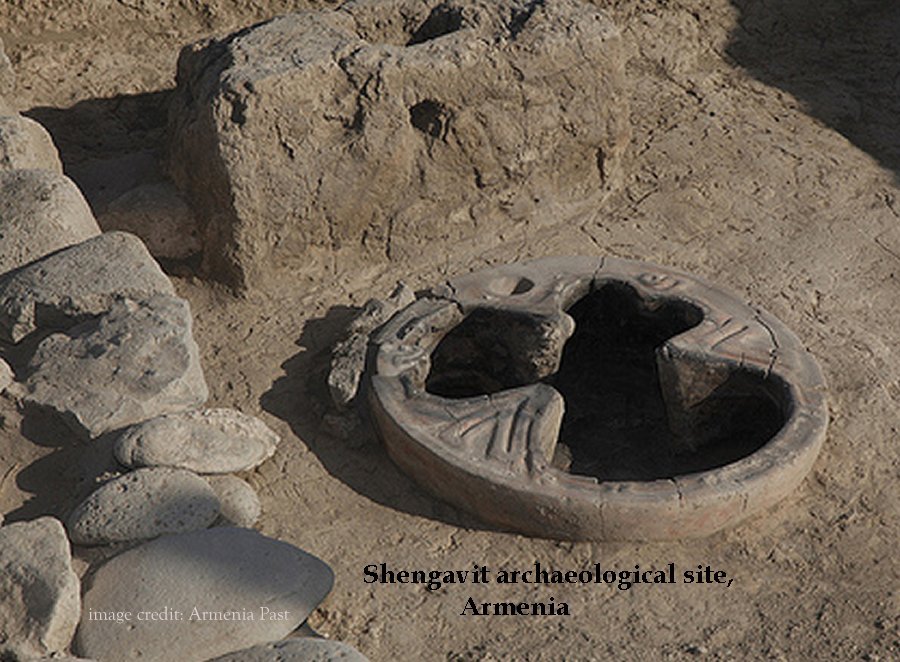
The walls of both round dwellings and rectangular buildings from inside and outside were plastered with clay. The round homes - covered with rubbles - had a corridor entrance opened from the east side.
Shengavit's ancient burial places were found outside the walls of the city. Each unearthed tomb had a place for 10-12 people, burial property, tools, goods, black clay pots, flint and obsidian, copper armlets, earrings, and beads.
According to one theory, Shengavit's burial area was once inside the walled city. Later, for unknown reasons, the city was confined to a smaller place within the walls, and the abandoned area became a burial place dated 3,000 BC.
Written by – A. Sutherland AncientPages.com Staff Writer
Updated on October 29, 2022
Copyright © AncientPages.com All rights reserved. This material may not be published, broadcast, rewritten or redistributed in whole or part without the express written permission of AncientPages.com
Expand for referencesMore From Ancient Pages
-
 New Study Challenges Theories Of Earlier Human Arrival In Americas – Archaeological Evidence Has Been Misinterpreted – Scientists Say
-
 Headteacher’s Sarcophagus Unearthed In Ancient City Of Aigai, Turkey
-
 Skulls and inscriptions on three rings found by archaeologists in Wales
-
 Ancient Trade Routes Between Iran And Mesopotamia – Uncovered
-
 Researchers Reconstruct Genome Of Centuries-Old E. Coli Using Fragments Extracted From An Italian Mummy
-
 Was Ice Age Cave Art Influenced By Pareidolia?
-
 Discovered Inscription On Ancient Stone Vessel Reveals Location Of Legendary Tomb Of Chinese Emperor
-
 On This Day In History: Rosa Parks’ Act Of Defiance And The Montgomery Bus Boycott – On Dec 1, 1955
-
 Extraordinary Bronze Age Jewelry Hoard Discovered In A Carrot Field In Switzerland
-
 Why Were Egyptian Pyramids Built Along Long-Lost Ahramat Branch Of The Nile?
-
 Why Did First Printed Books Scare Ancient Scholars In Europe?
-
 Unique Medieval Perfectly Preserved Sword Found In The Odra River, Poland
-
 Ancient ‘Refrigerator’ And Unique Coins Discovered In Roman Military Camp In Bulgaria
-
 First Pompeiian Human Genome Sequenced Fron An Individual Who Died After The Eruption Of Mount Vesuvius In 79 C.E
-
 Mysterious Crypt Points To A Rosicrucian Secret That Was Never Meant To Be Revealed
-
 Remarkable And Unexplained Historical Sighting Reported By Multiple Witnesses In Wyoming
-
 Study: Paleo-Americans Hunted Mastodons, Mammoths And Other Megafauna In Eastern North America 13,000 Years Ago
-
 Pre-Incan Tombs Of The Chancay Culture Discovered In Lima, Peru
-
 Ancient Oil Lamp Shop Discovered In Aizanoi, The Second Ephesus
-
 Unique Life-Sized Camel Carvings In Northern Arabia Are Much Older Than Previously Thought

