
Clothing And Jewelry In Ancient Egypt – How Did The Ancient Egyptians Dress?
A. Sutherland - AncientPages.com - The Egyptians always differed in their lifestyle, appearance, and customs from the people they came into contact with.
They emphasized their otherness and individuality and showed reluctance to accept anything from strangers. That's why Egyptian paintings make it so easy to recognize any foreign visitor to the country on the Nile.
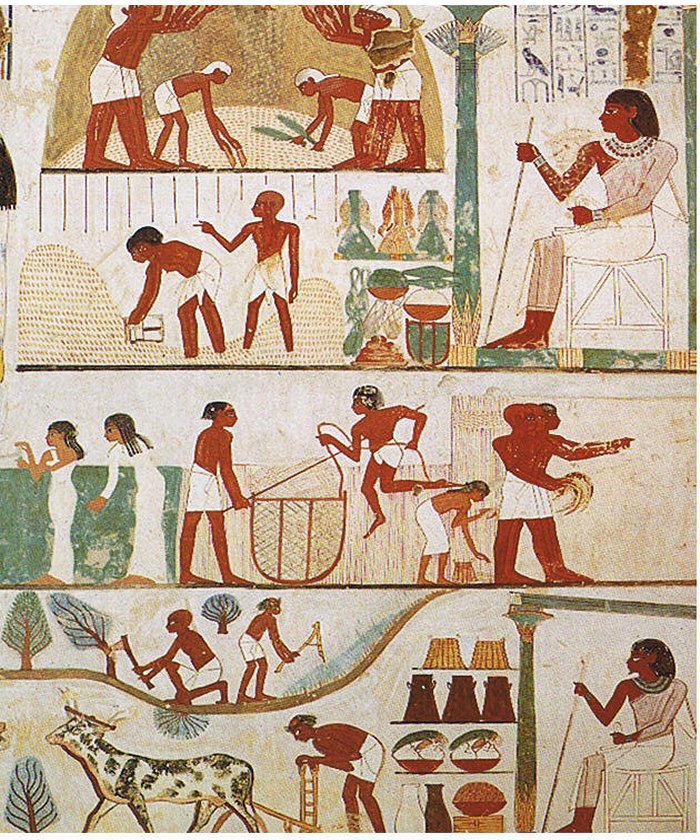 The clothing of men and women of several social levels of ancient Egypt are depicted in this tomb mural from the Eighteenth Dynasty (15th century BC). Agricultural scenes of threshing, a grain store, harvesting with sickles, digging, tree-cutting and ploughing from the tomb of Nakht, 18th Dynasty Thebes. Image credit: Norman de Garis Davies, Nina Davies (2-dimensional 1 to 1 Copy of an 15th century BC Picture - Public Domain
Whether they were diplomats, shepherds, merchants, enslaved people, mercenary soldiers, or invaders, they differed in dress, hairstyles, and ornaments; their appearance was very different from that of the Egyptians.
Ancient Egyptians considered garments and cloth one of the most essential elements in a person's life. People today have a similar attitude, regardless of their culture and traditions. In ancient Egypt, clothing symbolized a person's social position and wealth. It was also used as a form of security for a loan, given away as a mark of respect and honor, or left as a legacy.
Clothing that has already been worn was often reused.
Linen Was Worn in Ancient Egypt
For thousands of years, the basic style of Egyptian clothes remained unchanged. Women wore a simple, tight-fitting, ankle-length dress with two shoulder straps, while men wore a kilt made from a piece of linen wrapped around the waist and tucked in.
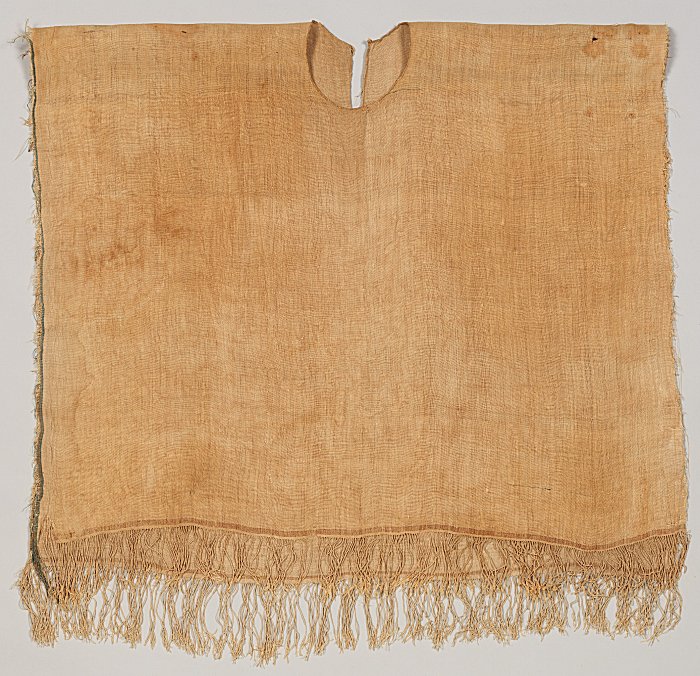
Child's Shirt dated to 650–400 BC. Period: Late Period - Dynasty: Dynasty 26–27. Discovered in Upper Egypt, Thebes, Deir el-Bahri, Temple of Mentuhotep II. Image credit: Rogers Fund, 1925 - Source: MET
Kilts could be either knee- or ankle-length. Linen was considered clean due to the plant's origin, and it was also easy to keep clean. In winter, men and women wore cloaks made from thick linen. Fine linen, which is delicate, light, and cool, works perfectly in a hot climate. Therefore, it was popular during hot months.
White color was most important in ancient Egypt and suitable for wearing in the sun and heat.
Farmers and other working men wore a kind of 'loincloth or kilt' of coarse linen wrapped around the waist and legs. While hunting and fishing, men usually could skip clothing, and women working hard in the fields could wear only a loincloth or short kilt while very young children could play around without clothing, but older ones wore the same type of clothes as their parents.

Linen from Tutankhamun's Embalming Cache, inscription reading the Good God, Lord of the two Lands, Nebkheperure (Tutankhamun), Beloved of Min, linen of year six. circa 1336–1327 B.C. Period: New Kingdom - Dynasty: Dynasty 18 - Reign: reign of Tutankhamun. Gift of Theodore M. Davis, 1909 - source - MET
Women in ancient Egypt wore wrap-around clothing, including kilts, skirts, cloaks and shawls, and dresses. Men wore aprons that only covered the genital region. Aprons are not the same as a kilt. They also wore a long, almost transparent skirt over their short tunics. Tunics (usually kept plain without decorations) and cloaks made of pleated cloth became trendy for men and women.
Most popular were clothes made of linen; other materials included goat hair, palm fiber, and sheep wool. Over their basic tunic, women began to wear a pleated garment that sometimes had a brightly colored fringe decorated by small ornaments hanging from it.
Egyptians didn't wear hats. They sometimes wore hair bands to keep their hair out of their face of wigs. The Egyptians decorated their clothes with beads and feathers and liked their jewelry, makeup, and diverse hairstyles to create a dramatic effect. During the New Kingdom, a more elaborate dress style developed in Egypt.
Sandals
People in ancient Egypt went barefoot, but sometimes they wore sandals.

Pair of Sandals from the Tomb of Yuya and Tjuyu. circa 1390–1352 B.C. Period: New Kingdom - Dynasty: Dynasty 18 - Reign: reign of Amenhotep III (Grass, reed, papyrus). Image credit: Gift of Theodore M. Davis, 1910 - source - MET
Usually, most Egyptians went barefoot, but the rich wore sandals made from leather (often decorated), while the poor wore sandals made of woven papyrus or grass. A pharaoh could possess a pair of golden sandals. Ancient Egyptians used the same footwear both sexes. The sandals were worn on special occasions or at times when their feet might get hurt.
Jewelry
No ancient Egyptian costume was complete without a selection of jewelry. Even poorer people wore necklaces, bracelets, earrings, collars, rings, and necklaces. Jewelry was worn to show wealth and to look beautiful for their gods.
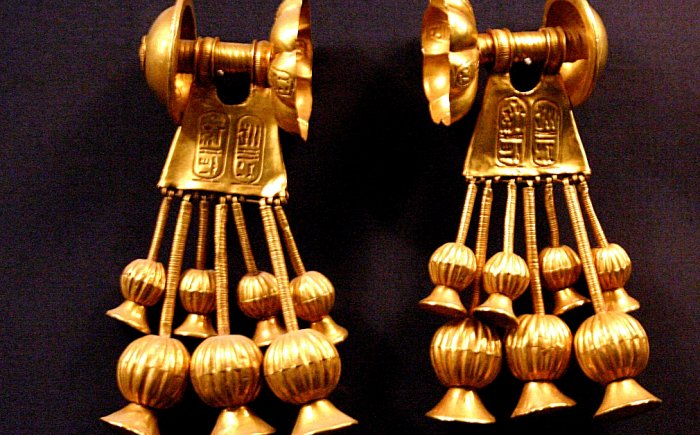
Gold earrings bearing the cartouche of pharaoh Seti II (Sethos II) found in tomb KV56 in 1908 by an Egyptian expedition funded by Theodore M. Davis. It is now located in the Cairo Museum. Image credit: Hans Ollermann - CC BY 2.0 DEED
Poor people's jewelry was made from copper and faience (colored, glazed pottery), while the rich wore golden and silver jewelry, often decorated with glass and small semiprecious stones.
Rich and poor men and women commonly wore colorful and very decorative collars. They were composed of several strings of beads, often adorned with semiprecious stones, glass, and leaves. Collars additionally adorned with cornflowers and olive leaves were found in the pharaoh Tutankhamun's tomb.
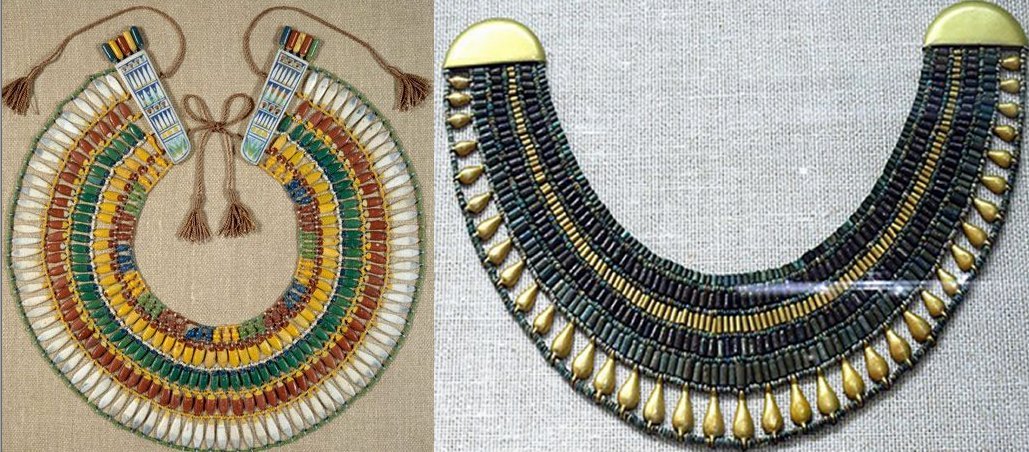
Left: Egyptian collar, New Kingdom, Amarna Period, reign of Akhenaten, Dynasty 18, ca. 1353–1336 B.C. Egypt. Faience. The Metropolitan Museum of Art, New York; Right: Broad collar necklace from the tomb of Senebtisi Dynasty 12, late–early 13 ca. 1850–1775 B.C. Image: MET
Poor people’s jewelry was made from copper and faience (colored, glazed pottery), while the rich wore golden and silver jewelry, often decorated with glass and small semiprecious stones.
Colorful and very decorative collars were commonly worn by rich and poor men and women. They were composed of several strings of beads, often adorned with semiprecious stones, glass, leaves. Collars additionally adorned with cornflowers and olive leaves were found in the pharaoh Tutankhamun’s tomb.
"The most common ornament was the wide flexible collar, made of concentric rows of beads, some of which might be shaped like animals or flowers or leaves. It covered the front of the wearer’s
body from the base of the neck to the middle of the breast, and since it was made of bright colors, it formed an important part of the overall costume. Instead of a collar, necklaces or pendants might be worn..." 1
Written by – A. Sutherland AncientPages.com Staff Writer
Updated on Oct 3, 2023
Copyright © AncientPages.com All rights reserved. This material may not be published, broadcast, rewritten or redistributed in whole or part without the express written permission of AncientPages.com
Expand for referencesMeskell L., Private Life in New Kingdom Egypt
- Mertz BArbara, Red Land, Black Land Daily Life in Ancient Egypt
More From Ancient Pages
-
 How Ramesses II Became The Greatest Pharaoh In Egypt
-
 Unique Metal Ingot Dated To Iron Age Found For The First Time In Sweden
-
 Mystery Of An Edinburgh Crypt – Secrets Of Warriors Of Dark Ages In Scotland – Revealed
-
 How An Old Norse Poem Changed Biblical Studies
-
 Mysterious 11,000 – Year-Old Tower Of Jericho: Was World’s First Skycraper A Symbol Of Power Or An Ancient Time-Keeping Device?
-
 On This Day In History: Independence Of Lower Canada – Today Quebec – Proclaimed On Feb 28, 1838
-
 Grandfather Frost And Snow Maiden Bring Gifts On New Year’s Eve
-
 1,300-Year-Old Avar Warrior Tomb With Rare Well-Preserved Treasures Discovered In Hungary
-
 Ars Amatoria – Ancient Roman Flirting Tips – Could They Still Work?
-
 Virtual Nubia: Sudan’s Medieval Monasteries Digitally Reconstructed By Polish Archaeologists
-
 Over 2,000 Clay Figurines Discovered In The Ancient City Of Kythnos
-
 Rare Ancient Dacian Stonemason’s Toolkit Discovered In Romanian Forest
-
 Huge Ancient Hydraulic System Built By The Liangzhu Culture May Be World’s Oldest And Predate Mesopotamian Water Systems
-
 On This Day In History: Ferdinand Magellan Discovers Guam – On Mar 6, 1521
-
 Pharaonic Water Wells Discovered For The First Time Near ‘Horus Road’ In Sinai, Egypt
-
 Bolivia And The Mystery Of The Twins Of Atlantis
-
 Ancient Artifacts Reveal North American-Japanese Human Connection 16,560 Years Ago
-
 When Giants Ruled North America – Giant Skeletons ‘Erased’ From History – Part 2
-
 Manco Capac: Legendary Founder Of The Inca Dynasty Of Peru
-
 Ravana: Ten-Headed And Multi-Armed Demon King Of Lanka And Chief Antagonist In Epic Ramayana

