
Attila The Hun: The Destroyer Of Rome Among Most Fearsome Enemies The Empire Ever Faced
David Tee - AncientPages.com - Many brilliant leaders serve their countries well but live their lives and careers in obscurity. Thus, they achieve little. They may be in the right place or time but not both.
Attila the Hun, who ruled 434-453 AD, was fortunate as he lived in the right place and at the right time. He was given an excellent opportunity to break the hold of the Romans over the many different nations they conquered and controlled.
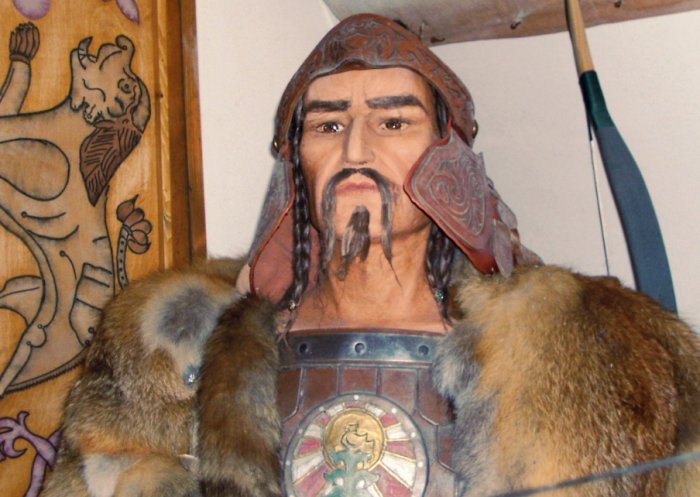 The figure of Attila in a museum in Hungary. (Wikimedia Commons)
During his youth, his training seemed to prepare him for those moments of glory he would eventually achieve. He was an excellent archer and horse rider. With his warrior skills, he could create a vast army willing to die for his objectives.
Attila Came From The Unknown
It seems strange that such a famous warrior and conqueror has little information about him and his people. The date and place of his birth have been hidden by history, as has the language of his people. No one knows what language the Huns spoke.
Any evidence for their language only comes from people's names, which have various nationalistic origins. Another unknown piece of the puzzle comes from the fact that Attila is not his real name.
On top of that, the origin of the Huns is unknown. Their appearance on the European landscape seems to be one of mystery. The historian Gibbon has suggested that the Huns were part of the Xiongnu tribe, which was defeated earlier by Chinese Imperial armed forces. It is also argued that this tribe was forced to migrate and eventually became the Huns.
Two Brothers Attila And Bleda Were Joint Rulers
It was the death of his uncle Rugila (a ruler who was a significant factor in the Huns' early victories over the Roman Empire) that opened the path of power to Attila. Rugila was his uncle, but he was unsure if he had any sons to replace him. What is known is that both Attila and his brother Bleda were given the positions of joint rulers.
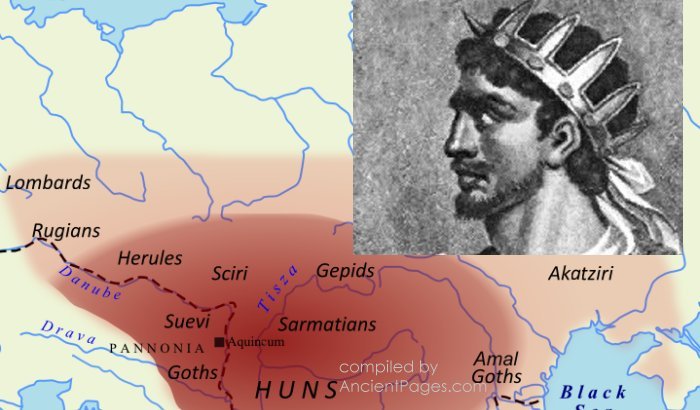
Attila and his brother were not men of character and often broke their word and treaties.
Upon ascension to power, the brothers worked with the Romans, and the Huns were paid as mercenaries to help defend the Roman borders. At the Treaty of Margus (443 AD), though, the Romans began to pay the Huns to keep them from invading their territory.
When the Treaty was signed, the Romans moved most of their troops to fight the Vandals on the western boundaries. It left the Huns vulnerable and tempting as Roman soldiers no longer guarded the Eastern borders.
Bleda died at approx. 445 AD, but it is unknown how he died or if Attila grew tired of joint rule and took the throne for himself.
Attila Used Religion To Keep Control Over People
It is without a doubt that religion holds significant influence over the general public. What religious people believe can be used to manipulate them into behaving in very non-religious ways. Attila seemed to have known this and used religion to keep his people under control.
He often claimed that he held the 'divine sword' and was destined to be the ruler of the known world. Attila probably used the religious beliefs of his people to help train them to be excellent guerrilla fighters. Their hit-and-run strategies made it almost impossible for the Romans to defeat.
It wasn't till the Roman general Aetius put together a coalition army of Visigoths, Vandals, and Romans that Attila suffered a defeat at the hands of his former Roman friends.
Attila Was Defeated But Not Conquered
However, the bloodiest battle in human history did not top Atilla or the Huns. They recovered from their defeat and returned to devastate Italy a year later. Attila never reached Rome as his army stopped at the River Po due to a lack of supplies.
The army soon returned to their homeland, where Attila died celebrating a marriage. His sons were not as capable of holding the empire together, and the Huns soon departed from history.
Written by – David Tee AncientPages.com Staff Writer
Updated on December 10, 2022
Copyright © AncientPages.com All rights reserved. This material may not be published, broadcast, rewritten or redistributed in whole or part without the express written permission of AncientPages.com
Expand for referencesMore From Ancient Pages
-
 Hedeby: Prestigious Trading Center And One Of The Largest Baltic Sea Ports In Viking Age
-
 Frightening Edinburgh Vaults: The Spooky Underground City Of The Dead
-
 Inchbrayock Stone: Pictish Samson Stone Carved With Biblical Symbols And Scenes
-
 Ancient Petroglyphs In Toro Muerto Are Not What We Thought – Archaeologists Say
-
 Stone Slab c. 9,000-Year-Old Used In Making Fire Discovered Not Far From Jerusalem, Israel
-
 Little Known Neanderthal Technology Examined – Turning Bones Into Tools
-
 Dwarf Ninja Ukifune Jinnai’s Toilet Assassination Of Uesugi Kenshin
-
 Giant 4,500-Year-Old Axe Grinding Site Discovered In Scotland
-
 Excavations Reveal New Artifacts That Change History Of Ancient City Of Pergamon
-
 Cosmic Impact 12,800 Years Ago Forced Hunter-Gatherers In The Levant To Adopt Agricultural Practices
-
 On This Day In History: Sorley MacLean, A World Renowned Gaelic Poet, Died – On Nov 24, 1996
-
 More Than 3,000-Year-Old Multicolored Pre-Inca Mural Discovered At Huaca Yolanda, Peru
-
 Has An Unknown Ancient ‘Israel Silk Road’ Been Discovered?
-
 Major Discovery Reveals Neanderthals In Italy Engaged In Plant Food Processing
-
 Ancient Aqueduct System Discovered In Boroujerd, Lorestan
-
 How Can AI Affect Human Evolution? Predicting Changes In Brain Size And Social Behaviors
-
 Mystery Of Nebra Sky Disk: New Analysis Shows Surprising Results
-
 Mysterious Advanced Underground Civilization And A Secret Society – Technology, History, Language And Goals – Part 2
-
 Prehistoric Human Migration In Southeast Asia Driven By Sea-Level Rise – Study Reveals
-
 New Fossil Of 145-Million-Year-Old Pterosaur Nicknamed Elvis

