
Texas Revolution – A Courageous Fight For Independence
Ellen Lloyd - AncientPages.com - The modern city of Houston, Texas, is named after General Sam Houston, who led his troops to victory against Mexicans at the Battle of San Jacinto in 1836.
Not every revolution is as famous as the one that took place in France (1789- 1799), but to people living in Texas, the uprising at the end of 1835 dramatically changed the political situation and their living conditions.
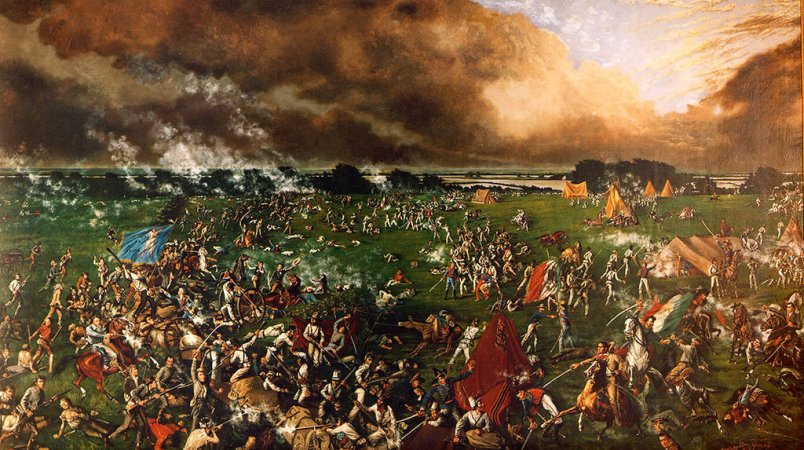
Henry Arthur McArdle's 1895 painting, The Battle of San Jacinto. Credit: Public Domain
The Texas Revolution lasted from October 2, 1835, to April 21, 1836, and led to Texas’ independence from Mexico and the founding of the Republic of Texas (1836–1845).
Many factors led to the revolution. The main reason behind it was cultural and political disputes between Anglo-Americans who lived in Texas and the Mexican government.
When Mexico gained independence in 1821, colonists had fewer restrictions. As a result of this, thousands of settlers moved from the southern USA to Texas.
These newcomers made Texas their home, and soon, there were more Anglo-Americans in the area than Spaniards and Mexicans. The situation between the English and Spanish-speaking population became tense.
Mexico felt the country was losing control over Texas and responded in 1835 by introducing “Siete Leyes” – the Seven Laws.
This angered the Anglo-American population in Texas because these laws gave the Mexican President Antonio López de Santa Anna (1794 – 1876) more political power. This led to the Texas Revolution in 1835.
Using guns, people in the Mexican province of Texas forced federal troops out of the region. Shortly after this, a temporary Texas government was established. Its task was to decide whether Texas should become an independent state or remain under the control of Mexico.
President Santa Anna was furious and responded by sending the Mexican army that he led himself. The Mexican President was determined to end the revolutions and crush the colonists, but his plans failed.
When the revolutionists and the Mexican army troops confronted each other, it became clear that the Anglo-Americans had no intentions to surrender. The “Runaway Scrape”, the name Texans applied to their flight from their homes started in January 1836. When Mexicans gathered on the Rio Grande, people left the area.
In 1836, after fighting intensely for 13 days, a group of Texan volunteer soldiers was brutally killed by the Mexican Army. President Santa Anna had ordered his troops to take no prisoners and only a small number of Texans were spared.
The heroic Battle of the Alamo became a symbol of Texans’ resistance and fight for independence.
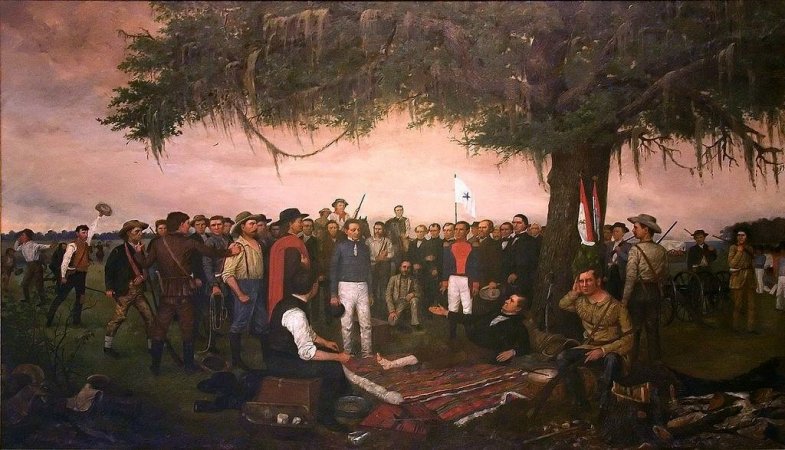
"Surrender of Santa Anna" by William Henry Huddle (1847 - 1892) shows the Mexican president and general surrendering to a wounded Sam Houston, battle of San Jacinto. Credit: Public Domain
On April 21, 1836, everything changed, but this time in favor of the Texans.
President Sam Houston (1793 -1863) led about 800 Texans against Santa Anna’s Mexican force of 1,500 men at San Jacinto. While shouting “Remember the Alamo” the Texan army attacked and defeated the Mexican forces.
President Santa Anna was captured and agreed with President Houston to end the war.
The victory at San Jacinto ensured the success of Texan independence.
Updated on March 11, 2024
Written by Ellen Lloyd – AncientPages.com
Copyright © AncientPages.com All rights reserved. This material may not be published, broadcast, rewritten or redistributed in whole or part without the express written permission of AncientPages.com
Expand for referencesBarker, Eugene C. "Stephen F. Austin and the Independence of Texas." The Quarterly of the Texas State Historical Association13, no. 4 (1910): 257-84. http://www.jstor.org/stable/30242989.
More From Ancient Pages
-
 Romans Were Early Pioneers Of Recycling – New Evidence Reveals
-
 Rare 2,300-Year-Old Tomb Of Greek Courtesan Found In Jerusalem Burial Cave
-
 Ritual Bath In Herod’s Fortress Found In Ruins Of Machaerus, East Of Jordan River
-
 19 Cannons Shot From British Ships During The American Revolution Discovered In Savannah River
-
 Viking Children Were Buried With Extremely Sharp Knives – Afterlife Tools To Be Used In Valhalla?
-
 Eleanor Of Aquitaine – Mother Of King Richard The Lionheart And One Of Most Powerful Women Of Middle Ages
-
 Scipio Africanus – Rome’s Greatest General Who Defeated Unbeatable Hannibal
-
 Ancient Egyptian Papyrus Tells A Different Story About Biblical Isaac’s Fate
-
 Stunning Reconstruction Of Caterthun Iron Age Forts In The Grampian Mountains, Scotland
-
 Beautiful Mosaic Dated To Graeco-Roman Times Discovered In Alexandria, Egypt
-
 Mysterious Sarcophagi Belonging To The Chachapoyas The Cloud Warriors
-
 Evidence Of Beer Drinking 9,000 Years Ago In Southern China Discovered
-
 Oldest Human Remains From Puerto Rico Reveal A Complex Cultural Landscape Since 1800 BC
-
 Viminacium Ancient Roman Camp: Sarcophagus With Skeletons, Rich Grave Goods Found In Serbia
-
 Fresco Reveals Renaissance Genius Raphael Used Egyptian Blue – World’s Oldest Artificial Pigment
-
 Original Colors Of 2,000-Year-Old Inscriptions At Temple Of Esna, Luxor – Revealed
-
 Roman Empire’s Emerald Mines In The Egyptian Eastern Desert – New Evidence
-
 Sculpted Head Of Ancient Warrior Wearing A Serpent Helmet Found At Chichen Itza
-
 On This Day In History: King James I Of Scotland Was Assassinated – On Feb 21, 1437
-
 İnkaya Cave Study Brings To Light 86,000-Year-Old Traces Of Human Life

