
Tower Of The Winds And Daydreaming Of Andronicus Of Cyrrhus
A. Sutherland - AncientPages.com - Tower of Winds, located in the city of Athens, is considered to be the world’s first weather station. The building keeps some old secrets that no one has been able to solve.
A building with a sundial and a weather vane, known as the Tower of Winds, is about 14 meters (46 ft) tall, with a diameter of about 8 meters and it dates back to about 40 BC.
This enigmatic structure most probably measured time, indicated the sides of the world and the directions of the wind.
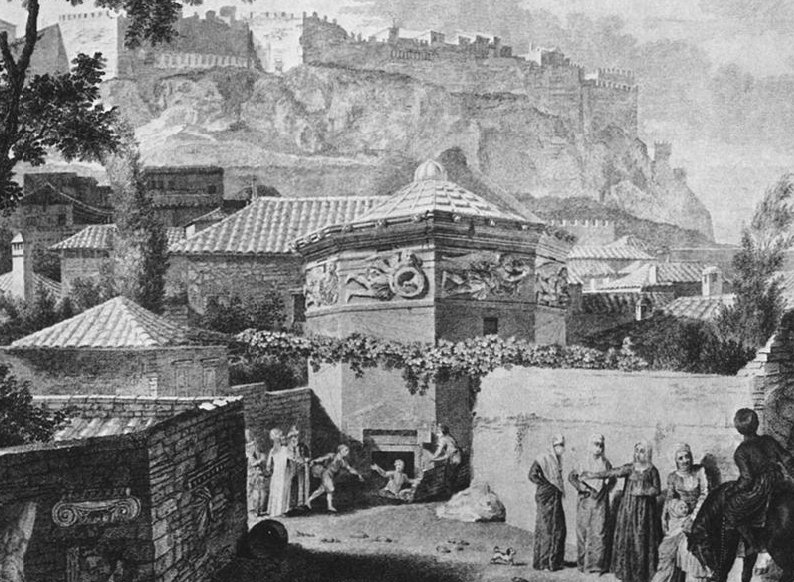 General view of the tower, from Stuart & Revett's The Antiquities of Athens, 1762. Public Domain
However, it is still unknown how the clock exactly functioned at night. Based on the most prevailing theory, a hydraulic mechanism powered a water clock device with water originating from a stream on the Acropolis hill.
According to ancient sources, a Macedonian architect, merchant, and sky observer, Andronicus of Cyrrhus was credited with both the design and construction of the tower.
Andronicus, who flourished ca. 100 BC, had a daydream, which later inspired his design and construction of the Tower of the Winds. In spite of the ancient beliefs of the Greeks that all dreams live under the earth, Andronicus wanted to make his dream alive on the earth. He loved stars abut he also loved winds very much.
He “was chosen by the people of Athens to plan a tower which should contain a water clock--this new tower to stand not far from the old marketplace, on the low land lying north of the Acropolis…"
"...the tower was built, with a turret on the south side to contain the cistern which supplied the water for the water clock. The movement of water wheels caused the gradual rise of a small figure which pointed a rod to the hours on a dial. The Athenians were much pleased with their new water clock, or clepsydra. Greeks of earlier centuries had had to look to the stars for their time at night…" (B. Palmer Lane, Legendary Towers)
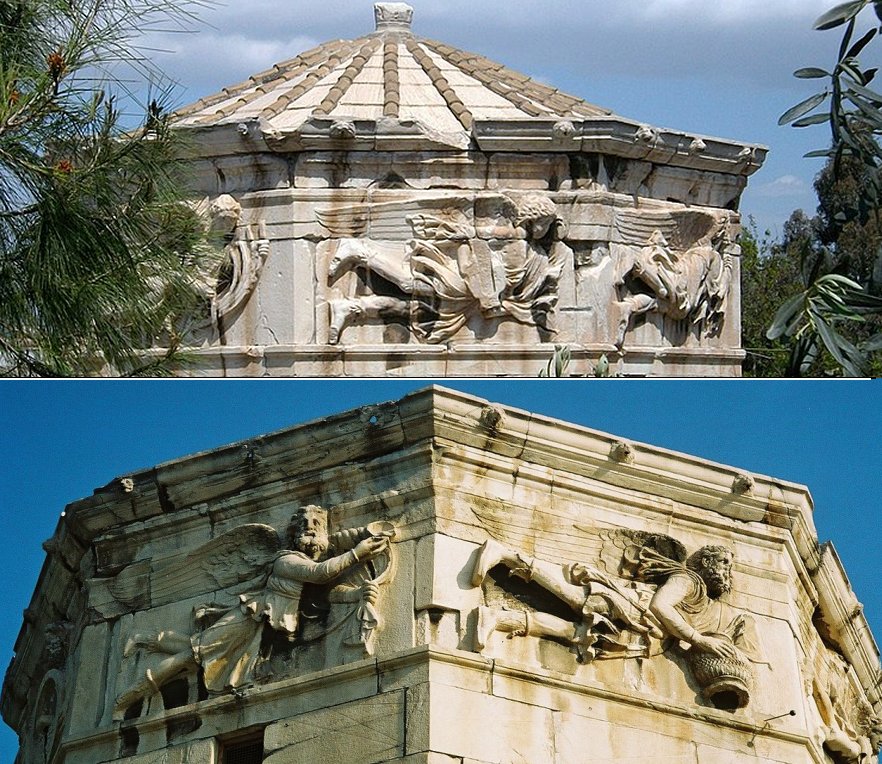
The Tower of the Winds. image source
The marble clock tower still stands proudly at the entrance to the Roman Agora of Athens, as it did 2000 years ago.
The tower catches the eye due to its characteristic, octagonal shape and beautiful decoration in the form of intriguing bas-reliefs at the top of each wall of the tower.
The reliefs that decorate the tower are the personified images of the winds and show the main features of each of the winds and weather that they bring with them. Below the frieze depicting the eight wind deities, there are eight sundials and inside the tower, there was a water clock (or clepsydra), driven by water coming down from the Acropolis.
The Tower of Winds owes its name to the reliefs on the top of each wall, depicting eight winds: Boreas (N), Apeliotes (E), Kaikias (NE), Notus (S), Eurus (SE), Lips (SW), Zephyrus (W), and Skiron (NW).
Each wall is oriented according to the sides of the world and decorated at the top with a relief depicting one of 8 winds, below each relief there is a sundial. The conical roof was originally crowned with a bronze wind vane in the form of sea god Triton, with a sticker showing the direction of the wind. Inside the tower, there was a wooden water clock with a complex mechanism, but it did not survive to the present day, however, the remains of the fixtures are still visible in the walls.
This was a water clock combined with sundials that were positioned in the eight principal wind directions. By then, it was the most accurate device built for keeping time, and today, the tower is considered the world's first meteorological station.
Curiously, this little-known monument, which was sometimes also called Aerides (in Greek: 'winds') is regarded as one of the best-preserved monuments of the ancient city of Athens.
Written by – A. Sutherland - AncientPages.com Senior Staff Writer
Copyright © AncientPages.com All rights reserved. This material may not be published, broadcast, rewritten or redistributed in whole or part without the express written permission of AncientPages.com
More From Ancient Pages
-
 5 Different Types Of Priests In Ancient Rome – Their Role And Responsibility Explained
-
 On This Day In History: Courageous And Heroic Radio Rescue At Sea – On Jan 23, 1909
-
 Why Did King Solomon Hide Advanced Technology In A Secret Place? – The Great Deception – Part 2
-
 Spectacular 2,500 Years Old Shwedagon Pagoda In Myanmar – World’s Oldest Pagoda
-
 The Hidden Face Of The Elusive Master
-
 Lost Mayan City Hidden Deep In The Peten Jungle Discovered By Expedition Team
-
 More Than 1000 Bones Of Extinct Predators From 240 Million Years Ago – Found In Upper Silesia, Poland
-
 Fragment Of A 1,750-Year-Old New Testament Translation Discovered
-
 Rare Discovery: Giant Stone Artifacts Found On Ice Age Site In Kent
-
 Vandalism – Stonehenge Sprayed With Orange Paint – Two People Arrested
-
 Shiva – Hindu God Who Resides In Every Being And In All Things
-
 A Millennium-Old Gilded Bible Seized In Tokat, Turkey
-
 Yuezhi Civilization: Ancient Nomadic People Who Once Ruled Bactria
-
 Underwater Stone Age Village Habonim North Found Off Israel’s Carmel Coast Thrived During Climate Change
-
 How Emma Of Normandy Risked Her Life To Save England
-
 Mysterious Tiny Pre-Viking Gold Foil Figures Baffle Scientists
-
 Man-Made Square Burial Cave Dated To Rameses II-Era Accidentally Found In Israel
-
 St. Swithin’s Day And The 40 Days’ Weather Prophecy
-
 Mjölnir: Thor’s Terrible Axe-Hammer And Its Magical Powers In Norse Mythology
-
 South Africa ‘s Blombos Cave: Ochre Was A Tool For Stone Toolmaking During The Middle Stone Age

