
Ancient Village Of Monsanto, Miraculously Balanced Giant Boulders And Knights Templar Connection
A. Sutherland - AncientPages.com - Monsanto is a very ancient and remote village made of stone. Here, most of the homes are built into the rocks! The whole place is truly astonishing.
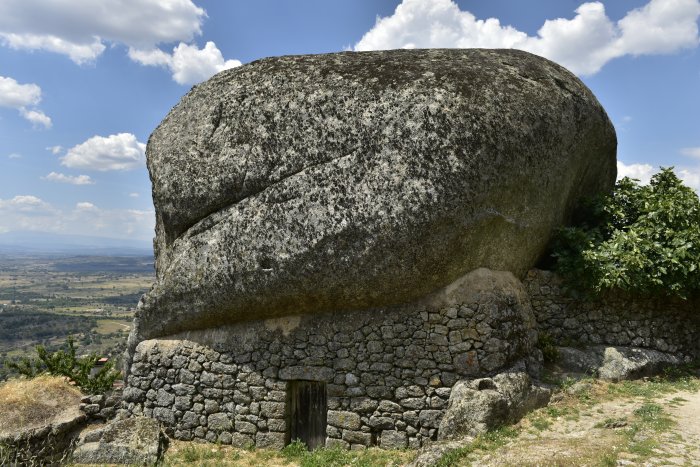
Monsanto Village. Credit: Adobe Stock - LaureanoJesus
Monsanto is located southeast of Serra da Estrela, the highest mountain range in mainland Portugal. The region has a rich history. People lived there in the Paleolithic Era, and archaeologists have found evidence of Roman, Visigoth, and Arabian occupations.
A Lusitanian fortress in the area was conquered and improved by the Roman Army, and it was then occupied by the Visigoths, the Alans, and others during the 8th century.
Finally, the place was conquered by the Christian Army of the first king of Portugal, Afonso Henriques, also known as Afonso the Conqueror.
The Lusitanian fortress was entrusted to Gualdim Païs, Master of the Templar Order in Portugal, who rebuilt it to protect the new kingdom's southern border. He finished the works in 1171, that is to say, two years after building the fortress of Tomar.
Tomar was originally a 12th-century Templar stronghold, but when the order was dissolved in the 14th century, the Portuguese branch became the Knights of the Order of Christ.

Left: 19th-century depiction of King Afonso I Henriques of Portugal, on the ceiling of the Kings' Room, Quinta da Regaleira, Sintra, Portugal. Image credit: via Wikipedia; Right: Dom Gualdim Pais (1118 – 13 October 1195), a Portuguese crusader, Knight Templar. Image credit: Jornal de Sintra
King Afonso Henriques conquered Monsanto from the Moors, and in 1165, the city was given military orders to maintain the reconquered city with Christian hands.
King Alfonso granted it to the Templar monks, who built the Castle under the orders of Gualdim Pais, Grand Master of the Order of Knights Templar.
King Sancho I (1190) and King Afonso III (1217) confirmed the Charter. King Sancho I of Portugal reconstructed and repopulated the fortress because it was severely damaged during the wars with the king of Leonese, an independent kingdom founded in AD 910 and situated in the northwest region of the Iberian Peninsula.
In 1308, King Dinis granted it a Charter, which allowed a fair to occur near the Chapel of São Pedro de Vir-a-Corça. King Manuel I granted it a New Charter in 1510, giving it the right to be a 'town.'
However, Monsanto and its inhabitants could not contemplate a quiet life.
In the middle of the 17th century, Luis de Haro, Minister for Filipe IV, tried to siege Monsanto, but his attempts were unsuccessful.
Later, at the beginning of the 18th century, the Duke of Berwick also laid siege to Monsanto. Still, the Portuguese Army, commanded by the Marquis of Minas, defeated the invader on the slopes of the hill. In 1758, Monsanto was a municipality, having kept this privilege until 1853.
Unfortunately, the impressive medieval Castle of Monsanto was destroyed in the nineteenth century because of an accidental explosion in the ammunition depot of the Castle.
In 1938, Monsanto bestowed the "most Portuguese Village of Portugal." It might seem a little odd because most villages in Portugal don't have houses squeezed between gigantic boulders.
The ancient population carved dozens of narrow streets and passageways right through the center of the boulders. The passages lead the residents upwards and downwards over the rocks and through the village.
One can easily say that this unique village is frozen in time. Its appearance hasn't changed in centuries.
Written by – A. Sutherland - AncientPages.com Senior Staff Writer
Updated on May 29, 2024
Copyright © AncientPages.com All rights reserved. This material may not be published, broadcast, rewritten or redistributed in whole or part without the express written permission of AncientPages.com
Expand for referencesMore From Ancient Pages
-
 Draupnir: God Odin’s Magical Ring That Could Multiply Itself
-
 Scientists Found A Link Between Ancient Human Teeth And An Extinct Reptile
-
 Pharos Of Alexandria – One Of The First Lighthouses In The Ancient World
-
 Weird Archaeological Discovery In Ancient Scottish Cave – A Neolithic And Celtic Mystery
-
 1,200-Year-Old Carbonized Bread Featuring A Rare Jesus Motif Discovered In Topraktepe, Türkiye
-
 Drones Find Evidence Roman Siege Of Masada Lasted Much Shorter Than Previously Thought
-
 10 Enigmatic Ancient Underwater Ruins – Our Oceans Are Full Of Secrets
-
 Massive 2nd-Century Fountain In Turkey’s Ancient City Of Tripolis Will Be Soon Restored
-
 Gruesome Discovery Of Headless Bodies In Vráble, Slovakia – Remains Of Stone Age Cult Victims Unearthed
-
 What Was The Extreme Ritual Of Sokushinbutsu?
-
 First Peoples’ Early Migration To Australia – Influenced By Evolving Landscapes
-
 Ancient DNA Of Segorbe Giant Reveals A Brutal Event In Medieval Spain
-
 Lost Ancient Mayan Cities Lagunita And Tamchen Hidden In The Jungle Reveal Their Secrets
-
 Ehecatl: The Snake-Bird Deity And God Of Wind Feared And Respected By The Aztecs
-
 Djoser – Most Outstanding King Of The Third Dynasty In Ancient Egypt And His Step Pyramid
-
 8,000-Year-Old House Remains Discovered In Svinjarička Čuka, Serbia Raise Questions About Europe’s First Farmers
-
 On This Day In History: The U.K.’s First Murder Case Solved By A Fingerprint – On March 27, 1905
-
 New Study Challenges The Beginning Of Civilization
-
 Surprising Discovery Of Oldest Decoratively Carved Wood In Britain
-
 On This Day In History: Columbus Reached Honduras With His Ships – On July 30, 1502

