
Susanoo-no-Mikoto – Shinto God Of The Sea And Storms Was Banished From Heaven
David Tee - AncientPages.com - The earliest records anyone has of the Japanese myth Susanoo-no-Mikoto appear in the 8th century AD. These records tell the story of the Japanese storm and sea god who could not control himself when he got excited.
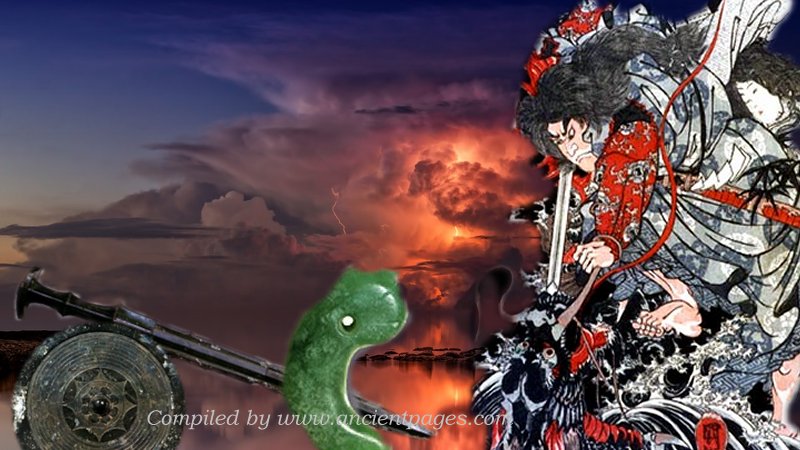
In fact, it was his uncontrollable nature that got him banned from heaven. Susanoo was born when his father, Izanagi, washed the remnants of the underworld off his body. Amaterasu was born when Izanagi washed out his left eye; her brother Tsukuyomi was born from washing of the right eye, and Susanoo was born when Izanagi washed his nose.
How his sister was born, we do not know. But Susanoo’s banishment came when he could not control his temper. Like some gods, Susanoo had a favorite weapon, the Kusanagi sword, which was one of the three Imperial Regalia of Japan.

This is a preview of our premium article available only to members of Ancient Pages.
Become a member to read more - Click here
If you are already a member and have logged in to your account, you can access the article here

See also:
Legend Of Baku – The Dream Eater – Was It An Ancient Supernatural Being?
Raijin: Shinto God Of Thunder And Lightning With Three Fingers Representing Past, Present And Future
Yuki-Onna ‘Lady Of The Snow’: A Female Demon And Symbol Of Death In Japanese Mythology
More From Ancient Pages
-
 Secrets Of Maxims Of Ptahhotep – Ancient Egyptian Wisdom Is Still Relevant Today
-
 The Fierce Great Heathen Army And The Invasion Of East Anglia
-
 Anartes: Forgotten Celtic Tribe And The Hercynian Forest With Strange Animals
-
 Mysterious Ancient Rulers With Elongated Skulls – Who Were They Really?
-
 Scientists Say Dinosaurs Could Be The Reason Humans Can’t Live For 200 Years
-
 Mysterious Ancient Tracks In Rock, Strange Legend And Hidden Treasure – A Puzzle From Arkansas
-
 Circe: Powerful Divine Greek Sorceress Who Mastered Healing, Miracles And Transformed People Into Animals
-
 Unknown Biological Entities And Disturbing Weather Phenomenon In Washington Still Baffle Scientists
-
 Forbidden High-Tech Knowledge Of A Controversial Ancient Lost Super Race
-
 Mysterious Ancient Stone Structures Discovered In Illinois Remain Unexplained – Archaeologists Say
-
 Unravelling The Mystery Of Apollonius Of Tyana – Was He A Superhuman?
-
 Lugh Of The Long Hand – One Of The Greatest Heroes Of Irish Folklore
-
 Phoenicians: Powerful Traders And Their Remarkable Seafaring Achievements
-
 Antediluvian Artifact Discovered In Egyptian Tomb May Solve The Great Pyramid Mystery?
-
 Unexplained Phenomena Witnessed Around Mysterious Ancient Stone Structures In New York – Can A Sacred Native American Mountain Offer Clues?
-
 Mysterious Ancient Underground King And Ruler Of The World – Who Was He? Part 1
-
 The Opening Of Pandora’s Box May Have Been A Real Event
-
 Curious Story How Sæmundur The Wise Tricked The Devil Three Times
-
 Does A Baffling Artifact Offer Evidence Of Ancient Extraterrestrial Visitation In New Zealand? – The Discovery – Part 1
-
 What They Never Told Us About Lullabies When We Were Children (Or Adults)

