
Naqsh-e Rostam: Spectacular Tomb Complex With Rock Reliefs From Elamite To Sasanian Times
A. Sutherland - AncientPages.com - An incredible complex of tombs and artworks known as Naqsh-e Rostam ("Picture of Rostam"), or Necropolis, is located outside of the city of Shiraz and only a few kilometers northwest of Persepolis - the capital of the ancient Achaemenid Empire - in central Iran.
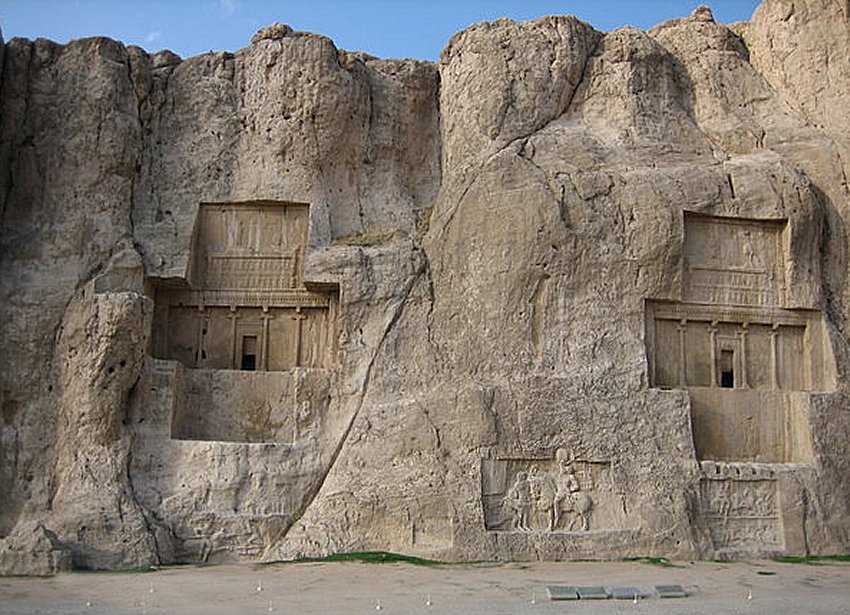
Naqsh-e-Rostam. Image credit: Iran Chamber Society
Naqsh-e Rostam monument is a perpendicular wall of rock with four similar tombs, cut considerably from the bottom of the valley.
The rock art below the tombs with sculptures from Elamite, Achaemenid, and Sassanid periods on mountains and rock is one of the unique and most beautiful examples of stone masonry of the historical and ancient period.
The Sasanian carvings are believed to represent the mythical hero Rostam (or Rustam), who fought legendary monsters such as the dragon and the White Demon and was described in the great Persian Epic of the Kings, 'Shahname,' completed in 1010 CE.

A rock relief at Naqsh-e Rostam, depicting the triumph of Shapur I over the Roman Emperor Valerian, and Philip the Arabian. Image credit: Iran Chamber Society
The four impressive rock tombs - cut at a considerable height from the bottom of the valley - are all elaborately carved into the side of a stone mountainside. The perfection of the building's right angles testifies to the skill of the builders.
The tombs belong to Achaemenid kings and are locally known as the 'Persian crosses, due to the shape of the facades of the graves.
Seven oversized and rich ornamented reliefs dedicated to the Achaemenid kings belong to the early first millennium BC.

Darius 2's tomb, Naqsh-e-Rostam. Darius The Great's Inscription at Naqshe Rostam, Iran; right: Darius, source
At the center of each cross is an entrance to each tomb, which opens into a small chamber where the king lay in a coffin. The horizontal beam of each tomb's facades is believed to be a replica of the palace's entrance at Persepolis.
Naqsh-e Rostam was already an important place when king Darius I the Great (522-486 BC) ordered his monumental tomb to be carved into the cliff.
Later, similar royal rock tombs were added, and they are believed to belong to Darius' son and successor Xerxes (486-465), his son Artaxerxes I Makrocheir (465-424), and his grandson Darius II Nothus (423-404), whose original name was Ochus. He was often called Nothus ('Bastard') because he was the son of King Artaxerxes I and a concubine from Babylon.

Left: Relief of Xerxes in Naqsh-e Rustam; Right: Artaxerxes III (Artaxšaçā) - Emperor of Achaemenid Persia. Image via Wikiwand
There is also a fifth tomb, but it's unfinished. Archaeologists are almost sure that the tombs were closed after the burial. After Alexander the Great had overthrown the Achaemenid Empire, the doors were smashed, and the graves were looted.
Today Naqsh-e Rostam is an abandoned ancient site, visited only by a small group of tourists.
Written by – A. Sutherland - AncientPages.com Senior Staff Writer
Copyright © AncientPages.com All rights reserved. This material may not be published, broadcast, rewritten or redistributed in whole or part without the express written permission of AncientPages.com
Expand for referencesMore From Ancient Pages
-
 Radiocarbon Dating Of Santorini Eruption And Egyptian Artifacts Shed New Light On Pharaoh Ahmose And The New Kingdom
-
 Ancient Secrets Of The Masters Of Mu – Myths And Legends Examined – Part 1
-
 Secrets Of Neanderthals’ 130,000-Year-Old Carved Bear Bone Found In The Carpathian Mountains
-
 Entrance To An Unexplored Ice Age Cave Discovered Near Engen!
-
 Numa Pompilius – Remarkable Second King Of Ancient Rome Who Succeeded Romulus – Did He Ever Exist?
-
 Unique 2,500-Year-Old Celtic Jewelry – Oldest Iron Age Gold Treasure Ever Found In Britain
-
 The Tuli Mummy: Botswana’s Only Ancient Mummified Human Body Discovered So Far
-
 The Lost Prophecy Reveals Chilling Future Events – The Last Words To Mankind?
-
 Ancient DNA Reveals Irish Are Not Celts – Irish Ancestors Came From Biblical Lands – Scientists Say
-
 Archaeologists Found A 16th-Century Shipwreck Of Merchant Ship Close To Saint-Tropez, France
-
 Eriu: Powerful Irish Goddess And Sacred Uisneach Hill Where She And God Lugh Are Buried
-
 Earliest Evidence For Domestic Yak – Revealed By Ancient DNA And Archaeology
-
 Mystery Of The Knights Templar – Did A Secret Ancient Meeting Determine The Real Purpose Of The Christian Knights? Part 1
-
 Coca-Cola Was Invented As A Cure For Headache And Hangover In The 1880s
-
 On This Day In History: Copernicus’ s Book Banned By Catholic Church – On Mar 5, 1616
-
 World’s Oldest Shipwreck Discovered In Mediterranean
-
 Oldest Lunar Calendar Engraved On A Pebble Dated To 10,000 Years Ago
-
 Roman Naval Base of Haltern in Germany Was Rebuilt Four Times 2,000 Years Ago
-
 Solving The Bark Painting Mystery In Australia
-
 Mystery Of The Horrible ‘Thing’ Found In A Dominican Monastery

