
Mysterious Hakkari Stelae: Were They Carved By Inhabitants Of Ancient Kingdom Of Hubushkia?
A. Sutherland - AncientPages.com - In 1998, a resident made an intriguing discovery of thirteen stone stelae in Hakkari.
Hakkâri (also called Julemerg) is a city and capital of the Hakkâri province in the Turkish region of Kurdistan.
Hakkari Stelae. Credits: Museum of Van
The town is located roughly 200 km southeast of Van, another Kurdish city, in the southeasternmost corner of Turkey, close to the borders with Syria and Iraqi Kurdistan.
Throughout history, Hakkari has been ruled by various civilizations like the Urartians, Medes, Persians, Romans, Byzantines, Seljuks, and many more.
It has been suggested that this particular region of Eastern Anatolia was once occupied by an Iron Age Kingdom of Hubushkia, which was centered on the headwaters of the Great Zap River that goes through the Hakkari Province in Eastern Anatolia, Turkey.
However, the exact location of this independent kingdom is unknown.

The kingdom is mentioned in the Assyrian "Annals of Assur-Nasir-Pal," which most probably reigned from 883 to 858 BC:
"...While I was staying in the land of Kirruri, the awe-inspiring splendor of Assur, my lord, overwhelmed the men of the lands of Gilzani and Hubushkia; horses, silver, gold, lead, copper, and vessels of copper they brought to me as their tribute..."
The Assyrian expeditions crossed the territory of Hubushkia many times and were under the Urartian and Assyrian influence. Disputed by Assyria and the kingdom of Urartu, Hubushkia eventually lost its independence.
What Is Known About Hubushkia
For the first time, an ancient city and kingdom of Hubushkia is mentioned in Assyrian sources dated to the 1st millennium BC. Hubushkia was located south or west of Lake Urmia (modern-day Kurdistan), according to annals of the Assyrian king Tukulti-Ninurta II (890-884 BC), describing his war expedition to the Land of Nairi, on the border of Assyria and Urartu.
Later, the kingdom appeared among the lands conquered by Ashurnasirpal II (883-859 BCE), the son and successor of Tukulti-Ninurta II, during a military campaign conducted in the first year of his reign. Salmanasar III (858-824 BC), son and successor of Ashurnasirpal II, also led his first war expedition towards Nairi.
His annals say that during this expedition he was supposed to destroy the city of Hubushkia with fire and burned a hundred other cities in its environs. 1
Then, after defeating Kakia - the King of Nairi - he reached the "Sea of Nairi" (most likely Lake Urmia), where he ordered to erect an inscribed stele.
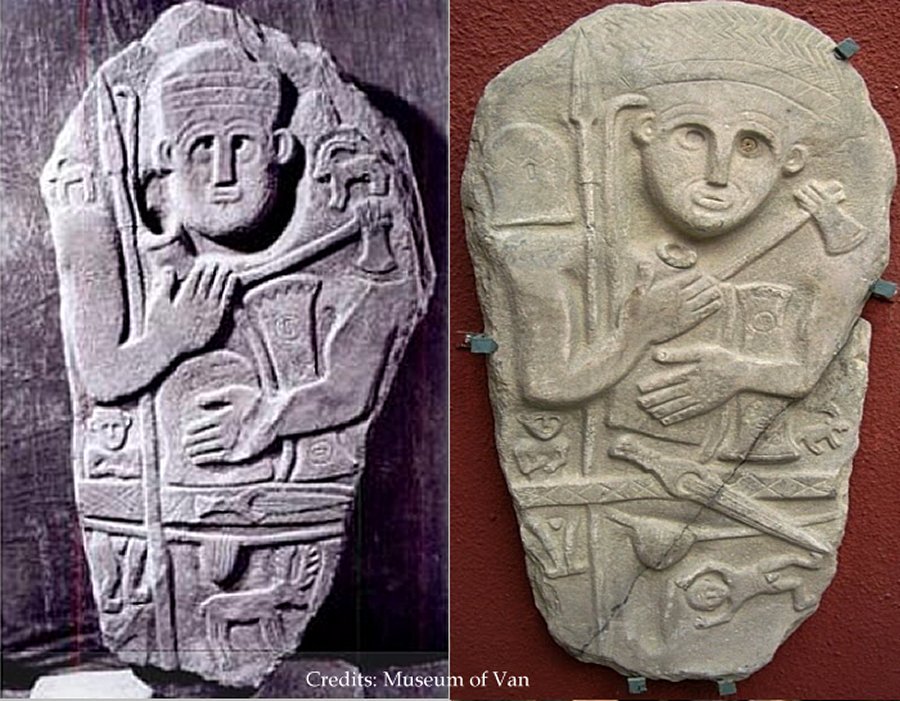
The fascinating cut stone figures are hewn in high relief and vary in size from 70 cm to 3.1 m.
In the third year of his reign, Salmanasar III again entered the territory of Hubushka, where he stormed the fortress of Shilaya, thus, Hubushkia again became the target of this king's war expedition in 844 BC. in 829 and 828 BC.
Several military expeditions against the Land of Hubushkia were conducted on behalf of King Dayan-Ashur, commander-in-chief of the Assyrian army (turtan). In both cases, these expeditions ended with a tribute to the Assyrians by Datana, King of Hubushkia.
Adad-nirari III (810-783 BC), the grandson of Salmanasar III, conducted four campaigns of war against the Land of Hubushkia, in 801, 791, 785 and 784 BC. in 715 BC. Janzu, King of Hubushkia, sent a tribute to Sargon II (722-705 BC) during his expedition against Urartu.
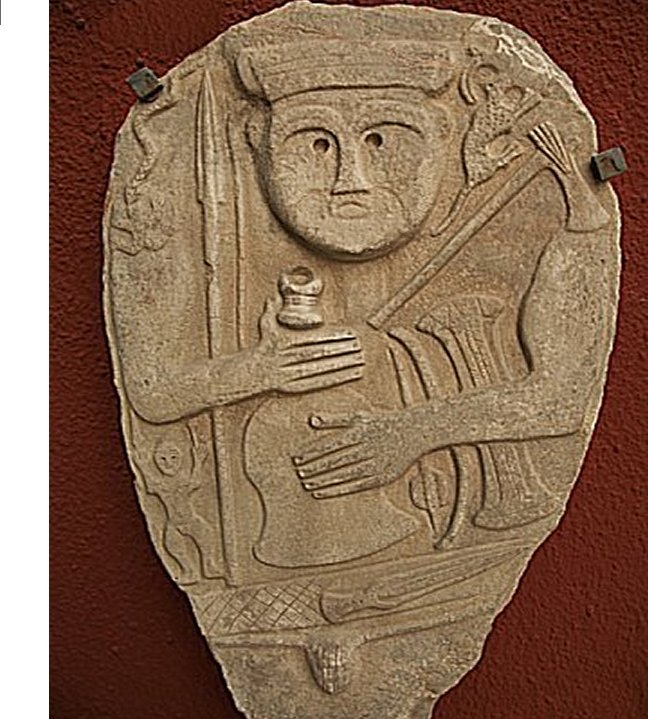
The artifacts, which are now on display in Van Museum, were discovered accidentally by a resident of the southeastern Turkish town of Hakkari at the base of a steep crag crowned by an Ottoman castle.
Were these stone stelae erected to venerate the dead? They could be tombstones depicting warriors or other important people that lived in the Kingdom of Hubushkia.
They portray human figures in cluttered compositions amidst an array of motifs and objects – weapons, other human figures, reptiles, deer, snakes, and other wild animals.
The figures are primarily men (only two stelae contain female figures without arms), are shown front-on, and stare emotionlessly with round penetrating eyes at the observer. They have long noses and small, closed mouths, and around each of their waists is a belt from which hangs a dagger. Most of these enigmatic figures wear a cap and hold an object tightly in their hands.
Researchers believe that these anonymous stelae were carved by ancient people who inhabited Hubushkia. These stelae had never been previously discovered in Eastern Anatolia and dated back to the fifteenth century BC.
Written by – A. Sutherland - AncientPages.com Senior Staff Writer
Updated on September 30, 2022
Copyright © AncientPages.com All rights reserved. This material may not be published, broadcast, rewritten or redistributed in whole or part without the express written permission of AncientPages.com
Expand for referencesReferences:
Sagona,Zimansky, Ancient Turkey
Shigeo Yamada, The Construction of the Assyrian Empire
More From Ancient Pages
-
 The Invisible Plant Technology Of The Prehistoric Philippines
-
 6,000-Year-Old Village Unearthed In Kurdestan
-
 Mystery Of A 5,000-Year-Old Mass Grave In Poland Reveals A Family Tragedy
-
 A 4,500-Year-Old Collective Tomb In France Reveals Its Secret – The Final Stage In The Formation Of The ‘European Genome’
-
 Viking Ship Burial Detected By Georadar In Norway
-
 Ouroboros – Cosmic Serpent And The Self-Devourer – Universal, Powerful Symbol Of Great Antiquity
-
 King Menelaus Of Sparta: Husband Of Helen Of Troy And Key Figure In The Trojan War
-
 Search For A Viking Cemetery Near Truso Settlement In Janow, Poland – Continues
-
 Secret Archaeological Excavations Have Led To The Discovery Of An Extremely Rare Ancient Roman Gold Treasure In Parc Hosingen, Luxembourg
-
 Who Has Stolen Charles Darwin’s Notebooks Worth Millions From The University Of Cambridge?
-
 How The Handbook ‘Hammer Of Witches’ And Then-Existing Networks Inspired Europe’s Witch Craze
-
 Unique Artifacts Reveal The Ancient City Of Troy Is Much Older Than Previously Thought
-
 3-D Reconstructions Of Three Wooden Boats Found At Ancient Port In Italy
-
 North America’s New Snake Species Deepen Our Understanding Of Reptile Social Behavior And Development
-
 On This Day In History: Roman Emperor Caligula Was Born – On August 31, 12 AD
-
 Great Viking Fortresses Built By King Harald Bluetooth
-
 Vikings’ Legacy Is Still Alive In Ireland – DNA, Ancient Ruins And Modern Cites Reveal
-
 First Carbon-Based Paleolithic Paintings Found In Font-De-Gaume Cave, France Could Be 19,000 Years Old
-
 Mystery Of The Man Whose Supernatural Abilities Still Captivate Scientists
-
 DNA From Mysterious Hominin In China Suggests Native Americans’ East Asian Roots

