
Obeah: Who Were The Feared Shadow Killers Of Jamaica?
Ellen Lloyd - AncientPges.com - It is said that some hundred years ago, the people of Jamaica believed in the powers of so-called “Shadow Killers.”
These were witches, wizards who spread terror by practicing black magic. Is there any truth behind these stories, or are we simply dealing with superstition? Do some modern people really still believe in the power of spells and black magic?
Are there any interesting historical accounts and ancient history facts that can help us shed more light on the mysterious “Shadow Killers”? Why is the practice of Obeah forbidden?
Who Are The Obeah – Shadow Killers?
The so-called “Shadow Killers” were men and women who became known as Obeah.
The term 'obeah' was first encountered in documents from the early 18th century, and the history of Obeah is similar to that of Voodoo in Haiti and Santeria in Latin America. African slaves brought spiritual practices to the Caribbean that included folk healing and belief in magic.
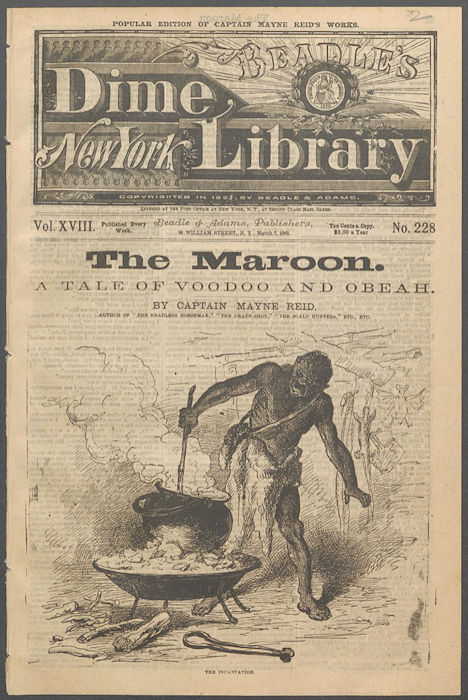
Captain Mayne Reid, The maroon, A tale of vodoo and obeah - Publication date 1862. Credit: Public Domain
It is from these arrivals and their spiritualisms that Obeah originates. Obeah is perhaps the oldest of all Afro-Creole religions in the Caribbean. Its name is derived from the Ashanti words Obay-ifo or Obeye, meaning wizard or witch.
According to Margarite Fernandez-Omos and Lizbeth Paravisini-Gerbert, authors of the book Creole Religions of the Caribbean: An Introduction from Vodou and Santeria to Obeah and Espiritismo, Obeah “is not a religion so much as a system of beliefs rooted in Creole notions of spirituality, which acknowledges the existence and power of the supernatural world.”
Why Is Practicing Obeah Illegal?
Jamaica is a highly religious country. Christianity dominates nearly every aspect of life, and according to the Church, the practice of Obeah is associated with evil. Until recently, the practice of Obeah was punishable by flogging or imprisonment, among other penalties.
But how did the Obeah become known as “Shadow Killers”?
Stories tell that Obeah men and women used to practice black magic in secret. They undertook assignments on behalf of others to deliberately hurt another person. What made many people especially afraid of the Obeah were the rumors that they could kill people by capturing their shadows.
These rumors are most likely the result of a conflict between Myal and Obeah.
Myal is a variation of Obeah that is practiced in Jamaica.
The Myal men positioned themselves as the "good" opponents to "evil" Obeah. They claimed that Obeah men stole people's shadows, and they set themselves up as the helpers of those who wished to have their shadows restore. After 1760, it became punishable by death for slaves to practice Obeah in Jamaica, and the rest of the British colonies followed suit.
The story can be traced to the Tacky Rebellion's in 1760, when a man named Tacky led a revolt by Koromantyn slaves.
It was said that he gave the slaves a “magical preparation that was supposed to render them invulnerable to the weapons of the authorities.”
The law's passage was meant to safeguard against the practice of Obeah, which the colonizers though could lead to further revolts.
In court documents from 1760, it is written that Obeah practitioner's blood, feathers, teeth from dogs and alligators, broken bottles, snakes, roosters, soil, eggs, and eggshells for evil magical purposes.
In 1824, there were about 150 Obeah men and women throughout Jamaica, but the numbers have not been officially confirmed.
Obeah men and women were feared, but also popular, at least to some extent and they played an important role in the lives of slaves who had no human rights. Slaves who had been mistreated turned to an Obeah to seek justice and revenge.
Obeah was considered bad magic, but for many people, it seemed to empower them to shape their existence by manipulating the spirits, both benevolent and malevolent.
It should be added that most people on Jamaica, both free as well as slaves distanced themselves from the Obeah people.
Practicing Obeah resulted in the expulsion of the social community. The situation was different on other islands, such as Barbados and Leeward Islands, where Obeah was admired and held a high status.
The practice of Obeah is forbidden in Jamaica, but there are still those who refuse to give up their belief in the power of magic. Although few people believe in Obeah in the cities, there are some modern Obeah men and women who say they can help with all manner of things, from curing illness to removing curses.
Over the years, the popularity of Obeah has waned, and finding Obeah men and women to reveal what they do is rare.
People who use Obeahs’ services rarely want to talk openly about it, and it looks as if the old Obeah traditions are slowly fading away.
Updated on January 26, 2024
Written by - Ellen Lloyd – AncientPages.com
Copyright © AncientPages.com All rights reserved. This material may not be published, broadcast, rewritten or redistributed in whole or part without the express written permission of AncientPages.com
Expand for referencesMore From Ancient Pages
-
 Kahina – The Prophetic Berber Queen Who Resisted The Muslim Invasions Of The Numidia Kingdom
-
 Burial Of Queen Of Emma Of Normandy Discovered In Winchester Castle
-
 Unexplained 17th Century Encounters With A Malevolent Entity That Defy Rational Explanation
-
 Mysterious Disappearance Of Philip Christoph Königsmarck – Where Is The Swedish Count Buried?
-
 Tuatha De Danann: Mythical Race Of God-Like Beings With Supernatural Abilities In Celtic Mythology
-
 The Rise And Fall Of The Sasanian Empire
-
 Yet Another Beautiful Roman Mosaic In Hatay, Turkey
-
 Secrets Of The Jungle And Hidden Ancient Treasures Of The Serpent People
-
 Hiding Tunnel Complex Dated To The Bar Kokhba Revolt Revealed Near The Sea of Galilee
-
 Axum: Mysterious Megalithic Towering Obelisks In Ethiopia
-
 Anglo-Saxon Previously Unknown Monastic Or Trading Center – Discovered
-
 Sumerians Built A Huge ‘Anti-Drought Machine’ To Save Ancient City Of Girsu From Destruction
-
 2,000-Year-Old Fountain In Kibyra, The City Of Gladiators Flows Again
-
 Ancient Skeletons Reveal Britain Suffered From Parasite Infections Since The Bronze Age
-
 1,500-Year-Old “Church of the Glorious Martyr” With Beautiful Mosaic Unearthed Near Jerusalem
-
 Has The Mystery Of The 11,000-Year-Old Amazonian Rock Art Been Solved?
-
 Unsolved Mystery Of The Aleppo Codex And Its Missing Pages: One Of The World’s Most Precious Ancient Books
-
 Jars With 2,600-Year-Old Vanilla Remnants Discovered In The City Of David
-
 On This Day In History: King Henry VII’s Coronation Was Held – On Oct 30, 1485
-
 Remarkable 5,000-Year-Old Crystal Dagger Discovered In Megalithic Tomb Of Montelirio Tholos

