
Saturnalia Feasts In Roman Empire
A. Sutherland - AncientPages.com - The Romans had many days of religious significance and some of these lasted only a few hours, while others – such as the festival of Saturnalia – could last for almost an entire week and later even more.
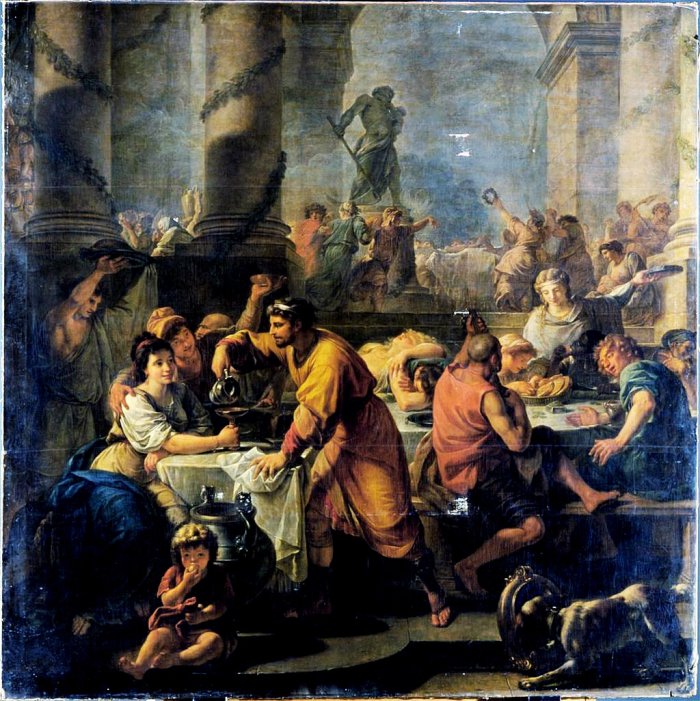
Saturnalia by Antoine Callet. Image credit: - source - CC0 1.0
The Roman calendar included a large number of public holidays, called feriae that increased in number as time went on.
One popular Roman holiday was the Saturnalia held during the winter solstice.
Saturnalia feasts were established in honor of the god Saturn who was a god of agriculture. The holiday included the day of Saturn – the god of seeds and sowing – which was the Saturnalia itself. The holiday began as a farmers’ festival to mark the end of autumn planting and at first, it was held just after the last wheat crop of the year was sown.
Eventually, the Romans settled on December 17 as the date to celebrate the Saturnalia.
Later, the 17th was given over to the Opalia, a feast day dedicated to Saturn’s wife and the goddess of abundance and the fruits of the earth.
Associated with heaven (Saturn) and Earth (Opalia), the Saturnalia ended up combined, according to Macrobius, a Roman Latin grammarian and philosopher, who flourished in AD 400 and whose most important work is the “Saturnalia”, a compendium of ancient Roman religious and antiquarian lore.
The third one, was a feast day celebrating the shortest day, called the bruma by the Romans. The Brumalia coincided with the solstice, on 21 or 22 December.

Ave, Caesar! Io, Saturnalia! Sir Lawrence Alma-Tadema - 1880 Akron Art Museum (United States) Painting - oil on panel. Image credit: - source - Public Domain
Thus, the holiday became a seven-day-long festival for the Roman people. Later, the emperor Augustus who ruled from 27 BC-AD 14, shortened the Saturnalia to a three-day holiday, as it was causing chaos in the people’s working days.
It worked for some time but Caligula who ruled AD 37–41, extended it again to a five-day holiday. By the time of Macrobius, the Saturnalia was an almost two-week holiday.
The first Saturnalia was in 497BC when the Temple of Saturn in Rome was dedicated. As with so many Roman traditions, the origins of the Saturnalia are lost to the mists of time.
Some of the Saturnalia days included private rituals of worship, but more common were religious rites performed by state officials at mass ceremonies, accompanied by public entertainments held as a part of the religious observances.
The official component of the Saturnalia was on December 17, when the senators performed a mass animal sacrifice at the temple of Saturn, and afterward, there was a huge banquet to which everyone was invited. The rest of the week, the people participated in nonstop parties and feasts. All shops, schools, and other important institutions were closed.
In "Daily Life In The Roman City", Gregory S. Aldrete writes that "normal moral restraints were loosened and everyone was expected to engage in all forms of revelry and fun. This was the only time of year when people were legally allowed to gamble in public. Bands of revelers ran through the streets drinking and shouting "lo Saturnalia..."
Written by - A. Sutherland - AncientPAges.com Senior Staff Writer
Copyright © AncientPages.com All rights reserved. This material may not be published, broadcast, rewritten or redistributed in whole or part without the express written permission of AncientPages.com
Expand for referencesMore From Ancient Pages
-
 Codebreakers Crack Secrets Of The Lost Letters Of Mary, Queen Of Scots
-
 Chonchon ‘Tue Tue’ Bird With Human Head Brought Bad Omens To Places It Haunted In Beliefs Of Mapuche Indians
-
 Legendary Pirate Black Sam And His Ship Discovered Off The Coast Of Cape Cod
-
 What Was Eaten In Old Dongola – Capital Of The Kingdom Of Makuria?
-
 Could Doggerland Be Europe’s True ‘North Atlantis’ Of Stone Age?
-
 Terahertz Imaging Reveals Hidden Inscription On Early Modern Funerary Cross
-
 Hippocrates Didn’t Write The Oath, So Why Is He The Father Of Medicine?
-
 Subterranean Kingdom Of Shahmaran And The Land Of The Snakes
-
 Intrepid Southern Voyage In The Wake Of Early Waka
-
 Treasure Of 1,753 Roman Silver Coins Accidentally Discovered In Poland
-
 World’s Oldest Recorded Solar Eclipse Re-Writes History Of Egyptian Pharaohs
-
 Why Was Ayllu Very Important For The Inca People?
-
 Nova Anglia: The Anglo-Saxon New England In The East
-
 Massive Menhir Champ Dolent Built By Fairies In Ancient Beliefs Of Brittany’s People
-
 Jedek: Previously Unidentified Language Found By Swedish Linguists In in Southeast Asia
-
 Unsolved Enigma Of The Lost Ancient City In The Kalahari Desert
-
 Intact 1,000-Year-Old Sword With A Viking And Christian Symbol Found In Dutch River
-
 Massive trophy skull rack discovered in the Aztec ruins
-
 Impressive Study Highlights Female-Led Migration Into Bronze Age Orkney And Wins Prestigious Award For 2023
-
 Mysterious People Who Appeared Out Of Nowhere

