
The Thunder Stone: World’s Largest Monolith Moved By Man
Jan Bartek - AncientPages.com - The Thunder Stone is the world’s largest monolith ever to be moved by man. It gained its name from an ancient local legend that thunder split a piece of the stone.
The monolith was discovered at Lakhta, 6 km (3.7 mi) inland from the Gulf of Finland in 1768.
The stone was moved from Finland to St. Petersburg, Russia, to serve as a pedestal for the Bronze Horseman, the equestrian statue of Peter the Great.
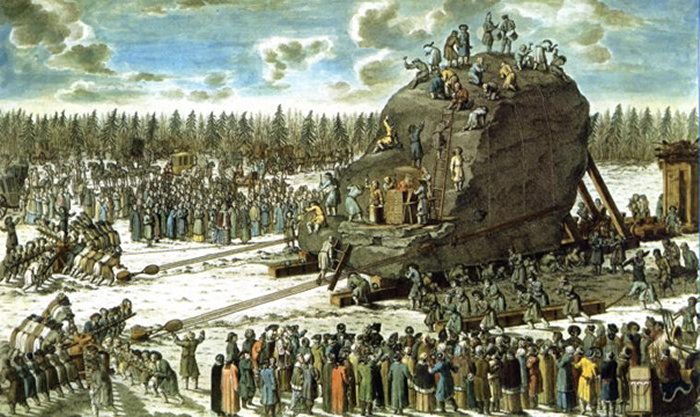
The Transportation of the Thunder-stone in the Presence of Catherine II; Engraving by I. F. Schley of the drawing by Yury Felten, 1770
Catherine the Great, a German princess who married into the Romanov line, wished to connect herself to Peter the Great to gain legitimacy in the eyes of the people. She ordered, therefore, ordered the construction of the Bronze Horseman. It was her way of showing her admiration for her predecessor and her view of her own place in the line of great Russian rulers.
Today, the statue is one of the symbols of Saint Petersburg, in much the same way that the Statue of Liberty is a symbol of New York City.
It is said that the Thunder Stone was moved by manpower, rollers, and capstans. Later it was transported by barge up the Neva River to St. Petersburg. Moving the stone required 400 men and took nine months, during which time master stonecutters continuously shaped the enormous granite monolith.

The Bronze Horseman statue of Peter the Great. Credit: Godot13 - CC BY-SA 3.0
The workers made over 150 m of progress a day while on level ground. Upon arrival at the sea, an enormous barge was constructed exclusively for the Thunder Stone. The vessel had to be supported on either side by two full-size warships.
After a short voyage, the stone reached its destination in 1770 after nearly two years of work. A medal was issued to commemorate its arrival, with the legend "Close to Daring". The stone's dimensions before being cut were 7 × 14 × 9 m. Based on the density of granite, its weight was determined to be around 1500 tons.
The entire effort is considered a historic feat of engineering!
Written by Jan Bartek - AncientPages.com Staff
Expand for referencesReferences:
Wikipedia
More From Ancient Pages
-
 Ancient Astronomical Symbols At Göbekli Tepe Confirm A Comet Swarm Struck The Earth 11,000 B.C.
-
 Petronella Oortman And Her Giant Dolls’ House
-
 Fascinating Time Capsule With Secret Code Found In North Carolina
-
 More Than A Meteorite: New Clues About The Demise Of Dinosaurs
-
 How An Old Norse Poem Changed Biblical Studies
-
 T. Rex’s Direct Ancestor Crossed The Bering Strait From Asia To North America 70 Million Years Ago
-
 Sarcophagus Of Pharaoh Ramesses II Found In Abydos, Egypt
-
 Unexpected Discovery Of Roman Baths Under Split City Museum In Croatia
-
 82 Mysterious 3,000-Year-Old Pits Discovered In Sweden – Bronze Age Cooking Pits And Ancient Ceremonial Center?
-
 1,900-year-old ‘water law’ unearthed in Laodicea
-
 Impressive 9,000-Year-Old Stone Mask Uncovered In Southern Hebron Hills, Israel
-
 Earliest Version Of Our Alphabet Possibly Discovered
-
 Unique Ancient Structure With Mysterious V-Shaped Carvings, Wine Press And More Discovered In The City Of David, Jerusalem
-
 Limestone Stela Of Liberation Discovered In Kom Ombo Temple In Aswan, Egypt
-
 Seven Times People Discovered The Americas And How They Got There
-
 2,000-Year-Old Historical Tombs Unearthed In Close Vicinity To Ancient City Of Laodicea
-
 Emerald Production In Eastern Desert Of Roman Egypt – New Evidence
-
 Surprising And Fascinating Finds On The Wreck Of The Lootsi Cog
-
 Wupatki Ruins And Sacred Sunset Crater Of Ancestral Puebloans In Arizona
-
 On This Day In History: Louis Braille – Creator Of Alphabet For Blind People Died – On Jan 6, 1852

