
Why Is A Snake Symbol Of Medicine And Pharmacies?
Ellen Lloyd - AncientPages.com - The snake has been used as a symbol by pharmacies and doctors for a very long time. The serpent is a symbol of medicine and through the iconography of pharmaceutical history, snakes appear wrapped around a staff or a bowl.
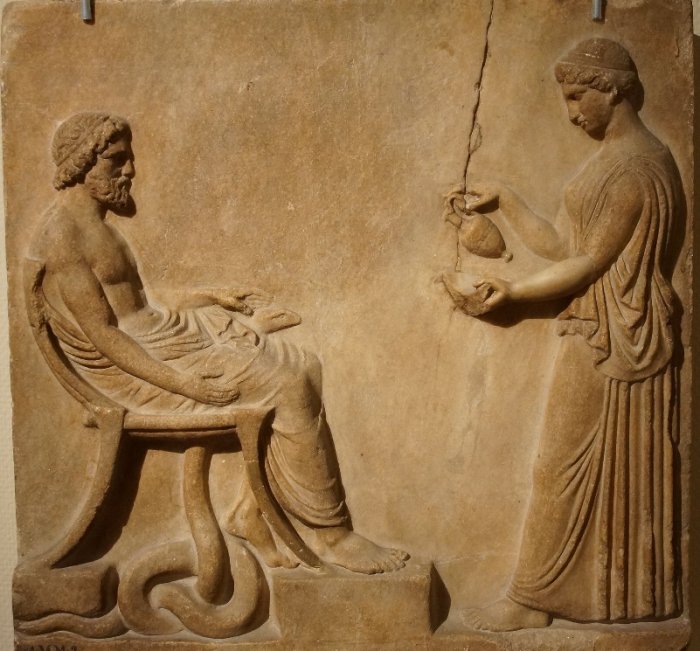 Asclepius and Hygieia. Asclepius with his staff is accompanied by his daughter Hygieia, who pays homage to him by offering wine as a libation from a bowl. Marble, Italy, 1st century AD. Image credit: NearEMPTiness - CC BY-SA 4.0
There are various types of snakes used as medicine symbols. Modern pharmaceutical signs have a long history going back to ancient Greece.
Rod Of Asclepius – Symbol Of Medicine
According to the Greek myths, Asclepius, the Greek God of medicine learned the art of healing from both his father Apollo and the centaur Cheiron. In time, he became so skilled in surgery and the use of drugs that he was revered as the founder of medicine. A major sanctuary was dedicated to him at Epidaurus, the place where he was born.
It was believed that Asclepios had the power to rise from the dead.
Legend tells that Zeus was worried that Aesculapius would make mankind immortal because of his healing power. Out of fear, he killed Aesculapius with a lightning bolt. Temples were built for Aesculapius, and seemingly dead serpents were found inside.
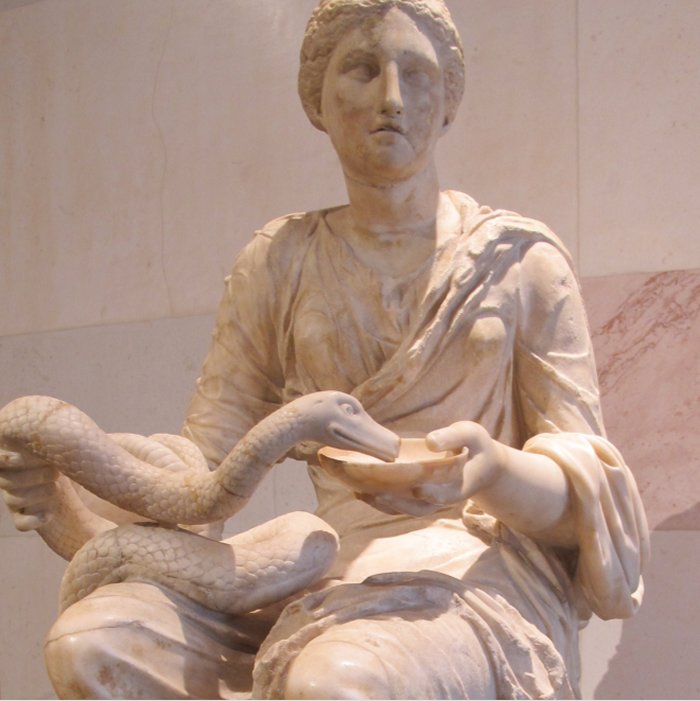 Goddess of good health, cleanliness, and sanitation. 1st century Roman statue of the goddess.
Image credit: I, Sailko - CC BY-SA 3.0
When these serpents were picked up and dropped, however, they slithered away. To people, this was interpreted as that the serpents were brought back to life by the healing powers of Aesculapius, which ultimately caused them to be associated with healing. Tame snakes were kept in his temples as this animal was regarded as a symbol of regeneration.
From about 300 B.C. onwards, the cult of Asclepius grew very popular and pilgrims flocked to his healing temples (Asclepieia) to be cured of their ills. Sacred Asclepion of Pergamum was an ancient healing center and the world's first psychiatric hospital.
The Rod of Asclepius, also known as the Staff of Asclepius, a serpent-entwined rod wielded by the Greek god Asclepius is today associated with medicine and health care. It’s the symbol of medicine, but it’s often confused with the staff of the god Hermes, the caduceus.
Bowl Of Hygieia
Hygieia, Goddess of Health hygiene who was the daughter of Asclepius tended to his temples. Her symbol became a bowl containing a medicinal potion, with the serpent of Wisdom drinking from it. She is a goddess of health, healing, and hygiene.
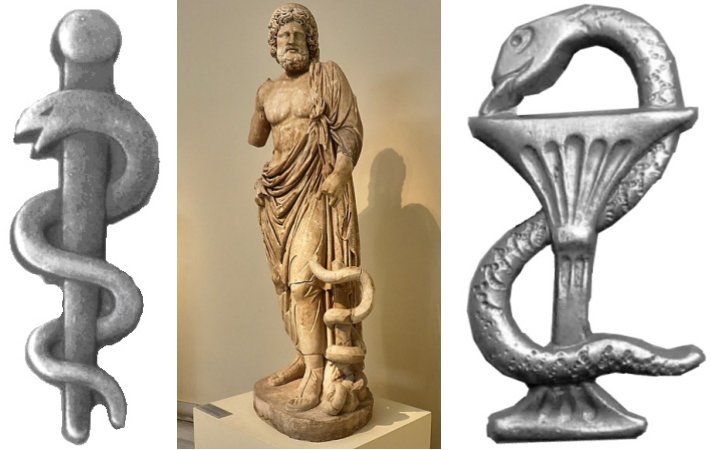
Left: Rod of Asclepius. Credit: Piotrus - Public Domain - Middle: Statue of Asclepius. Credit: George E. Koronaios - CC BY-SA 4.0 - Right: Bowl Of Hygieia - Piotrus - Public Domain
The Bowl of Hygieia has become an international emblem representing pharmacies. Hygieia, one of the daughters of Asklepios (Asclepius) and granddaughter of Apollo, played an important role in the cult of Asklepios as a giver of health.
Modern people associate the snake with poison, but the animal had a powerful symbolic meaning to our ancestors. Snakes have been used for worship, magic potions and, medicine, and they have been the symbol of love, health, disease, medicine, pharmacy, immortality, death, and even wisdom since ancient times.
The story of the Serpent People and their guidance is known worldwide for as long as anyone can remember. Collectively, they were all known as the Serpents of Wisdom and their great contribution to the global development of our planet can never be erased. So, it’s not surprising that the serpent was worshipped in many corners of the world.
Updated on June 23, 2021
Written by - Ellen Lloyd – AncientPages.com
Copyright © AncientPages.com All rights reserved. This material may not be published, broadcast, rewritten or redistributed in whole or part without the express written permission of AncientPages.com
More From Ancient Pages
-
 Magnificent Reconstruction Of Scotland’s Largest Pictish Fort Burghead
-
 Stunning Ancient Roman Artifacts And Three Shipwrecks Discovered Underwater Off The Coast Off Alexandria, Egypt
-
 Invasion Of Mysterious Sea People – Enigmatic 3,200-Year-Old Luwian Hieroglyphic Inscription Sheds New Light On Ancient Puzzle
-
 Cosquer Cave And Its Magnificent Underwater Stone Age Paintings Created 27,000 Years Ago
-
 Remarkable Marble Fragment From The Temple Of Zeus In Akragas Found Underwater Off The Coast Of Sicily
-
 Secret Archaeological Excavations Have Led To The Discovery Of An Extremely Rare Ancient Roman Gold Treasure In Parc Hosingen, Luxembourg
-
 Secret Ancient Knowledge Of The Toltecs Examined
-
 Power Of Water In Beliefs Of Ancient Cultures
-
 Those Who Mysteriously Disappeared To A World Beyond Human Understanding
-
 300 BC Mummy Shroud Fragment In NZ Finds Match In US
-
 Zyndram’s Hill: Oldest-Known Stone Wall – A Masterpiece Of Architecture Found In Poland
-
 Rare Medieval Seal Matrix Found By 10-Year-Old Boy In UK
-
 Acta Diurna: World’s First Newspaper Appeared In 131 B.C
-
 Mystery Of The Artificial Cave And Ancient Encounters With Short People With Strange Feet
-
 Mystery Of The Amazing 2,500-Year-Old Underwater Rochelongue Treasure
-
 Can Diseases Explain Why Neanderthals Suddenly Disappeared About 40,000 Years Ago?
-
 Oral Stories Of Australia’s First Nations Might Be 10,000 Years Old – Evidence Found
-
 Forbidden Antediluvian Egyptian Secrets Revealed By Initiated Masters Show Most We Know About Egypt Is Wrong
-
 Remarkable Discovery Of Unusual “Hammer Of Thor” Finally Solves An Ancient Mystery
-
 Secrets Of A Lake That Could Re-Write Ancient History Of America – Interesting Artifacts And Buildings – Part 2

