
Vimanas Of The Rama Empire: Flying Machines Dominated Ancient Skies In Distant Past
A. Sutherland - AncientPages.com - Sanskrit texts are filled with references to gods and battles they fought in the sky, using powerful Vimanas equipped with the most sophisticated deadly weapons.
Once upon a time, there were present (permanently or temporarily) several races on Earth. Some of them fought for dominance over our planet.

The Indian yogi Swami Vivekananda and Nikola Tesla
Stories of these encounters were continuously transmitted orally from one generation to another until they were finally written down through the centuries.
Today we can read about them in sacred epics such as "Ramayana", "Mahabharata", "Bhagavata Purana" and others.
At the end of the 19th century, the Indian yogi Swami Vivekananda was the first to demonstrate Vedic religion and philosophy in the United States and Europe. He had met with great scientific minds such as Edison, Lord Kelvin, and brilliant scientist Nikola Tesla. Tesla was deeply inspired by Vivekananda's concepts and the knowledge he obtained from Indian Vedas.
He was also fascinated with Vedic cosmology and its concepts and understood that they perfectly complemented already existing western theories.
However, Tesla failed to "show the identity of energy and matter… The mathematical proof of the principle did come until about ten years later when Albert Einstein published his paper on relativity. What had been known in the East for the last 5,000 years was then known to the West…" (Tesla Memorial Society of New York).

Vedic texts say that the "aerial car" - we know as Vimana - could move like a UFO, in any way the pilot wanted - up, down, forward, or backward. It was shaped like a sphere and borne along at great speed on a powerful wind generated by mercury that apparently played an important role in propelling the 'heavenly chariots" frequently described in ancient Sanskrit texts.
In his book "The Anti-Gravity Handbook" David H. Childress mentions yet another Indian source, the Samar and says that "Vimanas were "iron machines, well-knit, and smooth, with a charge of mercury that shot out of the back in the form of a roaring flame".
It is "possible that mercury did have something to do with the guidance system and the propulsion system of the Vimanas? Could the Soviet discovery of "age-old instruments used in navigating cosmic vehicles" in distant caves of Turkestan and the Gobi Desert, prove the significance of mercury in the Vimana'systems?
These mysterious instruments were described as hemispherical objects of glass or porcelain, ending in a cone with a drop of mercury inside.
Rediscovered in a temple in India in 1875, the "Vaimanika Sastra" (a 4th century BC) is Sanskrit text on aerospace technology.
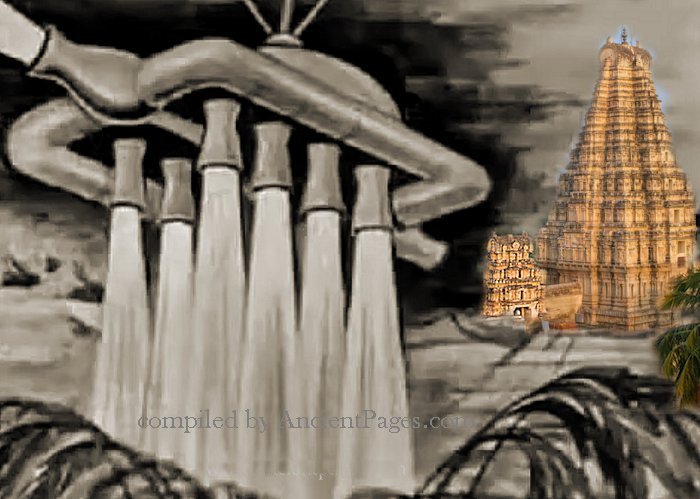
Bharadwaja the Wise compiled information about the Vimanas from at least eighty earlier texts and Vedic epics for his book "Vaimanika Sastra". Scholars who found the work in 1918 in the Barbuda Royal Sanskrit Library north of Bombay, India, have verified the authenticity of Bharadwaja's work as well as the manuscripts he consulted when he assembled it.
The work includes detailed descriptions of flying vehicles for civil aviation and warfare, two- and three-decker planes, cargo-carrying aircraft, and passenger planes used for the transportation of 400 to 500 people.
It also includes construction details (31 essential parts of these vehicles and 16 materials from which they are constructed, which absorb light and heat, instructions for pilots, accurate dimensions, and descriptions of what type of metal and other materials would be most suitable for construction of aircraft, including apparatuses that could neither catch on fire nor break.
Bharadwaja the Wise refers to no less than 70 authorities and 10 experts of air travel in antiquity; unfortunately, these sources are today lost.
It is highly doubtful that any poet, even the most brilliant one, could create this kind of "high-tech fairytales" with precise descriptions of powerful weapons and advanced vehicles.
On the other hand, it is likely that the later writers on Vimanas, wrote as observers and from much earlier texts, and were understandably confused on the principle of their propulsion or other technical details.
Powerful Vimanas, both gigantic and smaller ones designed for just one passenger, are described in these texts. Next to them, there are descriptions of "flying cities", moving in space and almost self-sufficient. These "cities" - gigantic objects rotating around their own axis - were spacious and richly decorated. Such cosmic cities had special gates for arriving craft and were constantly orbiting Earth.
Also, the "Samaranganasutradhara" describes how the vehicles were constructed. The work, which gives us insights into the ancient Indian technological knowledge, has one of its eighty-three long chapters, devoted to various mechanical devices and explains the construction of bird-shaped aerial cars; it also has some verses dealing with the robots meant to act as guards.
Written by – A. Sutherland AncientPages.com Staff Writer
Copyright © AncientPages.com All rights reserved. This material may not be published, broadcast, rewritten or redistributed in whole or part without the express written permission of AncientPages.com
Expand for referencesChildress, David H. The Anti-Gravity Handbook
Tesla Memorial Society of New York
S. Andrews, Lemuria and Atlantis
Childress, David H. Technology of the Gods
More From Ancient Pages
-
 Huge Mass Grave With Remains Of Pirate Black Sam’s Crew Discovered In North America
-
 2,000-Year-Old Lavatory In Turkey’s Denizli Province Will Be Restored
-
 Ancient People Handled Sun Exposure Better Than Modern People – An Anthropologist Explains Why
-
 The Seal Of Solomon, The Fifth Element And The Andromeda Constellation Reveal An Intriguing Connection
-
 Ancient Mystery Of Acra Citadel – Solved
-
 Rare Collection Of Roman Coins Unearthed In Ancient City Of Aizanoi, Turkey
-
 Codex Gigas – The Devil’s Bible – Ancient Secrets Of The World’s Largest Book
-
 Ancient Secrets Of Iberian Warrior Vase – 2,000-Year-Old Masterpiece Of Art
-
 Neanderthals Had Capacity To Speak And Understand Language Like Humans
-
 Archaeological Evidence Amazon Warrior Women Did Exist Found At Nakhchivan Necropolis, Azerbaijan
-
 Extraordinary Find: The Oldest Neanderthal DNA Of Central-Eastern Europe
-
 Magnificent Ancient Egyptian Gold And Soapstone Jewelry Discovered At Tell El-Amarna Necropolis
-
 Unique More Than 1,600-Year-Old Board Game With Pieces Recovered From Roman Soldier’s Tomb
-
 Unexpected Discovery Of Rare Ancient Roman Carved Wooden Figure In Buckinghamshire
-
 Ancient Textile Mystery: King Canute Enshrined In His Own Clothes But Found In His Brother’s
-
 Amazon Forest Communities Disappeared Long Before 1492 Arrival Of Europeans
-
 How Far South Did Prehistoric Highly Skilled Polynesian Seafarers Sail?
-
 Ancient Stone Monoliths In Ethiopia Are 1,000 Years Older Than Previously Thought
-
 Evolution Of Paleodiet At Neolithic Qujialing Site Unveiled By Scientists
-
 Dispute Between Russia And Poland Over Discovery Of Czarist Officer’s Corpse In Turkey

