
Ancient Byblos: Powerful Phoenician City With Own Kings
A. Sutherland - AncientPages.com - According to the Amarna Letters and the annals of Thutmose III, Byblos ('Papyrus' in Greek) was dependent and subservient to Egypt for hundreds of years.

Carved limestone sarcophagus of Ahiram, a king of Byblos, bearing a Phoenician inscription, 10th century BC; Credits: National Museum of Lebanon, Beirut via Britannica
However, these ancient texts do not indicate that this Phoenician city remained wealthy during this period.
Most of the ancient Phoenician cities were located along the coastline of today's modern countries of Israel and Lebanon.
The primary Phoenician cities were Byblos, located the farthest to the north along this coastline, Tyre at the south end, and Sidon between the two.
Early in Phoenician history, Byblos was the most important of the three cities. The oldest known historical mention of the town is on the ancient Egyptian "Palermo Stone," dated to the reign of the Fourth Dynasty Egyptian king Snefru.
 St. John-Mark Church, Byblos. source
Founded as Gebal by the Phoenicians, Byblos is believed to have been continuously occupied between 8800 and 7000 BC. It's among the oldest cities in the world, located about 35 kilometers (23 miles) north of the capital Beirut in modern-day Lebanon.
The modern port city of Byblos is built upon multiple layers of ancient ruins.
It was given its name by the Greeks, who imported papyrus from the city, which has a history of diverse cultures closely related to the Mediterranean for millennia.
It began as a small fishing village called Gubal (or Gebal), while the coastal region of the land, which the Greeks named Phoenicia, was known to the inhabitants as Canaan.
By 3000 BC, Byblos became a prosperous city through trade and the most crucial timber shipping port to Egypt and elsewhere.
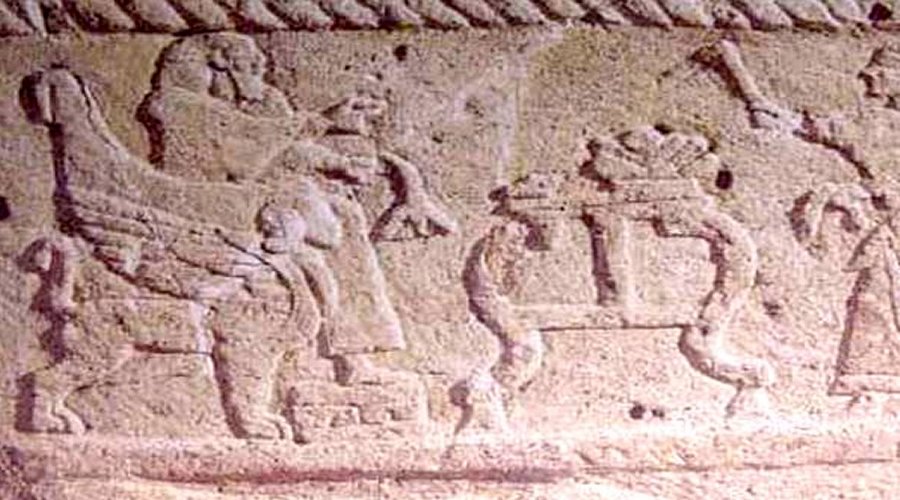 Bas relief is from his sarcophagus. The Cherubim have been identified as Winged Sphinxes (p. 127. Sabatino Moscati. The Phoenicians. Gruppo Editoriale Fabbri Bompiani, Sonzono, Etas S.p.A. Milan. March 1988
Byblos was also the first city to perfect shipbuilding, and it is primarily due to the craftsmanship of the shipwrights of the town that Phoenicians acquired their fame as sailors and "princes of the sea" (as they are referred to in the biblical book of Ezekiel).
It was also when the most significant powers of the ancient New East, such as the Hittites, Babylon, and Egypt, dominated the region. They divided smaller kingdoms amongst themselves. Byblos and most of Phoenicia fell under Egyptian control.
Archaeological evidence shows that ancient Byblos was a walled city with both a land and a sea gateway during Egyptian domination. Byblos' planning was relatively advanced for the time.
Byblos streets were built concentrically to the town center, and canals carried rain and drainage water away. Many funerary offerings indicate that the inhabitants of Byblos prospered financially and materially despite their subordination to Egypt.
Historians believe that it was possible mainly due to trade with the Egyptians. Egypt delivered gold, papyrus, alabaster, and linen to Phoenicia. The Phoenicians had cedar and other wood for shipbuilding, tomb construction, and funerary ritual, which the Old Kingdom's pharaohs needed.
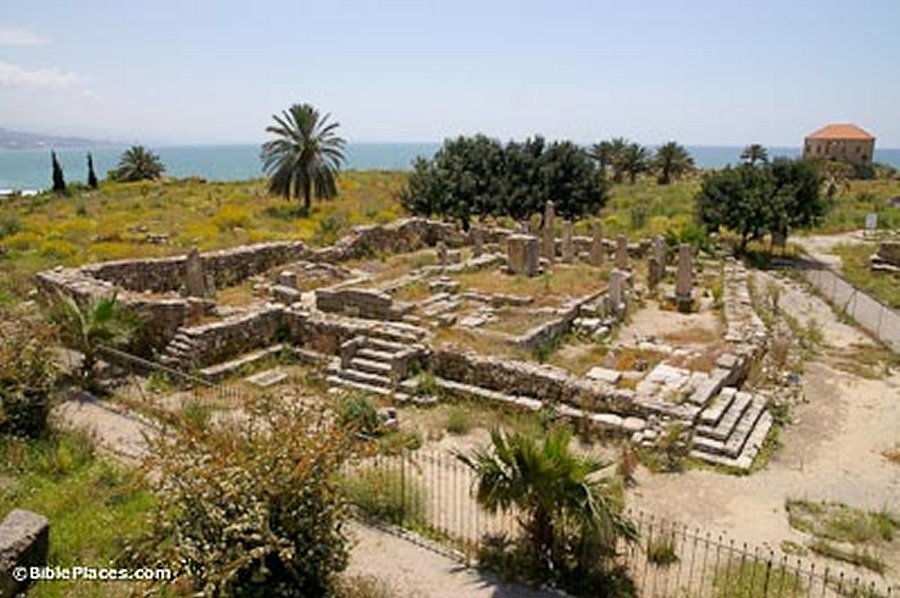 The Obelisk temple is named after the nearly 30 obelisks discovered standing in the temple’s courtyard.
The Phoenicians then developed their alphabet of 22 characters, which replaced cuneiform in written communication. Through trade routes, the Phoenician alphabet traveled first to Greece around 800 BC and then spread to other countries through Greek merchants.
Between 1100 and 725 BC, Byblos declined in importance, but later it began to prosper again.
This city has a turbulent history of at least 6,000 years, full of interactions with various cultures, which left the Bronze Age's monumental temples, the Persian fortifications, the Roman road, Byzantine churches, the Crusade citadel, and the Medieval and Ottoman town.
Under Arab rule beginning in 637 AD, Byblos started to decline in wealth and importance. The great port was virtually ignored for centuries; thus, the city became an easy target for invading Crusaders in 1098 AD. Once the Crusaders left, the Muslim rulers neglected the town until it was utterly forgotten for centuries.
In 1860 AD, thanks to the French historian Ernest Renan, the ancient site was rediscovered, and continuous excavations took place between 1925 and 1975.
This city has a turbulent history of at least 6,000 years, full of interactions with various cultures, which left the Bronze Age's monumental temples, the Persian fortifications, the Roman road, Byzantine churches, the Crusade citadel, and the Medieval and Ottoman town.
Under Arab rule beginning in 637 AD, Byblos started to decline in wealth and importance. The great port was virtually ignored for centuries; thus, the city became an easy target for invading Crusaders in 1098 AD. Once the Crusaders were driven out, the Muslim rulers neglected the town until it was forgotten for centuries.
In 1860 AD, thanks to the French historian Ernest Renan, the ancient site was rediscovered, and continuous excavations were organized from 1925 to 1975.
Written by – A. Sutherland AncientPages.com Staff Writer
Updated on December 30, 2023
Copyright © AncientPages.com All rights reserved. This material may not be published, broadcast, rewritten or redistributed in whole or part without the express written permission of AncientPages.com
Expand for referencesReferences:
M. De Lafayette, Phoenicia, Ur, and Carthage: Artifacts, Inscriptions, Slabs, Sites
Bob E.J.H. Becking, L. Grabbe, Between Evidence and Ideology
More From Ancient Pages
-
 Ancient Inventions Of Firefighting Vehicles
-
 Silver Offers Evidence Viking Age Started Much Earlier Than Previously Thought – Archaeologist Says
-
 Rare Bronze Seal Matrix Of St. George Slaying The Dragon Discovered In French Castle
-
 On This Day In History: Ensisheim Meteorite Fell To Earth – On Nov 7, 1492
-
 Well-Preserved Warring States Period Swords And Cultural Relics Discovered In Xiangyang, Hubei
-
 Oldest Fossil Human Footprints In North America Confirmed
-
 Remains at Crenshaw Site Are Local, Ancestors Of Caddo – New Study
-
 DNA From 3,800-Year-Old Individuals Sheds New Light On Bronze Age Families
-
 On This Day In History: Peter The Great Defeats Charles XII Of Sweden At The Battle Of Poltava – On June 28, 1709
-
 Mystery Of Moses’ Double Mask, Dramatic Personality Change And The Hidden Prophet – What Did Really Happen On Mount Sinai?
-
 Rare Roman Mosaic Depicting The Adventures Of Greek Hero Achilles Discovered In Rutland, UK
-
 William The Conqueror: Ruthless And Powerful Ruler Who Changed Britain Forever
-
 What Is The Codex Mendoza?
-
 Mystery Of Biblical Noah’s Strange Connection With Red-Skinned Giants And The Watchers – Celestial Secrets – Part 2
-
 Unique Sword Discovered In Mysterious Pre-Viking Tomb In Uppsala, Sweden
-
 Unraveling The Mystery Of A Lost Biblical Underground World – Is A Precious Ancient Artifact The Answer?
-
 Ancient Egyptian Monuments Threatened By Climate Change Restored By Oriental Institute
-
 Uncovering The Lost Indigenous Settlement Of Sarabay, Florida
-
 Ship-Shaped Burial Of Tjelvar – Legendary First Man Who Brought Fire To Gotland
-
 Neolithic Farmers Invented Methods To Fight Pests 8,000 Years Ago

