
Horrible Ancient Massacre On The Island Of Chios Led To Greek Independence
Ellen Lloyd - AncientPages.com - In April 1822, a horrible massacre took place on the Greek island of Chios. The awful event shocked several European countries and forced ancient superpowers to help Greece become independent.
During the Greek War of Independence, also known as the Greek Revolution, against the Ottoman Empire, 120,000 inhabitants of the island of Chios suffered tremendous brutality. They were killed, forced to flee, or sold as slaves. Only 900 inhabitants survived the Turkish massacre.
The island of Chios was part of the Ottoman Empire since about 1450. Living conditions were not only poor, but the Greeks were constantly humiliated by the Turks. Greek rebellions were quickly and forcefully terminated; many people had little hope they would ever become free from the Turks.

Portrait of sultan Mahmud II, given by Mustafa Resid Pasha to king Louis-Philippe of France, now at the Musée de Versailles. Credit: Public Domain
The most frightening event in the history of Chios occurred in 1822 when the Turkish Sultan Mahmud II (1785-1839) gave the order to kill all men over 12, all women over 40, and all children younger than 2 years.
Thousands of Turkish soldiers brutally killed men, raped women, and slaughtered babies with their swords.
Domestic animals were killed, houses were set on fire, and churches plundered. Inhabitants of the island of Chios paid the highest possible price for the Greeks’ rebellion against the Turks.
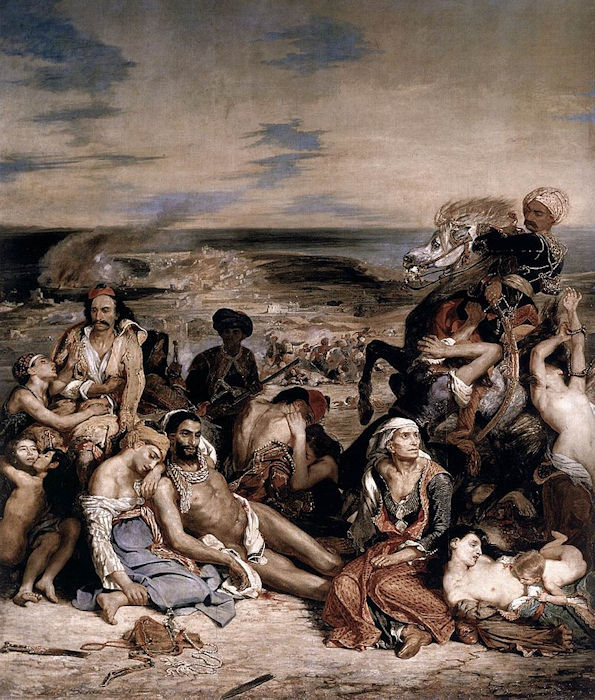
Soldiers of the Ottman Empire had no mercy when they massacred people on the island of Chios. The Massacre at Chios by Eugène Delacroix. Louvre, Paris. Credit: Public Domain
The Greeks fought bravely for their independence and gained control over vital cities like Corinth, Athen, and Thebes. Commercial ships were rebuilt into warships. All that was necessary to fight against the Turks was done. But the small island of Chios was doomed. It was located just outside the Turkish coast, and Greek rebellions could never arrive on time to save the island’s inhabitants.
Ironically, Chios’ inhabitants never wanted to participate in the Greek rebellion. People on the island asked several times to be left out outside the conflict. In fact, they even preferred to obey the Turkish Sultan than risk living in insecurity. To the Greeks, Chios showed cowardness.
One month before the devastating massacre, a fleet of 4,000 Greek soldiers arrived on the island of Chios. They managed to convince a few of the local farmers to join them in their rebellion, but most inhabitants were frightened and locked themselves in their homes. The Greek rebellions launched an attack against the fortress of Chios, but the Turks quickly terminated their military advances. When the rebellions realized there stood no chance against the Turks, they plundered local houses, stealing jewelry, expensive clothes, and anything of value before leaving Chios to return to Samos.

Chios had 120,000 inhabitants. Only 900 survived the Turkish massacre. Anavatos abandoned village. Credit: Heidi Broome-Raines - CC BY-SA 4.0
When news of the events reached, the Turkish Sultan Mahmud II hell broke out. The Sultan felt betrayed by the Greeks on Chios even if only one thousand people had participated in the rebellion and ordered the island's destruction.
For three months, the Turks killed people on Chios. About 52,000 people were taken as slaves, 25,000 were killed, 15,000 died of their wounds or committed suicide, and 23,000 managed to escape in small boats. Only 1,800 people managed to survive the massacre by hiding, but half of them died of hunger and illness.
The Danish consul of Chios helped people to escape but was later killed by the Turks who caught him. The English consul, on either hand, asked to be paid so he could arrange a safe escape route. It was a big lie. Instead of helping, he betrayed people and handed them over to the Turks.
In June 1822, Chios was nothing but ruins. The Greeks responded by destroying the flagship of Ali Pasha which carried 2,286 people. Most of them were Turkish soldiers and sailors, but many Chios women and children had been taken as prisoners.
Not long after the Chios massacre, the Turkish Sultan realized he had committed a mistake and lost the valuable financial asset the island had provided him.
He offered people who had fled the island to return to Chios, but few did so.
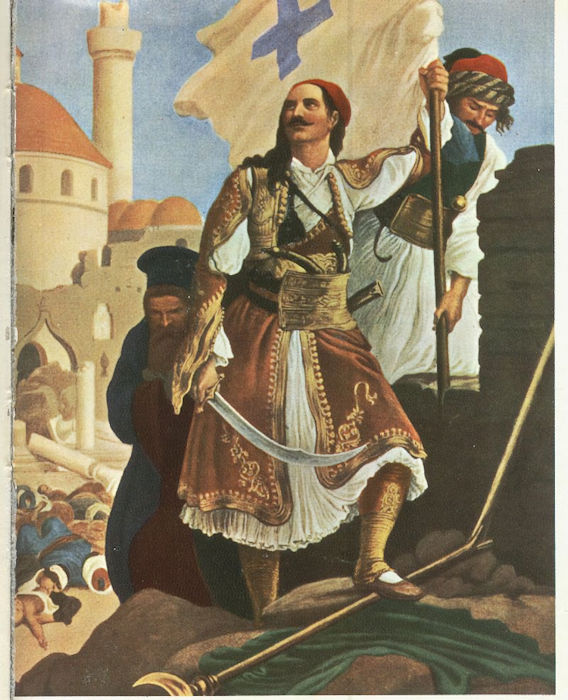
"Commander Kephalas plants the flag of Liberty upon the walls of Tripolizza" (Siege of Tripolitsa) by Peter von Hess. Credit: Public Domain
Many European countries felt sorry for Greece and wanted to support the Greek War of Independence, but England and France were reluctant as they feared a weak Ottoman Empire would tempt Russia to take control over the country and get access to the Mediterranean Sea.
In 1827, the Christian superpowers agreed to send a fleet to Greece, surprising the Turks. At the Peloponnese, a large peninsula linked to the northern territory of Greece by the Isthmus of Corinth 50 out of 70 Turkish ships were destroyed. The Turkish fleet never recovered from this defeat. Next year, the Ottoman Empire was forced to sign a new state that would be created along the line extending from south of Volos to south of Árta. Prince Otto of Bavaria accepted the crown, and the Turkish Sultan recognized Greek independence. This was the Treaty of Constantinople in July 1832.
Updated on March 26, 2024
Written by - Ellen Lloyd – AncientPages.com
Copyright © AncientPages.com All rights reserved. This material may not be published, broadcast, rewritten or redistributed in whole or part without the express written permission of AncientPages.com
Expand for referencesReferences:
Expand for referencesHelen Long - Greek Fire: The Massacres of Chios
John Boardman - Chios: A Conference at the Homereion in Chios, 1984
More From Ancient Pages
-
 On This Day In History: Battle Of Langside Was Fought – On May 13, 1568
-
 Huge Mitchell’s Log Reveals When The North American City Cahokia Experienced Political And Economic Zenith
-
 Ancient Human Remains A The Sima De Los Huesos Site Investigated
-
 1,600-Year-Old Estate Of Wealthy Samaritan With A Rare Greek Inscription – Discovered
-
 Cruithne: Legendary King, His Seven Sons And The First Celtic Tribe That Inhabited British Isles
-
 Ethical Ancient DNA Research Must Involve Descendant Communities – Researchers Say
-
 Little People: Ancient Race That Pre-Dates Native Americans, Celts, And Other Settlers Worldwide
-
 Saint Botvid – Viking Who Was Killed By A Slave He Granted Freedom
-
 Huge 40-Meter Long 16th Century Tunnel For Looting Was Exposed Inside Tower Tomb
-
 Rare Discovery Of 8,500-Year-Old Human Teeth Used As Jewelry
-
 On This Day In History: Independence Of Greece Is Recognized By The Treaty Of London – On May 7, 1832
-
 Unusual Ancient Skull Found In Chan Hol Underwater Cave Reveals Early American Settlers Were Morphologically Different
-
 Sirius Mystery – Scientific Evidence Of Alien Contact 5,000 Years Ago – Book Review
-
 Viking Grave Discovered In The Middle Of Oslo, Norway
-
 Eating And Social Habits Of People In The Balearic Islands 3,000 Years Ago – Reconstructed
-
 Strange 1,200-Year-Old Anglo-Saxon Artifact Used For Unknown Purpose Found In Norfolk, UK
-
 Strange Case Of The ‘Impossible’ Glove Remains Unexplained – The Investigation – Part 2
-
 Yggdrasil: Eternal And Sacred Tree Of Life In Norse Mythology
-
 Vishnu: Supreme, Universal Hindu God Whose Avatars Reach Nations, Cultures And Races
-
 During Tough Times Ancient ‘Tourists’ Sought Solace In Florida Oyster Feasts

