
Old Kingdom Of Alashiya And City Of Enkomi With Roots On The Island Of Cyprus
A. Sutherland - AncientPages.com - Ancient city of Enkomi flourished in the Late Bronze Age and was possibly the capital of Alashiya (Alasia), a Late Bronze Age country and kingdom located in the eastern part of the Mediterranean region, commonly identified with either Cyprus as a whole or the city of Enkomi by itself, located between the Levant and Anatolia.

Bronze statuette of a male figure wearing a conical cap with horns, known as 'The Horned God' (or 'Apollo Cereates). From Enkomi, Late Bronze Age, 1200-1150., Cyprus Museum, Nicosia
The earliest references to Alashiya are in texts from the Hittite capital Hattusa, but also in texts written in Egyptian, Hittite, Akkadian, Mycenean (Linear B), Ugaritic. Also, some of the Amarna Letters deal with copper trade affairs because Alashiya had rich copper resources.
The ancient city of Enkomi - an important trading center for copper, which was smelted at the site - certainly profited from trade with neighboring countries, which delivered silver, ivory, and other luxury goods in return for copper.
Enkomi manufactured finished bronze objects for sale and was the source of unworked copper shaped like an oxide - the form, in which copper was transported - incomplete vessels, the waste left over from the casting process, smelting, and leftovers from smith's tools.

Excavations carried out at various sites have revealed a large-scale metallurgical activity in Enkomi and several other sites in Cyprus increased during the Late Bronze Age (1650-1050 BC).
Also, the correspondence between the pharaoh and the king of Alashiyia took place, which confirmed by several letters inscribed in the cuneiform script in Akkadian on baked clay tablets. These tablets were unearthed in the palace of Akhenaten at Tell el Amarna in Upper Egypt and date from the second quarter of the 14th century BC.
Ancient history records of Alashiya and the city of Enkomi are very rich. In the 14th century, it was an ally of Egypt and an enemy of the Hittites.
During the 13th century BC, Enkomi was inhabited by Greeks, like most of the cities of Cyprus.
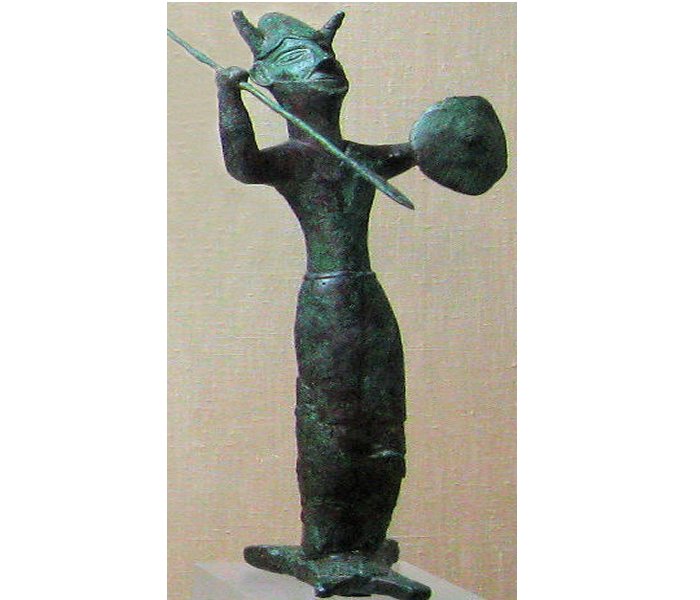
Bronze "Ingot God", Enkomi 12th century BC, Cyprus Museum
In about 1200 BC, Enkomi was - together with Greece, the Aegean, Anatolia, and Syria - overrun by the so-called 'Sea People'. (Enkomi was attacked two times by the Sea People who burned the city.)
After an earthquake ca. 1050 BC, the site was abandoned. Most of the ruins surviving to the present day belong to the city, which was rebuilt after the destruction of 1200 BC. This new city had straight streets which cut each other at right angles.
Among noteworthy finds from Enkomi are diverse inscriptions and the so-called "horned god", a bronze statuette dated to the early 12th century BC, depicting a deity wearing a horned helmet.
The most impressive religious structure revealed during the excavations is the Sanctuary of the Horned God. The solid statue of the Horned God (a young man wearing a helmet with two horns) was found in one of the rooms and is 54.2 cm high. The sanctuary consists of a large rectangular hall with an altar and offering table.
Another well-known statue is the "ingot god", a statue wearing a horned conical hat and greaves, armed with shield and spear, and standing on a miniature hide-shaped ingot.
Today Enkomi (once the important Bronze Age city) is a small village near Famagusta in Cyprus. The history of this ancient place dates back several millennia.
Written by – A. Sutherland AncientPages.com Staff Writer
Copyright © AncientPages.com All rights reserved. This material may not be published, broadcast, rewritten or redistributed in whole or part without the express written permission of AncientPages.com
Expand for referencesReferences:
C. Gates, Ancient Cities: The Archaeology of Urban Life in the Ancient Near East
More From Ancient Pages
-
 Mystery Of The Anglo-Saxon Burial At Lowbury Hill May Soon Be Solved
-
 Vijayanagara King Bukkaraya’s Earliest Inscription Discovered
-
 Marble 2th Century AD Statuette Of Goddess Cybele Unearthed In Bulgaria’s Plovdiv
-
 Årsgång – Year Walk In The Forest – Mystical Journey To Gain Knowledge About The Future – An Ancient Swedish Ritual
-
 Ankou: Breton Angel Of Death That Delivers Souls To The Underworld
-
 10 Norse Gods Who Vikings Gained Strength From
-
 Trajan’s Column – A Roman Triumphal Column In Ancient Rome
-
 7,000-Year-Old Unique Lipnik Idol Statuette Unearthed In Moravian Gate Valley, Czech Republic
-
 Troublesome Ancient History Of Forks That Were Long A Shocking Sensation
-
 Spectacular Square-Headed Creature And 143 New Nazca Geoglyphs – Discovered
-
 Catacombs Of Kom El Shoqafa – Largest Roman Burial Site In Egypt
-
 Mysterious Ancient People Who Mastered Thought-Transmission Through Space And Spoke At Distance
-
 Tombs Rich In Artifacts Discovered By Swedish Expedition In Cyprus
-
 Mini Sphinxes, Huge Baboon Statue And Blocks From Khufu’s Reign Discovered In Heliopolis
-
 DNA Study Of Ancient Humans Sheds Light On Human Evolution On The Tibetan Plateau
-
 Dian Cécht – Celtic Healer Who Cured Many But Killed His Own Son Of Professional Envy
-
 Temple Dedicated To Goddess Nemesis Discovered Under Ancient Theater In Greece
-
 LIDAR Discovery Of Valley Of Lost Cities In The Amazon
-
 Controversial Ancient Tomb Could Prove The Existence Of Biblical Jonah
-
 Forbidden Antediluvian Egyptian Secrets Revealed By Initiated Masters Show Most We Know About Egypt Is Wrong

