
Kuthodaw Pagoda – ‘The World’s Largest Book’ Carved In 729 Marble Slabs
A. Sutherland - AncientPages.com - Kuthodaw Pagoda is an amazing complex known as the ‘World's Largest Book’ and is located in Mandalay, Burma (Myanmar).
It was constructed during the reign of King Mindon (1808 – 1878), one of the most popular and revered kings of Burma. At the same time, the nearby Royal Palace was also built.
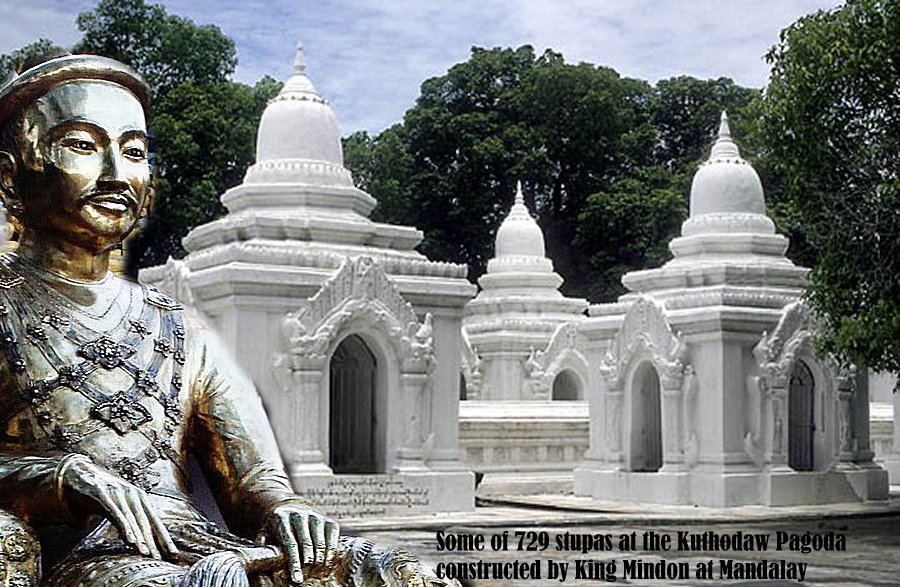
It comprises a gilded stupa, 188 feet (57 m) high: its four corners are decorated with four large golden Chinthe, mythological lions, that guard the pagoda. The structure is surrounded by hundreds of sacred stone shrines housing 729 marble slabs inscribed with Buddhist teachings.
These slabs are inscribed on both sides with a page of text from the Tipitaka – the Buddhist scriptures composed during the period from c. 500 BC to about the start of the Common Era.

This marvelous pagoda was built during the reign of King Mindon as part of the foundations of the then royal city of Mandalay in 1857.
The carving the Tipitaka text in hundreds of stone tablets took eight years, from 1860 to 1868. The 730th carved tablet was placed at the southeast corner and records the history of these 729 tablets. Neatly arranged in rows and housed by little white Buddhist stupas later built, these 729 marble tablets with the text of Tipitaka are considered “the biggest book in the world”.
See also:
Legend Of Ancient Princess Thone Pan Hla Who Is Believed To Haunt Pyay In Myanmar
Mireuksa Pagoda: Largest And One Of The Oldest Of Korean Pagodas
Ruins Of The Mysterious Kingdom Of Guge That Suddenly Vanished Overnight
Each marble slab measuring 153 centimeters tall and 107 centimeters wide is enshrined in a cave. The texts were copied from ancient manuscripts written on dried palm leaf, the letters chiseled out of the stone and inlaid with gold leaf.
It is said that one will need 450 days to finish reading all these tablet inscriptions if he reads eight hours a day. The masterwork was created for future generations of modern scholars in Buddhism and pilgrims.

Kuthodaw Pagoda's carved slabs. Each marble slab measuring 153 centimeters tall and 107 centimeters wide is enshrined in a cave. The texts were copied from ancient manuscripts written on dried palm leaf, the letters chiseled out of the stone and inlaid with gold leaf.
The main entrance to the pagoda – a gold and red South gate - is decorated with sculptures depicting deities and animals from Hindu and Buddhist mythology. Mural paintings dated to the 19th century) adorn its walls. At the end of the corridor is a pavilion enshrining an image of the Buddha. The compound of Kuthodaw Pagoda is surrounded in three square city walls, which were equipped with grand teak doors richly decorated with statues of lions and crocodiles.
On top of a pole in front of the pagoda is Garuda, a bird from Buddhist and Hindu mythology) grasping a Naga serpent.
The marble carved slabs were once very beautiful.
When the tablets were revealed in 1868, each line of writing had been filled with golden ink and the stones were decorated with precious stones including rubies and diamonds.
Unfortunately after the British invaded in the mid-1880s, the troops looted the temple site, stripping the slabs of their gold ink and gems.
Written by – A. Sutherland AncientPages.com Staff Writer
Copyright © AncientPages.com All rights reserved. This material may not be published, broadcast, rewritten or redistributed in whole or part without the express written permission of AncientPages.com
Expand for referencesJ. Powers, The Buddhist World
More From Ancient Pages
-
 Ratatoskr- Inhabitant Of Yggdrasil That Loves Intrigue, Strife And Gossips In Norse Beliefs
-
 Cryptic Ice Age Markings In European Caves Deciphered – Proto-Writing Discovered By Amateur Archaeologist
-
 The Cyclades And Their Mysterious Society Lost In Time
-
 On This Day In History: The Battle of Mortimer’s Cross – On Feb 2, 1461
-
 On This Day In History: Copernicus’ s Book Banned By Catholic Church – On Mar 5, 1616
-
 Lavish Home And Exotic Garden Of Emperor Caligula Discovered In Rome
-
 Ogham: Unique Celtic Alphabet Used By Druids And Abandoned During Christian Era
-
 Earliest Systematic Coal Exploitation For Fuel Goes Back To ~3600 B.P.
-
 Largest In Europe Underground Church Of Saint-Jean of Aubeterre Built By 12th Century Benedictine Monks
-
 Archaeologists Found A 16th-Century Shipwreck Of Merchant Ship Close To Saint-Tropez, France
-
 Trove Of Coins Dating Back To The 1100s Found On Visingsö, Sweden
-
 Baby Carriers Were Used 10,000 Years Ago – New Evidence
-
 Decebalus – The Brave One’ – Last Mighty King Of Dacian People
-
 Discovery Of Second Viking Site Point Rosee In North America Could Re-Write Ancient History
-
 Nobel Prize: Svante Pääbo’s Ancient DNA Discoveries Offer Clues As To What Makes Us Human
-
 Gonzalo Guerrero – The Renegade Who Joined The Maya Against His Own People
-
 Zagros Mountains: Home To Tribes, Kingdoms And Empires For Thousands Of Years
-
 Evidence Of 10,000 Years Of Violent Conflict Among The Hunter-Gatherer Societies In The Atacama Desert
-
 Evolution Of Paleodiet At Neolithic Qujialing Site Unveiled By Scientists
-
 Extraordinary Bronze Age Jewelry Hoard Discovered In A Carrot Field In Switzerland

