
Shengavit Of Kura Araxes Culture: One Of Armenia’s Historical Sites Inhabited Since At Least 3200 BC
A. Sutherland - AncientPages.com - One of the most prominent historical sites of Kura Araxes (Uraxes) culture, dating from 3400 BC to 2000 BC, is the Shengavit settlement, located just beyond the suburbs of the city of Yerevan, Armenia.

The Kura-Araxes culture (3400-2000 BCE). Although the Kura-Araxes people were less aggressive and more sedentary, they also underwent a significant expansion, first west to Anatolia, south to the Fertile Crescent, and east toward the Iranian plateau to Pakistan, where they would have influenced the Indus Valley Civilisation.
The area of modern-day Shengavit has been inhabited since at least 3200 BC, probably, late Neolithic 3500-3000 BC). The site was excavated and relatively well studied by archaeologists who revealed findings attributed to many cultures that existed during the very long time from 4,000 to 2,000 BC.
People had developed agriculture, ranching, cattle breeding industry, reprocessed agricultural produce, and possessed equipment for corn milling. The city had unique food storage and depository of wheat, housing 4 tons of crops.

The excavations at the ancient Shengavit revealed a large set of tools and bronze artifacts, which confirm that Shengavit was a town with prospering agriculture and well-developed craft, including spinning looms, bone spindle whorls, looms, seals, marble, and onyx scepters.
People also worked as craftsmen creating pottery and skilled metalworkers. It is believed that copper smelting may have taken place in ancient Shengavit.
The settlement's highly developed architecture included defensive, economic, administrative, residential, and spiritual buildings.

One example is a rectangular semi-subterranean temple-like building, a temple with a low altar with a hole that may have held a wooden figurine and terracotta hearths, and a place for keeping the sacred fire during rituals.

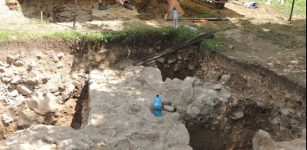
Square M5 room with ritual emplacement and symbols buried near it. Source
The ruins of the city area, located on an irregular-oval platform built on a slope, are approximately 6 ha and are still surrounded by a wall with cyclopean towers constructed of vast and uncut stones from basalt without mortar. Under the northern part of the wall is an underground passage leading directly to the river Hrazdan and on the south side, there are traces of a filled moat.
When Shengavit was a flourishing center, it had the best defensive system.

People lived in round (sometimes rectangular) dwellings about 6 to meters in diameter and built at a distance of 7.3 meters from each other. Still, they were connected with the last wall of the adjacent buildings.
Their walls had a stone base, on which raw brickwork increased. A round, decorated clay fireplace - usually located in the house's center–had an essential economic and ritual role.
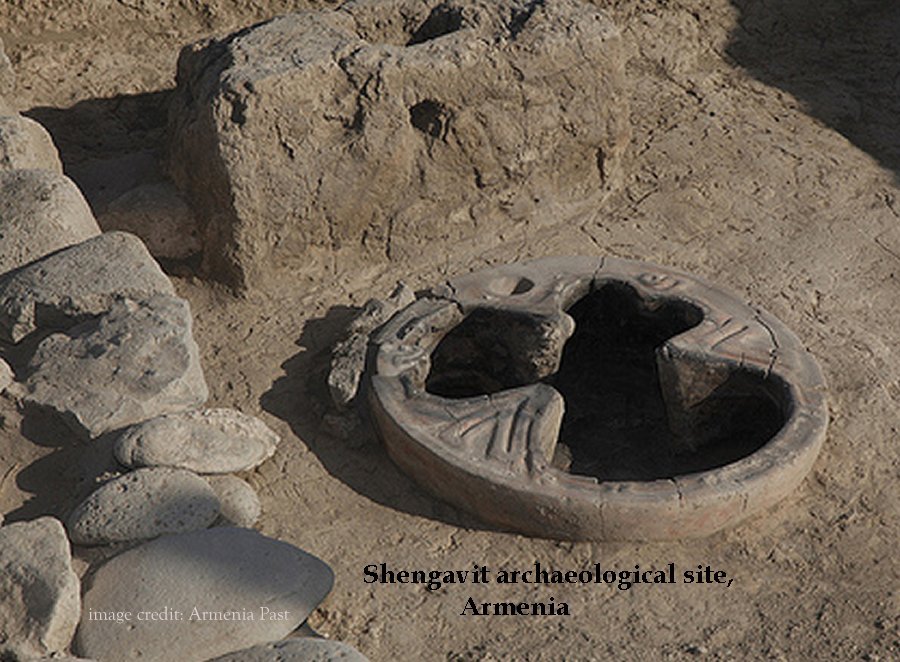
The walls of both round dwellings and rectangular buildings from inside and outside were plastered with clay. The round homes - covered with rubbles - had a corridor entrance opened from the east side.
Shengavit's ancient burial places were found outside the walls of the city. Each unearthed tomb had a place for 10-12 people, burial property, tools, goods, black clay pots, flint and obsidian, copper armlets, earrings, and beads.
According to one theory, Shengavit's burial area was once inside the walled city. Later, for unknown reasons, the city was confined to a smaller place within the walls, and the abandoned area became a burial place dated 3,000 BC.
Written by – A. Sutherland AncientPages.com Staff Writer
Updated on October 29, 2022
Copyright © AncientPages.com All rights reserved. This material may not be published, broadcast, rewritten or redistributed in whole or part without the express written permission of AncientPages.com
Expand for referencesMore From Ancient Pages
-
 1,800-Year-Old Military Medal with Medusa Head Unearthed In Ancient City of Perge (Perrhe), Southeastern Turkey
-
 10 Norse Gods Who Vikings Gained Strength From
-
 On This Day In History: Battle Of The Egadi Islands Took Place – On Mar 10, 241 BC
-
 Controversial Statue Of Anglo-Norman Knight William Marshal In Pembroke Faces Criticism
-
 Skull From Broken Hill, Zambia Is Relatively Young – New Analysis Shows
-
 Unique Ancient Makeup Mixture Based On Black Powder Discovered In The Kani Koter Cemetery
-
 God Of The Gallows And How Odin Hanged Himself From Yggdrasil To Know Secrets Of Runes
-
 Controversial Stone Statues Of Niulang And Zhinyu And The Legend Of The Heavenly Queen And Milky Way
-
 Archaeological Evidence Amazon Warrior Women Did Exist Found At Nakhchivan Necropolis, Azerbaijan
-
 Archaeological Finds Shed New Light On The Paleo Diet Habits Of Ancient Hunter-Gatherers
-
 Jambu Tree In Great Cosmogonic Forest Of Sacred Land Of Jambudvipa In Buddhist Mythology
-
 Does This Ancient Box Contain Buddha’s Cremated Remains?
-
 On This Day In History: The Battle Of Fulford Was Fought – On Sep 20, 1066 AD
-
 Viking Burial Rituals: High Ancient Funeral Pyre Reflected High Social Status
-
 Imhotep: Ancient Genius And Architect Of The Sakkara Pyramid
-
 Bora People Of The Northwest Amazon Use Drums To Speak Over Large Distances
-
 Saqqara Necropolis: Biggest Archaeological Discovery In 2020 – Photos Revealed
-
 On This Day In History: Statue of Liberty Arrived In New York Harbor – On June 17, 1885
-
 18th Century Potter Atmospheric Steam Engine Found In Slovakia
-
 DNA Sheds New Light On The Mysterious Dead Sea Scrolls

