
One-Eyed Giant Polyphemus – Most Famous Of The Cyclops In Greek Mythology
Ellen Lloyd - AncientPages.com - Polyphemus, whose name means "abounding in songs and legends," was a famous one-eyed giant in Greek mythology. He was the son of god Poseidon and Thoosa and the most famous of the Cyclops.
Cyclops were an ancient race of giants with a single eye in the center of their forehead. They were described as builders, blacksmiths, and craftsmen.

Polyphemus is an intriguing but horrible creature mentioned in Homer's Odyssey, probably composed near the end of the 8th Century B.C.
The classical Greek poem describes the Greek hero Odysseus (or Ulysses, as he was known in Roman myths) and his long journey home to Ithaca following the fall of Troy.
Odysseus traveled to distant countries for ten years and encountered remarkable people and creatures. His journey took him through the Ionian Islands and the Peloponnese and as far away as Egypt, North Africa, and the western Mediterranean, as the displeased sea-god Poseidon prevented him from reaching his home.
In Homer’s epic, we learn how Odysseus encountered the one-eyed Polyphemus on his return from Troy. The Greek hero and his men came across a cave and decided to enter it. Inside the cave, they ate and rested until they finally fell asleep.

Amphora painting of Odysseus and his men blinding Polyphemus (Eleusis museum) Credit: Wikipedia
When Polyphemus returned to his cave, he found the intruders and became furious. Odysseus and his friends could not escape because the giant had rolled a huge stone against the mouth of the cave to close the entrance. The furious Cyclops grabbed two of the men and ate them. The next morning, the giant left the cave to graze his sheep. When the giant returned in the evening, he ate two more of the captive men.
Odysseus offered Polyphemus some strong and undiluted wine given to him earlier on his journey. Before passing out, the giant asked Odysseus’ name and was told the Greek hero’s name was “Nobody.”
As Polyphemus was sleeping, the Greek hero took a wooden stake in the fire and drove it into the giant’s eye, making him blind. Polyphemus screamed for help, and the other Cyclops on the island came running. They asked him who had done this to him, and the giant replied, “Nobody.” Hearing this, the other Cyclops all returned home laughing. They thought Polyphemus was afflicted by divine power and recommended prayer as the answer.
In the morning, the blind Cyclops let the sheep out to graze. With his hand, he checked their backs to ensure the men were not escaping. However, Odysseus and his men had tied themselves to the undersides of the animals and managed to get away.

The Blinding of Polyphemus - Pellegrino Tibaldi (1527-1596)
When Odysseus was on his ship, he boastfully revealed his real name. This turned out to be unwise because the one-eyed giant Polyphemus prayed to his father, the sea-god Poseidon, asking for revenge. Poseidon was angry about what had happened to his son. He persecuted Poseidon and persecuted Odysseus at sea, throwing huge rocks toward the ship, which Odysseus barely escaped.
The story of Polyphemus became a favorite of classical poets and sculptors, inspiring a play by Euripides (“The Cyclops”) and appearing in the Aeneid of Virgil.
Ovid also popularized it in his Metamorphoses, but the story has a different ending. Ovid wrote that Polyphemus and Galatea married, and from their offspring were born several “savage” races, including the Celts, the Gauls, and the Illyrians.
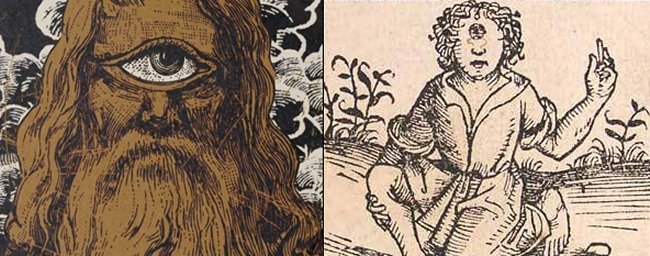
Arimaspians: Mysterious Mighty One-Eyed People From The North
Ancient myths and legends about mysterious one-eyes people are not uncommon. For example, Greek records mention the Arimaspians, a tribe of normal human-sized horsemen with only one eye in the middle of their forehead.
Updated on July 27, 2022
Written by Ellen Lloyd – AncientPages.com
Copyright © AncientPages.com All rights reserved. This material may not be published, broadcast, rewritten or redistributed in whole or part without the express written permission of AncientPages.com
Expand for referencesMore From Ancient Pages
-
 Demon Oni: Cruel Harbinger Of Disease And Misfortune In Japanese Folklore
-
 Genuine Bronze Warrior Statuette Unearthed At Technologically Advanced Celtic Settlement Oppidum Of Manching
-
 Ancient DNA Reveals Missing Link In The History Of Indo-European Languages
-
 Large Bronze Age Stone May Be Europe’s Oldest 3D Map
-
 Ancient Roman Women Wore Bikini In 1400 B.C.
-
 Unexpected Danger Lurks Beneath Ancient Maya Cities – Mercury Pollution Discovered
-
 Hunter-Gatherer Metallurgy In The Early Iron Age Of Northern Fennoscandia Was Integrated And Advanced
-
 Biblical Pool Of Siloam In The City of David To Be Excavated And Opened To The Public
-
 On This Day In History: ‘Sea King’ Ragnar Lodbrok Seizes Paris – On March 28, 845
-
 Ancient Secrets Of Sacred Towers And Stone Circles In Colorado Where Spirits Of Native Americans Still Live
-
 Ancient Maya Reservoirs Contained Toxic Pollution – New Study
-
 Long-Lost Wisconsin Ghost Ship F.J. King Finally Found
-
 Urban Resiliency Lie Within Ancient Cities – New Study Suggests
-
 Mysterious People Who Appeared Out Of Nowhere
-
 Elongated Skulls: Did Intentional And Intriguing Ancient Tradition Originate In China?
-
 800-Year-Old Shipwreck Discovered Off Salento Coast, Italy
-
 Ancient Egyptian Women Had Equal Rights As Men – Egyptian Cosmology And Goddess Maat Reveal Why
-
 Girl’s Ancient Tooth Solves One Of The Biggest Mysteries Of The Denisovans
-
 Stonehenge’s Monumental Altar Stone Came From Scotland – Not Wales As Previously Thought
-
 Paleolithic Inhabitants Of Cyprus Established Settlements Much Earlier Than Previously Estimated

