
Mesha Stele: One Of The Most Valuable Biblical Artifacts
A. Sutherland - AncientPages.com - Mesha Stele, which is also known as the Moabite Stone, is one of the most valuable Biblical artifacts.
It was accidentally discovered among the ruins of Dhiban (Biblical "Dibon," capital of Moab), 20 miles east of the Dead Sea, by a German missionary F. A. Klein in 1868.
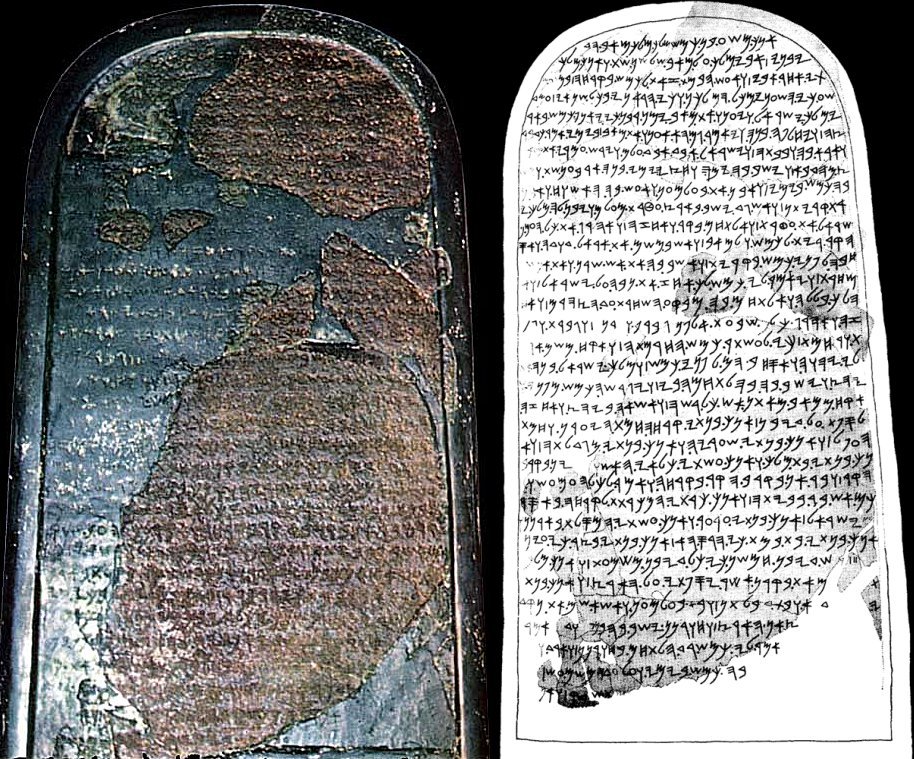
The artifact was discovered in 1868 about 20 miles east of the Dead Sea. What is most amazing is that it mentions "Israel," "Yahweh" and the "House of David." Image: Bible History
The artifact was a bluish basalt stone, about 4 feet high (about 142cm) and 2 feet wide, and 14 inches thick. It was erected and inscribed by Moabite King Mesha.
When it was found the Berlin Museum quickly negotiated for it while the French Consulate at Jerusalem offered more money.
Considered a valuable and spectacular find, the stele became an object of great interest of the Berlin Museum and the French Consulate at Jerusalem. The local Bedouin tribe was in possession of the artifact, but fearing the loss of it, decided to destroy it. They hang it on a rope and repeatedly dipped it in fire and water until it fell apart.
Most of the inscriptions, over thirty verses, were later reconstructed from the recovered fragments and assembled by Charles Clermont Ganneau, a renowned French Orientalist and archaeologist.

King David Enthroned, by Jerry Harston
The inscription has 34 lines, and it is the most extensive inscription ever recovered that refers to ancient Israel. It was written in Paleo-Hebrew alphabet (a variant of the Phoenician alphabet).
Not much is known about King Mesha, one source is the Hebrew Bible and the other is the Mesha Stele saying:
"I am Mesha, son of Chemosh[-yatti], the king of Moab, the Dibonite. My father (had) reigned over Moab for thirty years, and I reigned after my father. And I made this high place for Chemosh in Qarcho … because he has delivered me from all kings, and because he has made me triumph over all my enemies…." and another source is the Hebrew Bible:
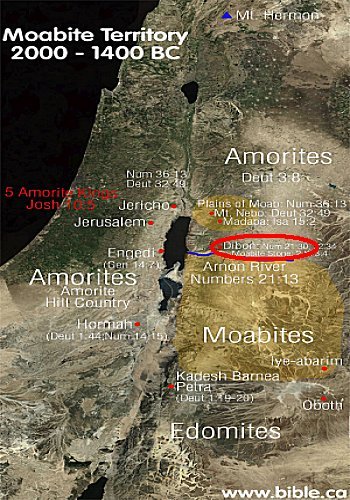
"Now Mesha king of Moab was a sheep breeder, and he regularly paid the king of Israel one hundred thousand lambs and the wool of one hundred thousand rams. But it happened, when Ahab died, that the king of Moab rebelled against the king of Israel." (2 Kings 3:4-27).
The king's name: "Mesha" is based on the Hebrew word "to save", but it has also been suggested that his name may be related to the Hebrew "Moshe" (Moses). While his personality is rather obscure, he left a clear message on to the stone, which gives us a glimpse of historical events, which were important for the Moabite Kingdom.
The text is a reminder of Mesha's heroic struggles with King of Israel, Omri and his son Ahab and how he got freed from the influence of Israel after many years of captivity. As we remember, the Bible gives the Messiah a similar story (2 Kings 3) but it is not clear, however, whether it describes the same battle as the Mesha Stele does.
The inscription also tells that king ordered repairs of the walls, built a palace and water tanks. It was extremely important because of the drought in Moab, (now west-central Jordan), which in Biblical times was the kingdom of the Moabites (14th century BC to 582 BC), who were closely related to the Israelites but frequently in conflict with them.
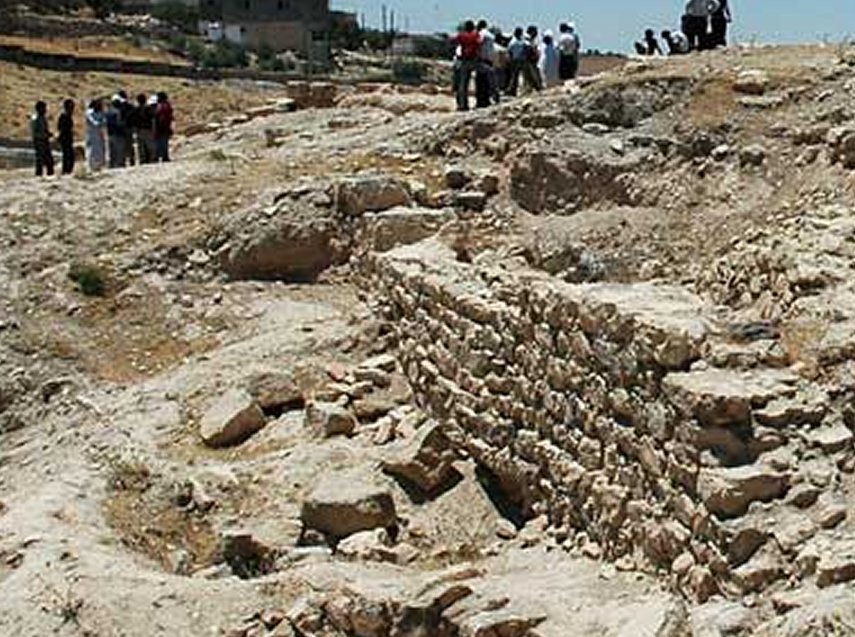
Dibon excavations. Image credit: Bible Places.com
Word: "Israel" is mentioned several times and so is "Yahweh" in verse 18:
"…And from there I took the vessels of Yahweh, and I presented them before the face of Chemosh..."
It appears that king Mesha knew about the Israelite God Yahweh and says he took "the vessels of Yahweh and presented them before the face of Chemosh", the god of the Moabites, according to the Hebrew Bible.
It is the first appearance of the name of the God of Israel in the Moabite language and Phoenician alphabet.
Moreover, line 31 is very significant because it bears the phrase the "House of David".
The existence of King David has been long questioned by scholars. When French scholar Andre Lemaire (who spent seven years studying it) was investigating the inscription, he determined that the same phrase appeared there in line 31. Lemaire was able to identify a previously faint letter as a "d" in the phrase "House of David." This phrase was used commonly in the Old Testament for the Davidic Dynasty, also referred to as the "House of David".
Much more have to be discovered to confirm the existence of the great King David, the founder of the ruling dynasty of Judah, the "House of David". So far he is mentioned in the Mesha Stele and on the pages of the Bible.
Other artifacts would confirm the existence of this historical figure of Biblical times.
The Mesha Stele is now stored in the Louvre of Paris and its copy is in the British Museum in London.
Written by – A. Sutherland - AncientPages.com Senior Staff Writer
Copyright © AncientPages.com All rights reserved. This material may not be published, broadcast, rewritten or redistributed in whole or part without the express written permission of AncientPages.com
Expand for referencesMore From Ancient Pages
-
 Medieval Irish Book Fitting Among Historical Finds Unearthed In Old Cemetery In Norway
-
 Centeotl: Lord Of Maize Who Was Revered Before The Olmecs By All Mesoamerica’s Inhabitants
-
 Skofnung – Formidable Sword With Supernatural Powers That Belonged To Legendary Danish King Hrólf Kraki
-
 Cyclops – First Generation Of Giants Who Were Prisoners Of Tartarus
-
 Unique Headstones Of Kela Mazin Cemetery In Kurdistan Are Probably 3,000 Years Old Or Much More
-
 New Insights Into The Dawn Of The Indo-European Languages
-
 Mystery Of The Stone Of Destiny Solved – It Was Originally A Doorstep!
-
 Giant 2,000-Year-Old Cat Geoglyph Discovered At Nazca In Peru
-
 Dangerous Magnetic Anomaly And Unexplained Events In Mysterious And Dark Valley Trouble Scientists – Why Must The Stone Gate Not Be Crossed?
-
 Ruins Of The Mysterious Kingdom Of Guge That Suddenly Vanished Overnight
-
 Ehecatl: The Snake-Bird Deity And God Of Wind Feared And Respected By The Aztecs
-
 Cooking, Roasting And Eating Of Root Plants Is 120,000-Year-Old Habit
-
 Radar Discovery Of Unknown Viking Age Stone Ship, Burial Mounds And Houses In The Trondheim Fjord
-
 Japan’s Ancient Practice Of Cranial Modification: The Case Of The Hirota People In Tanegashima
-
 Stone Homes Of Europe’s First Megalithic Builders Discovered
-
 Legendary Basilisk With Deadly Petrifying Stare – King Of The Serpents
-
 Child Finds Impressive 1,800-Year-Old Ring Engraved With Goddess Minerva On Mount Carmel, Israel
-
 Did The 8 Omens Of The Aztecs Foretell The End Of Their Civilization?
-
 Location of Roman Ballista Machines During The Siege Of Jerusalem – Uncovered
-
 Ancient Indigenous Carvings On Boab Trees – Time To Rescue Ancient Art Before Trees Disappear

