
Mystery Of Famous Viking Ruler Rollo: DNA Experts Seek The Truth About His Identity
AncientPages.com - Forensic experts from Denmark and Norway have opened a sarcophagus containing the remains of descendants of Viking ruler Rollo in Normandy, France.
DNA studies will hopefully once and for all answer the question: Where did the mighty Viking ruler Rollo come from? The identity of the Viking ruler Rollo is of great historical significance. Historians have not been able to determine whether Viking Rollo was from Denmark or Norway.

Famous Viking Ruler Rollo
The answer will also be important to the British royal family because their family descended from Rollo.
Who Was Viking Ruler Rollo?
Viking Rollo was the founder and first ruler of Normandy, the Count of Rouen and the great-great-great grandfather of William the Conqueror, the first Norman King of England.
There are many famous Vikings whose identity is unknown, one of them is Viking Rollo. He was born in the latter half of the 9th century somewhere in Scandinavia and came from a noble warrior family.
In 876 he led the Viking fleet which besieged Paris and attacked Bayeux and Évreux between 885 and 887. Some historians maintain Rollo became an experienced Viking, visiting Scotland and probably Ireland before he came to France.
Being a very tall man who preferred to walk instead of riding a horse, Rollo was often called Rolf the Walker. He was also noted for his strength and martial prowess.
Viking Rollo was such a big burden for the king Charles the Simple, that he offered Rollo the northeastern part of his kingdom just to avoid looting.
In the reign of Charles II the Bald, Rollo sailed up the Seine River and took Rouen, which he kept as a base of operations. He gained a number of victories over the Franks, and extorted the cession of the province since called Normandy. By the famous treaty which Charles the Bald and Rollo signed the latter agreed to adopt Christianity.

Rollo's sarcophagus at the Cathedral of Rouen. His remains are long gone though.
Viking Rollo died in 932 and was buried in the Cathedral at Rouen, but we still do not know where came from.
While Norwegian-Icelandic history holds that Rollo is the same man also known as Ganger Hrólf and hails from Norway, some Danish historians claim that Rollo is from Denmark.
DNA Studies Can Reveal The Truth About Viking Rollo
In January this year, French officials granted a Norwegian application to open the tomb of Rollo’s grandson and great-grandson, Richard I of Normandy (also known as Richard the Fearless) and Richard II, also called Richard the Good.
This is only the second time since the war that a king’s tomb has been opened in France.
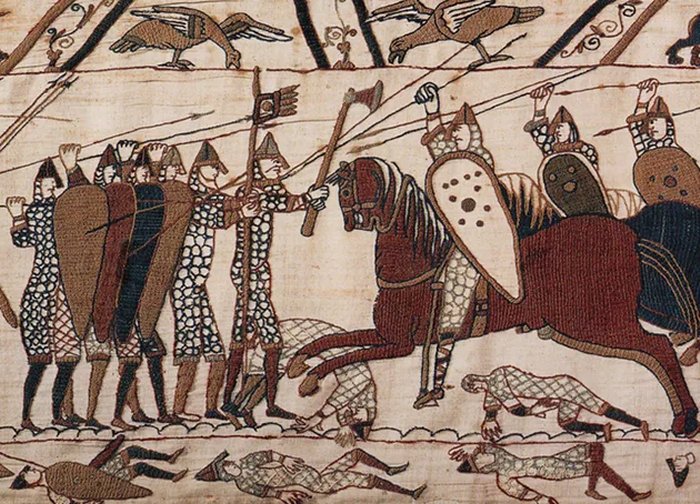
The Normans attacking the Anglo-Saxon shield castle at Hastings in southeast England in October 1066. The battle put Rollo's descendants on the throne of England . Bayeux Tapestry
When researchers opened the tomb, a sarcophagus on the floor of a Fécamp monastery, they discovered Richard the Good’s lower jaw with eight teeth. A DNA analysis is likely to be completed by the autumn and will be presented in cooperation with the French authorities.
Experts can not investigate the remains of Rollo, because his sarcophagus in the Cathedral at Rouen is empty. However, teeth of a close relative are considered excellent genetic and the researchers are optimistic about finding intact DNA.

Danish or Norwegian? Teeth hold the answer. Photo: Vegard Strømsodd/Explico / NTB scanpix
“Finding teeth is key because DNA can be found there even after this many years. Two forensic experts from Norway and Denmark took five teeth that will now be sent to the University of Oslo and the Centre for GeoGenetics at the University of Copenhagen for analysis,” Ole Bjørn Fausa, the founder of one of the project’s sponsors, the Samlerhuset Group, said.
Fausa said that if Rollo is confirmed to be Ganger Hrólf, it will have great historical significance.
“If the British royal family originates from the northern part of Western Norway, it will change the perception that the Norwegian royal family is relatively young with origins from the British and Danish royal houses,” he said.
Only when the analysis is complete will Danish and Norwegian historians be able to settle their conflicting claims on Rollo.
AncientPages.com
Expand for referencesMore From Ancient Pages
-
 Dazzling Time Capsule Of Unique Iron Age Artifacts And Celtic Roundhouses Discovered In England
-
 Large 4th Century Mosaic Floor Unearthed In İncesu, Kayseri Province, Turkey
-
 On This Day In History: ‘Diamond Sutra’ The Oldest Dated, Printed Book Is Published – On May 11, 868
-
 Rare 1,850-Year-Old Bronze Zodiac Coin Discovered During Underwater Survey Off Israel’s Coast
-
 Beer ‘Chicha’ Helped To Keep Peruvian Wari Empire Stable – New Study
-
 Ancient Oil Lamp Shop Discovered In Aizanoi, The Second Ephesus
-
 On This Day In History: Amelia Earhart, Most Famous Female Pilot – Disappeared Over The Pacific Ocean – On July 2, 1937
-
 Rare Ulfberht Viking Sword Discovered In Suldal, Norway
-
 Florentine Codex: Remarkable Manuscripts About Life Of The Aztecs
-
 Ötzi Had Dark Skin, Bald Head And Anatolian Ancestry- DNA Reveals
-
 Paleontologists Find New Predatory Dinosaur With Unique ‘Eyebrow’
-
 Ancient Sahul: Its Submerged Landscapes Reveal A Mosaic Of Human Habitation
-
 Rare Lost Pictish Stone With Strange Mythical Beasts Goes On Display For The First Time
-
 On This Day In History: Canute Lavard Was Murdered By His Cousin, Magnus I Of Sweden – On Jan 7, 1131
-
 Countess Loretta Of Sponheim Kidnapped Archbishop Of Trier And Got Away With It
-
 Tyrannical Tarquin The Proud: The Seventh And Last King Of Rome Was Banished
-
 The Parthenon Marbles Evoke Particularly Fierce Repatriation Debates – An Archaeologist Explains Why
-
 Ouroboros: Ancient Infinity Symbol Used By Different Ancient Civilizations
-
 Reconstructed Roman Gateway Tells The Story Of Britain’s Invasion
-
 Medieval Well-Preserved Sword Discovered In A Peat Bog In Poland

