
Catacombs Of Kom El Shoqafa – Largest Roman Burial Site In Egypt
A. Sutherland - AncientPages.com - Located in Alexandria, Egypt the catacombs of Kom el Shoqafa is one of the Seven Wonders of the Medieval Ages. It’s an archaeological site of great importance.
The tombs were tunneled into the bedrock in the age of the Antonine emperors (2nd century A.D.) The catacombs were originally intended as a burial chamber for only one family, but the privately funded project was expanded to allow for many more people.
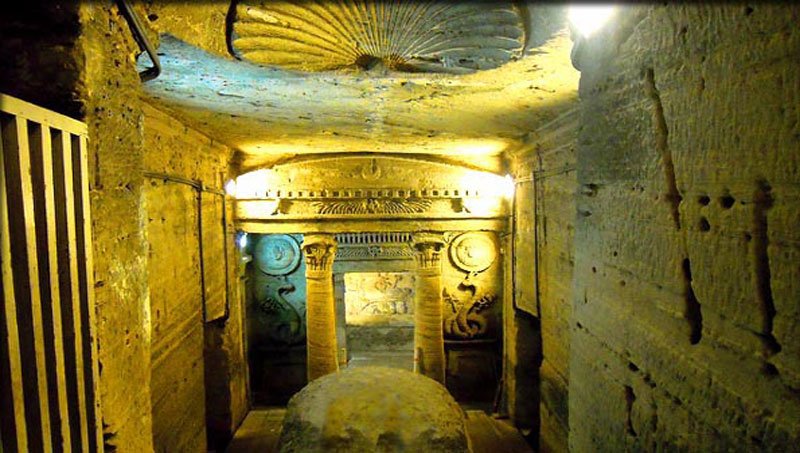
The necropolis consists in fact of a series of Alexandrian tombs, statues, and archaeological objects of the Pharaonic funeral cult with Hellenistic and early Imperial Roman influences.
Origin Of The Name Kom El Shoqafa
Kom el Shoqafa means Mound of Shards. This is because the area used to contain a mound of shards of terra cotta which mostly consisted of jars and objects made of clay. These objects were left by those visiting the tombs, who would bring food and wine for their consumption during the visit. However, they did not wish to carry these containers home from this place of death so they would break them.
The Catacombs Of Kom El Shoqafa Consist Of Three Levels Cut Through Solid Rock
The Catacombs reach 100 feet down into the ground into solid rock.
The tombs are truly remarkable and their existence testifies to an engineering feat of great magnitude. The funerary motifs are pure ancient Egyptian, but the architects and artists were schooled in the Greco-Roman style. Applied to the themes of Ancient Egyptian religion, it has resulted in amazing integrated art, quite unlike anything else in the world. For example, some statues are Egyptian in style, yet bear Roman clothes and hairstyles whilst other features share a similar style.

Entrance to a burial chamber. Image credit: Jerrye & Roy Klotz, MD - CC BY-SA 3.0
When you enter the catacombs of Kom el Shoqafa there is a circular staircase that takes the visitor several levels deep into the ground. To the left is the room where mourners of the deceased would sit and bring offerings. Another staircase leads down to a room full of sculptures.
The central tomb - located at the bottom of the building - is the main attraction of the catacombs of Kom el Shoqafa. In the vestibule of the tomb, there are bas-reliefs of bearded snakes with shields decorated with the heads of jellyfish. The sculptures guard the central tomb and its treasures. In its interior, there are somewhat strange statues of Sobek and Anubis dressed in Roman armor from the 2nd century. Anubis at the door is the god of the dead, immortalized as a Roman legionary with a dragon's tail.
On the second floor of the Catacombs, there are relief decorations of sarcophagi and walls of the burial chamber, presenting a mixture of Egyptian, Greek, and Roman art.
From the central chamber of the tomb, corridors spread to rooms with more than 300 niches for the bodies of the dead (so-called loculi).
Hall Of Caracalla - Entering The Largest Roman Mass Burial Chamber In Egypt
On the first level, there is a hallway that leads to a room called the Hall of Caracalla. It’s a mass burial chamber. Although this room was not intended to be a tomb it does contain horse bones and the bones of young Christian men massacred by order of Emperor Caracalla in 215 A.D. as well as horse bones.
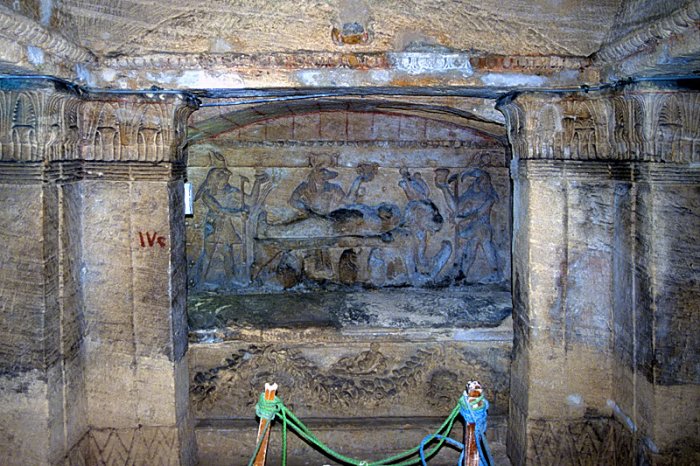
Funeral relief in the chapel, Kom el-Shuqafa, Alexandria, Egypt - Image credit: Roland Unger - CC BY-SA 3.0
The vestibule and central tomb chamber are the main chambers. They are lit by a single electric light bulb that throws the chamber into green, a perfect staging for that composite art. In the center of the facade, the familiar solar disk is carved below the frieze of serpents. Left and right are two serpents wearing the crowns of upper and Lower Egypt.
Three sarcophagi have been found in the Catacombs. The catacombs of Kom el Shoqafa are evidence of three cultures, religions, and art that came together on Egyptian soil.
Written by A. Sutherland - AncientPages.com Senior Staff Writer
Copyright © AncientPages.com. All rights reserved. This material may not be published, broadcast, rewritten or redistributed in whole or part without the express written permission of AncientPages.com.
More From Ancient Pages
-
 Non-Royal Elite Burial And Deciphered Hieroglyph Reveal Privileged And Hard Life Of Maya Ambassador
-
 Mystery Of The Anglo-Saxon Harpole Burial Continues – New Clues
-
 Ancient Nanotechnology Knowledge Inspired A Modern 3D-Printable ‘Lycurgus Cup’
-
 Piecing Together Scotland’s Religious Past With Shards Of Glass
-
 Seven Bronze Age Swords And Large Hoard Of Slavic Coins Found In Germany
-
 Was The Mysterious Powerful Viking Warrior Buried In A Ship In Scottish Highlands A Woman?
-
 Rare 2000-Year-Old Celtic Sword Unearthed In East Bohemia
-
 Impressive Ruins Of 13th Century Pagoda Remains Discovered At Nara’s Todaiji Temple, Japan
-
 Indigenous People Of Ancient Sicily Were Acrive Traders Long Before The Greeks Arrived
-
 More Than 1000 Bones Of Extinct Predators From 240 Million Years Ago – Found In Upper Silesia, Poland
-
 Neanderthal Hunting Camp Discovered In The Center Of The Iberian Peninsula
-
 Camas Plant Stewardship In The Pacific Northwest Dates Back More Than 3,500 Years
-
 Curse Of The Dancer – Mysterious 1,500-Year-Old Tablet Finally Deciphered
-
 Was Aztec And Mixtec Turquoise Mined In the American Southwest?
-
 A New Historical Inscription Of Sargon II From Karkemish Examined
-
 New Evidence Vikings Failed To Wipe Out Communities And Anglo-Saxon Monasteries
-
 Mysterious Ancient Spiral Structure And Buried Towers Discovered At Angkor Wat
-
 Secrets Of An Unusual And Mysterious Medieval Danish Axe Revealed By Scientist
-
 Mysterious Lost Kingdom Of Urartu And Its Enigmatic History
-
 Evidence Of Sangam Age Settlement Unearthed At Nangur, Tamil Nadu

