
Nalanda – One Of The Most Praised Learning Centers And Masterpiece Of Ancient World
A. Sutherland - AncientPages.com - Nalanda was one of the most praised, intellectual circles of the ancient world.
It was an active center of education located about 88 km south-east of Patna in Bihar, northeastern India, and not far from what is today the southern border of Nepal.
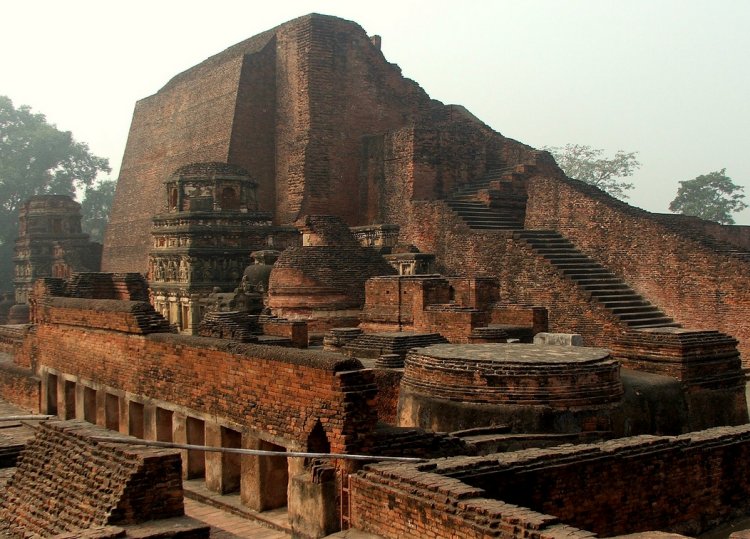
Scholars came from all over the world to study philosophy, medicine, astronomy, and other subjects. Credit: - CC BY-SA 2.5
Based on historical sources, we can say that the Nalanda University - supported by the Hindu Gupta rulers, Buddhist emperors like Harshavardhana as well as the later Pala Emperors - had a long and celebrated life that lasted almost continually for 800 years from the 5th to 12th century AD.
By the time the first European university was established in Bologna in 1088, Nalanda had been providing higher education to thousands of students from Asian countries for more than six hundred years.
The university was an architectural and environmental masterpiece. It had eight separate compounds, 10 temples, meditation halls, classrooms, lakes, and parks.
It had a nine-story library where monks meticulously copied books and documents so that individual scholars could have their own collections. It had dormitories for students, perhaps a first for an educational institution, housing 10,000 students in the university’s heyday, and providing accommodations for 2,000 professors.
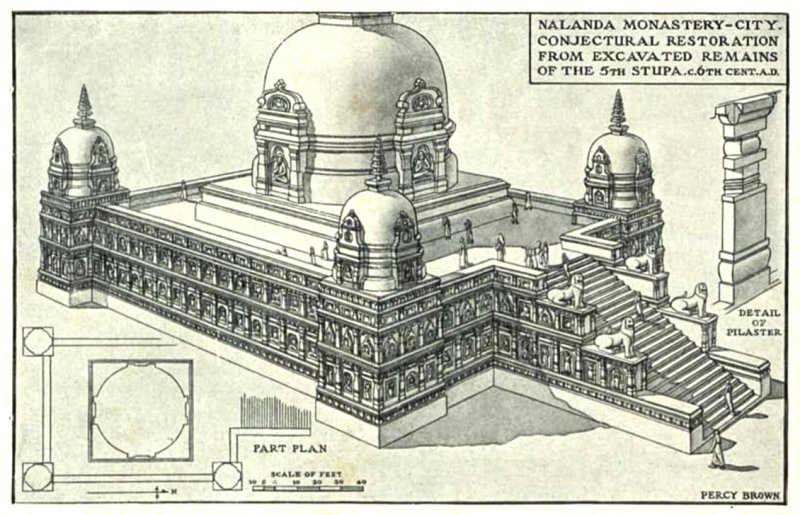
Conjectural Reconstruction of Temple no. 3, Nalanda University. Image credit: Percy Brown (1872-1955) - "Indian Architecture, Buddhist and Hindu", published in 1956 Bombay, India. First published in India in 1900. Public Domain
Nalanda was also the most global university of its time, attracting pupils and scholars from Korea, Japan, China, Tibet, Indonesia, Persia, and Turkey. Students and scholars came to the university to learn and teach.
The university’s library "Dharmaganja" ("Treasury of Truth") and Dharma Ghunj ("Mountain of Truth") had hundreds of thousands of texts.
During the period of its greatest popularity, Nalanda University was celebrated as the world's largest collection of Buddhist literature, with supportive followers admiring the university’s greatness and new philosophies.
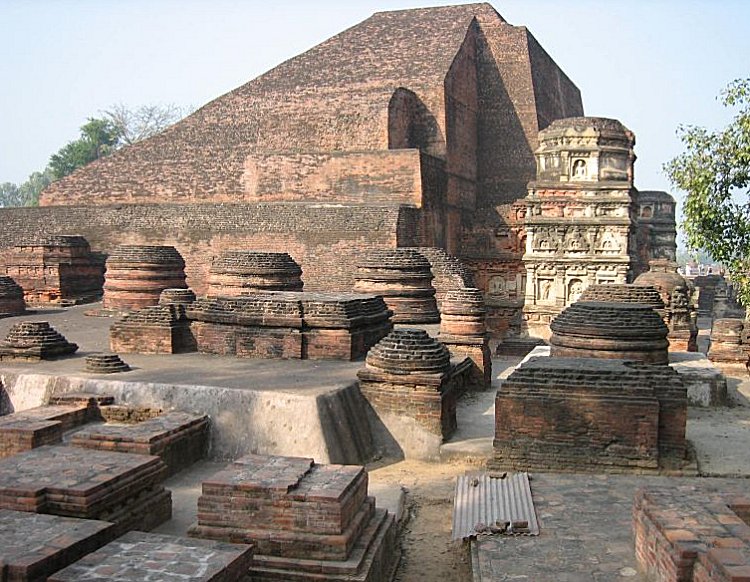
Credit: Prince Roy - CC BY-SA 2.0
A great fire wiped out the library of over 9 million manuscripts and at the beginning of the 12th Century, the Muslim invader Bakhtiyar Khalji sacked the university.
In the 1860s the great archaeologist Alexander Cunningham identified the site as the Nalanda University and in 1915/1916 the Archaeological Survey of India began excavations of the site.
Today, Nalanda is one of the most visited historical and architectural landmarks of India.
In 2006, the countries of China, India, Singapore, and Japan proposed a plan to revive and restore the ancient ruins of the Nalanda International University. The new venture is meant to be a revival of Nalanda.
After 800 years, the great learning center was formally inaugurated on 19 September 2014. Classes began at Nalanda University - after centuries of silence.
The powerful vision behind Nalanda to continue the great tradition is important for India, Asia, and for the rest of the world.
Updated on April 5, 2022
Written by – A. Sutherland AncientPages.com Staff Writer
Copyright © AncientPages.com All rights reserved. This material may not be published, broadcast, rewritten or redistributed in whole or part without the express written permission of AncientPages.com
Expand for referencesMore From Ancient Pages
-
 Neanderthals And Other Ancient Humans Were Much More Intimate Than Previously Thought – DNA Shows
-
 Controversial Story And Secret Knowledge Of Li Ching-Yuen Who Lived For 256 Years
-
 Archaeologists Survey Bronze Age Konar Sandal Site In Southeast Iran
-
 Ancient Mysteries Of Japan – Remarkable Story Of An Unknown Civilization And Lost Knowledge – Part 2
-
 16 Dead Sea Scrolls Fragments Are Forgeries – U.S. Bible Museum Says
-
 New Discovery: Fragments Of Pyramid Dated To 13th Dynasty Discovered In Dahshur Necropolis
-
 Ancient People Handled Sun Exposure Better Than Modern People – An Anthropologist Explains Why
-
 The Red Dragon Of Wales – Ancient Symbol Dating Back To Roman Times
-
 Ancient African Empires’ Impact On Migration Revealed By Genetics
-
 Arborglyphs – Basque Immigrant Sheepherders Left Their Marks On Aspen Trees In The American West
-
 Unique Miniature Roman Gold Lock Smaller Than A One-Euro Coin Discovered In Germany
-
 The Nunnehi – Immortal Spirit People And Mysterious Protectors Of The Cherokee Nation
-
 Extraordinary Collection Of Ivory Plaques Dated To The First Temple Period Unearthed In Jerusalem
-
 On This Day In History: The Battle of Mortimer’s Cross – On Feb 2, 1461
-
 Why Did Neanderthals Visit A Special Cave In Jersey For Over 100,000 Years?
-
 10 Mysterious Ancient Manuscripts With Hidden Secrets
-
 Thales Of Miletus: One Of The Famous “Seven Sages Of Greece” Who Predicted A Solar Eclipse
-
 Who Has Stolen Charles Darwin’s Notebooks Worth Millions From The University Of Cambridge?
-
 Ancient Quest For Mechanical Life: Humanoid Robots Of Our Ancestors
-
 1,500-Year-Old Fingerprints Will Say Much About Potters And Communities That Once Lived In Motza


