
Incredible Ancient Metallurgical Wonders That Defy Explanation And Pose A Real Mystery Even Today
A. Sutherland - AncientPages.com - The Antediluvians had technologies that matched our own; there are also serious indications that in certain areas they even possessed extraordinary knowledge, which has only hardly been nudged by our present-day science.
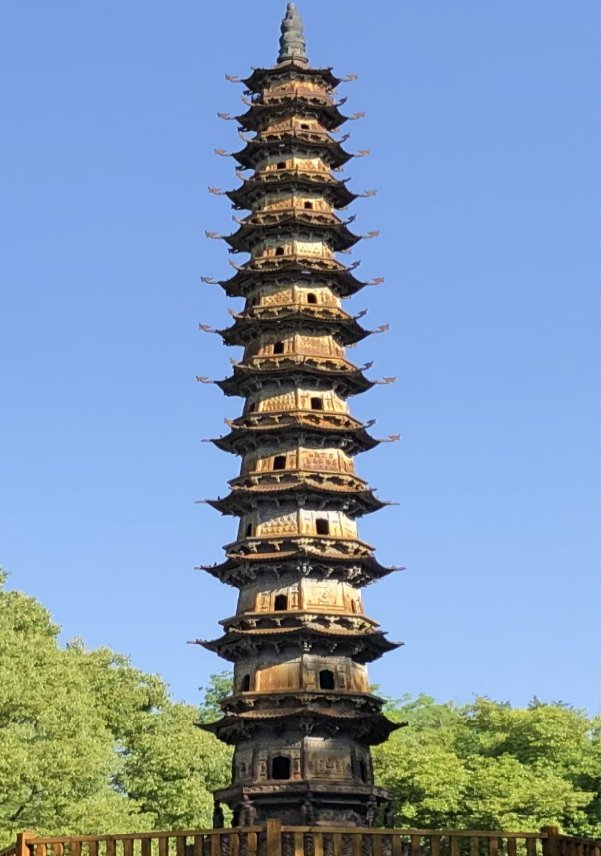
The 13m high Yu Quan pagoda at Dangyang (Hubei) is created entirely of cast iron. Erected in 1061, it is the oldest surviving cast-iron pagoda. Image courtesy: General Office of Hubei Provincial People's Government
Highly advanced hardening techniques of the ancients as well as ancient castings of large pieces were widespread in antiquity.
Our ancestors were in possession of an extremely sophisticated scientific knowledge of metalworking from an earlier civilization and evidence of this knowledge was found in different parts of the world.
China with a long history in metallurgy was the earliest civilization that manufactured cast iron and some of the ancient Chinese feats of casting iron are so impressive as to be almost unbelievable.
One of them is for example, the cast-iron pagoda entirely built of cast iron at Dangyang, Hubei Province, China, in 1061. It is the tallest (17.9 m high) surviving cast-iron structure, which has 13 stories, built up of cast-iron octagonal sections fitted together by a tenon-and-mortise system.
One large sculpture of legendary fame is the majestic cast-iron lion situated not far from the Grand Canal at Cangzhou, Hebei Province. It was manufactured in 953 AD.
The gigantic lion (5.4×3×5.3 m) weighs over 37 tons. It is hollow and the thickness of its walls varies from 40 to 20 cm. On its back is a lotus pedestal of cast iron weighing circa 5 tons.
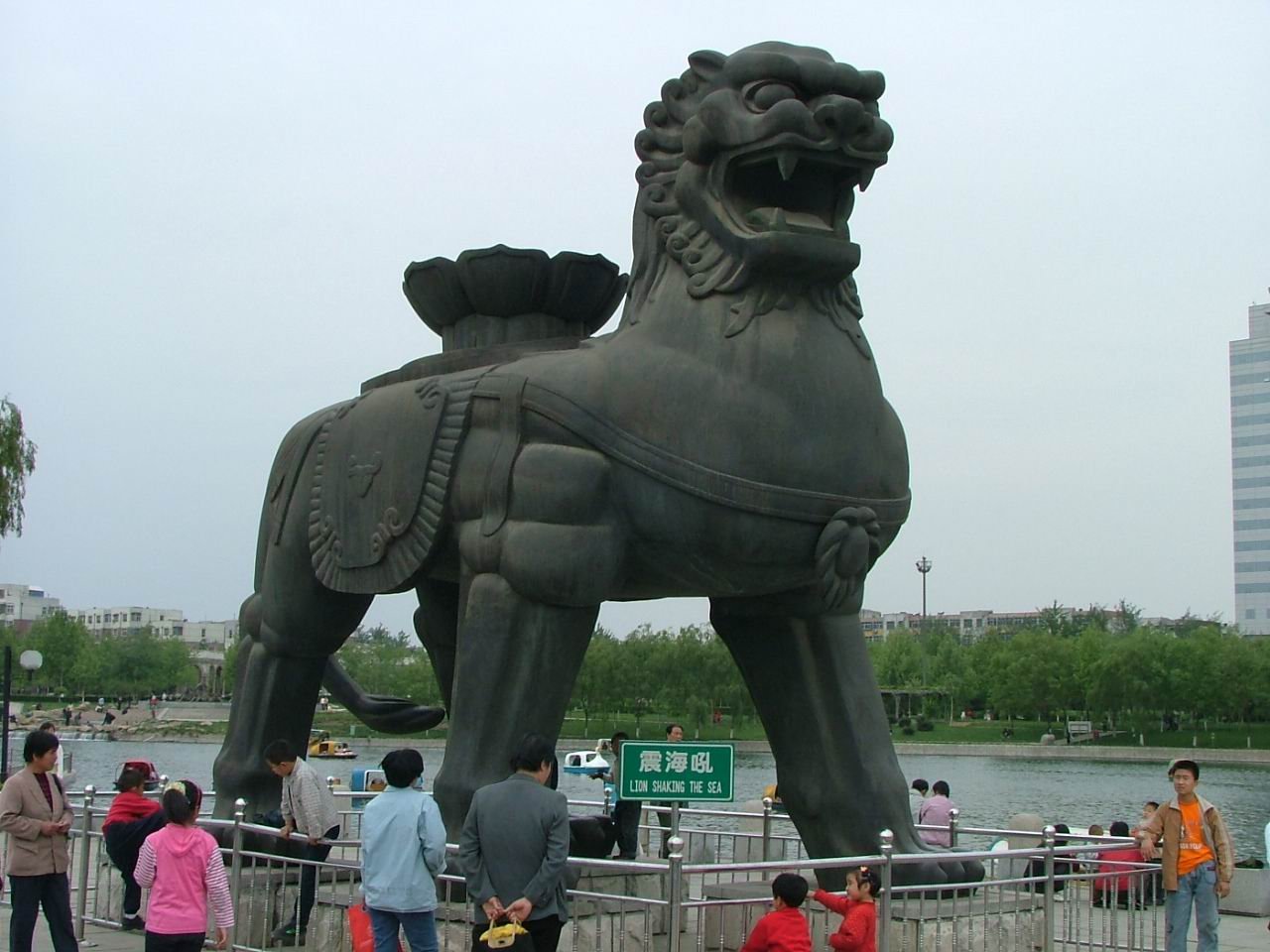 Majestic gigantic cast-iron lion at Cangzhou, Hebei Province was manufactured in 953 AD. It weighs over 37 tons. source
"The mystery of the use of iron in India and China is one that largely baffles modern metallurgists. It is assumed that these countries developed iron and other metallurgical skills after the west, but the evidence points otherwise," says D. H. Childress in his book "Technology of the Gods: The Incredible Sciences of the Ancients" and cites South African archaeologist Nikolaus van der Merwe, saying that "spreading east from the Mediterranean, iron was diffused throughout most of Asia before the Christian era.
"By 1100 BC it was in use in Persia, from where it spread to Pakistan and India. The date of the arrival of iron in India is still a matter of some dispute..."
Ancient Indians, for example, produced iron capable of withstanding corrosion, most likely due to the high phosphorus content of the iron produced during those times.
The height of the pillar, from the top to the bottom of its base, is 7.21 m (23 ft 8 in), 1.12 m (3 ft 8 in) of which is below ground. Its bell pattern capital is 306 mm (12 in). It probably weighs more than three tonnes (6,614 lb). The pillar that stands in the courtyard of Kutb Minar in Delhi, India, has attracted the large attention of archaeologists and specialists because of its high resistance to corrosion and has been called a "testimony to the high level of skill achieved by the ancient Indian iron smiths in the extraction and processing of iron"

Detail showing the inscription of King Chandragupta II, who was one of the most powerful emperors of the Gupta Empire in India. Image credit: User:~shuri - Public Domain
An inscription in the Sanscrit language informs that the column was originally erected in the temple of Muttra and capped with Garuda - "Messenger of the Gods" - an image of the bird incarnation of the god Vishnu, the Indian god known as "The Preserver".
But Muslim invaders destroyed the Garuda and tore the column from its original setting and moved it to the current place in Delhi in the eleventh century. It is unknown how long this impressive iron shaft had been at Muttra.
What was it meant to represent? Was it merely a religious symbol or did it serve any other purpose? To which era does the pillar really belong?
Many legends are devoted to the Ashoka Pillar also known as the Iron Pillar in Delhi, which is said to be in existence for the past 1600 years, but some scholars believe the structure is a few millennia old.
This metallurgical wonder defies explanation and poses a real mystery even today, due to its enormous size and a sizeable casting job related to it. It is difficult to even imagine how such a huge mass of iron was lifted and manipulated during manufacture.
How did the structure manage to "survive" under the Indian tropical heat and violent monsoon downpours?

The iron pillar stands within the courtyard of Quwwat-ul-Islam Mosque. Image credit: stevekc - CC BY 2.0
The column - made up of 98% wrought iron of impure quality - not in any way welded together - seems to have been forged as a single, gigantic piece of iron.
Normally a piece of iron manufactured 1600 years ago would have corroded long ago. But it is not the only mystery of the Ashoka Pillar.
The column - made up of 98% wrought iron of impure quality - not in any way welded together - seems to have been forged as a single, gigantic piece of iron.
Iron with exceptionally high purity can be produced today under controlled laboratory conditions by electrolysis. This knowledge was not duplicated until recent times. It was even possible to produce iron of comparable purity in 1938.

The iron column exists at Kottenforst has its local name the "Iron Man". Image credit: - Public Domain
It was placed at its present location around 1727, but where was it earlier? The artifact has been shrouded in mystery for centuries and still remains the subject of scholarly speculation. Who made it, how and why, is unknown.
Fabrication of the Iron Pillar, seven-ton heavy and seven-meter tall known for its amazing corrosion resistance despite exposure to the wind, sun, and rain in the open for more than 16 centuries is undoubtedly a metallurgical marvel of the ancients.
How metallurgists of ancient India achieved this level of iron purity and what kind of technique they used to cast such enormous iron pillars - remains a mystery.
Another mysterious iron column exists at Kottenforst, a few miles west of Bonn, Germany. It has its local name the "Iron Man". It has the appearance of a squared metal bar, with 4 feet 10 inches above the ground and an estimated 9 feet beneath the surface. The pillar is a unique oddity in Central Europe, and is alleged by some to be an out-of-place artifact.
Like the iron pillar of India, the "Iron Man" of Kottenforst shows some weathering but very little trace of rust.
Who made it, how and why, is unknown.
Written by – A. Sutherland AncientPages.com Staff Writer
Copyright © AncientPages.com All rights reserved. This material may not be published, broadcast, rewritten or redistributed in whole or part without the express written permission of AncientPages.com
More From Ancient Pages
-
 Mysterious Signs On Teotihuacan Murals Deciphered?
-
 Will-o’-the-wisp: Eerie Lights Over Swamps And Marshes That Frightened And Led People Astray
-
 6,000-Year-Old Submerged Settlement Shows Black Sea Level Was Lower 5,000 Years Ago – ‘Black Sea Deluge’ Theory?
-
 Lavish Home And Exotic Garden Of Emperor Caligula Discovered In Rome
-
 Spicy History Of Chili Peppers – Study From University Of Alabama
-
 Mysterious Cave With Giant Skulls Decorated By The Neanderthals Discovered In Spain
-
 Late Roman-Era Rooms, Offering Vessels Unearthed At Ancient City Of Antiocheia, Southern Türkiye
-
 Magnificent Golden Silk Cloth Made By 1 Million Spiders Is One Of The World’s Rarest Silk Textiles
-
 Terracina – Ancient City Where Mythology And History Meet
-
 The Inca Empire Was Powerful And Well-Organized – Why Were They So Successful?
-
 Devil’s Advocate – Ancient Phrase Traced To The Roman Catholic Church
-
 What Was Pax Deorum And How Important Was It?
-
 1,200-Year-Old Viking Sword Found By Hiker In Norway
-
 Mysterious Balkåkra Disc – Rare Strange Bronze Artifact Found In A Bog
-
 Huge Mass Grave With Remains Of Pirate Black Sam’s Crew Discovered In North America
-
 Babylon Excavation Uncovers 478 Artifacts, Including Cuneiform Tablets and Seals
-
 Enigma Of Ancient Upside Down Stairs At Sacsayhuamán
-
 Balkan Mountains’ Enigma – Strange Underground Anomaly Discovered
-
 Calçoene – Amazon Stonehenge And The Mysterious Amapán Megalithic Culture
-
 The Lost Prophecy Reveals Chilling Future Events – The Last Words To Mankind?


