DNA Archive
DNA
AncientPages.com - Neanderthals, the closest cousins of modern humans, lived in parts of Europe and Asia until their extinction some 30,000 years ago. Genetic studies are revealing ever
Read More
DNA
AncientPages.com - In 2022, we reported the DNA sequences of 33 medieval people buried in a Jewish cemetery in Germany. Not long after we made the data publicly
Read More
DNA
Jan Bartek - AncientPages.com - The Iron Age in the highland region of Pang Mapha, northwestern Thailand, was characterized by a unique mortuary practice known as the Log
Read More
DNA
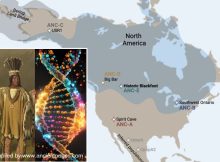
Jan Bartek - AncientPages.com - A new interesting DNA study reveals that the Blackfoot people trace their ancestry to a previously unknown genetic lineage that dates back approximately
Read More
DNA
Conny Waters - AncientPages.com - Emperor Wu, who reigned from 543 to 578, was a prominent figure in China's Northern Zhou dynasty. He is most notably recognized for
Read More
DNA
Conny Waters - AncientPages.com - According to recent scientific findings, new DNA sequencing technologies have successfully identified the historical remains of George Washington's grandnephews - Samuel Walter Washington and
Read More
DNA
Jan Bartek - AncientPages.com - Approximately 7,500 years ago, the last communities of hunter-gatherers in Western Europe came into contact with incoming Neolithic farmers. Over time, these hunter-gatherer
Read More
DNA
Jan Bartek - AncientPages.com - Ruled by many Emperors, the mighty and vast Roman Empire covered territories that included Europe, North Africa, and Western Asia. Established in 27
Read More
DNA
Conny Waters - AncientPages.com - In the early 1990s, excavations took place at Huseby-Klev, an early Mesolithic hunter-fisher site on the Swedish west coast, where a piece of
Read More
DNA
Jan Bartek - AncientPages.com - A new DNA study reveals contact with the Yamnaya people dramatically re-wrote Northern Europeans' genetic story. The Yamnaya (c. 3300 – 2600 BC -
Read More
DNA
Conny Waters - AncientPages.com - One of the most intriguing archaeological pre-Columbian sites is Teotihuacán, which scientists still know relatively little about. Who were the people who built
Read More
DNA
Conny Waters - AncientPages.com - A new computational tool detects up to second to third-degree cousins using ancient genomes. Scientists from the Max Planck Institute for Evolutionary Anthropology in
Read More
Archaeology
Jan Bartek - AncientPages.com - The high-altitude hero of the Himalayas, yak are among the few large animals that can survive the extremely cold, harsh and oxygen-poor conditions
Read More
DNA
Jan Bartek - AncientPages.com - A new study suggests that the difference in height between female and male individuals in northern Europe during the Early Neolithic (8,000–6,000 years
Read More
DNA
Conny Waters - AncientPages.com - Despite the Roman Empire’s extensive military and cultural influence on the nearby Balkan peninsula, a DNA analysis of individuals who lived in the region
Read More
Archaeology
Jan Bartek - AncientPages.com - The 9,000-year-old shaman burial in Bad Dürrenberg, Germany, is one of Central Europe's most spectacular discoveries. Discovered in 1934 during construction works, the
Read More
DNA
Jan Bartek - AncientPages.com - A new genetic study reveals indigenous Mexicans migrated to California 5,200 years ago. Researchers have found evidence hunter-gatherers who came from Mexico spread
Read More
DNA
Jan Bartek - AncientPages.com - Researchers have found that previous studies analyzing the genomes of people with European ancestry may have reported inaccurate results by not fully accounting
Read More
DNA
Jan Bartek - AncientPages.com - A research team led by the Institute of Evolutionary Biology (IBE) and Pompeu Fabra University (UPF) has identified the most widespread genetic contribution
Read More
DNA
AncientPages.com - For generations, Neanderthals have been a source of fascination for scientists. This species of ancient hominim inhabited the world for around 500,000 years until they suddenly
Read More
DNA
Conny Waters - AncientPages.com - Contemporary humans carry in their cells a small amount of DNA derived from Neanderthals and Denisovans. “Denny,” a 90,000-year-old fossil individual, recently identified
Read More
DNA
Conny Waters - AncientPages.com - By analyzing genomes up to 40,000 years old, scientists have traced the history of migrations between Homo Sapiens and Neanderthals. About 40,000 years
Read More
DNA
Jan Bartek - AncientPages.com - Modern humans migrated to Eurasia 75,000 years ago, where they encountered and interbred with Neanderthals. A new study published in the journal Current Biology shows
Read More
DNA
Jan Bartek - AncientPages.com - People who carry three gene variants inherited from Neanderthals are more sensitive to some types of pain, according to a new study co-led
Read More
DNA
Conny Waters - AncientPages.com - Africa is the birthplace of modern humans and the continent with the highest level of genetic diversity. While ancient DNA studies reveal some
Read More
DNA
AncientPages.com - When researchers used DNA from the 10,000-year-old “Cheddar Man”, one of Britain’s oldest skeletons, they unveiled what the first inhabitants of what now is Britain actually
Read More
DNA
Jan Bartek - AncientPages.com - According to a new genetic study, something strange happened to our ancestors about 900,000 years ago. Suddenly, the ancestral population of humans was
Read More
Archaeology
Jan Bartek - AncientPages.com - The diversity of family systems in prehistoric societies has always fascinated scientists. A groundbreaking study by Mainz anthropologists and an international team of
Read More
DNA
Jan Bartek - AncientPages.com - For the first time, a group of researchers have successfully extracted ancient DNA from a 2,900-year-old clay brick. Currently housed at the National
Read More
DNA
Jan Bartek - AncientPages.com - Cattle may seem like uniquely American animals, steeped in the lore of cowboys, cattle drives, and sprawling ranches. However, scientists have found evidence
Read More
Archaeology
Conny Waters - AncientPages.com - Early colonial settlers likely survived the harsh frontier conditions of 17th-century Delaware because they banded as family units to work alongside enslaved African
Read More
DNA
AncientPages.com - Geneticists have now firmly established that roughly two percent of the DNA of all living non-African people comes from our Neanderthal cousins. It’s difficult to imagine
Read More
Archaeology
Jan Bartek - AncientPages.com - A new DNA study reveals that Luzio, the oldest human skeleton found in São Paulo state (Brazil), was a descendant of the ancestral
Read More
Archaeology
Conny Waters - AncientPages.com - Who lived at Machu Picchu at its height? A new study used ancient DNA to find out for the first time where workers buried
Read More
DNA
AncientPages.com - Nomadic animal-herders from the Eurasian steppe mingled with Copper Age farmers in southeastern Europe centuries earlier than previously thought. In a new study published in Nature, researchers used
Read More
Archaeology
Jan Bartek - AncientPages.com - Recent archaeogenetic studies have shown that human migrations and individual mobility played a bigger role in prehistory than previously anticipated. With the movement
Read More
DNA
Jan Bartek - AncientPages.com - Butterflies and moths share "blocks" of DNA dating back more than 200 million years, new research shows. Scientists from the Universities of Exeter
Read More
DNA
AncientPages.com - The people known as the Picts have puzzled archaeologists and historians for centuries. They lived in Scotland during the early medieval period, from around AD 300 to
Read More
DNA
Jan Bartek - AncientPages.com - In testing the genetic material of current populations in Africa and comparing against existing fossil evidence of early Homo sapiens populations there, researchers have
Read More
DNA
Jan Bartek - AncientPages.com - Recent scientific discoveries have shown that Neanderthal genes comprise some 1 to 4% of the genome of present-day humans whose ancestors migrated out
Read More
DNA
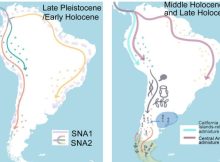
Conny Waters - AncientPages.com - How do today's Indigenous communities of South America trace back to the history of human migration and contact in the continent? Graphical abstract.
Read More
Archaeology
Jan Bartek - AncientPages.com - Researchers at the Francis Crick Institute have identified three 4,000-year-old British cases of Yersinia pestis, the bacteria causing the plague—the oldest evidence of
Read More