
AncientPages.com - Humans are an interesting mixture of altruism and competition. We work together well at times and at others we will fight to get our own way. To try to explain these conflicting tendencies, researchers have turned to the chimpanzees and the bonobos for insight.
Among the great apes, the chimpanzees and the bonobos are the most genetically related to us as we share about 98.7% of our DNA with them. We share a common ancestor with them as well as anatomical features, complex social hierarchies and problem-solving skills.

Credit: Adobe Stock - adrenalinapura
Bonobos may be one of our closest cousins but chimpanzees dominated research after Jane Goodall discovered in the 1960s that chimpanzees make and use tools. This finding paved the way for research on chimpanzees as a lens to understand which human aspects are natural rather than socially conditioned. An array of human characteristics, including empathy, playfulness and respect for elders have since been attributed to our shared ancestry with chimpanzees.
The aggressive chimp in us
However, one disturbing characteristic stands out. Chimpanzees "go ape" and attack each other in coordinated assaults. Dutch primate expert Frans de Waal's 1982 book Chimpanzee Politics included a colorful description of how Luit and Nikkie, two young male chimpanzees, allied to violently usurp Yeroen, the alpha male. They bit and ripped out Yeroen's testicles and the loss of blood killed him.
One argument scientists have made is that these warlike tendencies are hardwired in us the same way they are hardwired in chimpanzees, which challenges the view that wars are a man-made phenomenon. Chimps can also help us learn about the circumstances that might encourage aggression, such as when rivals are outnumbered or when positions in the status hierarchy are being negotiated.
Nevertheless, J. B. Mulcahy, co-director at the Chimpanzee Sanctuary Northwest in the US, believes aggression only "makes up a very small part of their daily activity". So some scientists may have overemphasized this trait. Increasingly, research is actually showing how cooperative chimpanzees can be.
The gentle bonobo
Once overlooked, researchers are recognizing bonobos as more similar than chimpanzees to humans. Which, considering their reputation as amicable apes, is good news for us.
Unlike the male-dominated groups of chimpanzees, bonobos live in peaceful communities where the chief is female. Indeed, human societies tend to be matriarchal when there is little direct competition for resources.
In bonobo communities, sexual relations play an important role in maintaining relationships and resolving conflicts. For instance, the prospect of food can stir chimpanzees into a hostile frenzy, but bonobos take a more harmonious approach and will gather for what often turns into a polyamorous picnic. There is plenty of sexual play and grooming reminiscent of our own free love movements in hippie culture. While the alpha female is typically smaller than the males, all the females will rally around her to chase the males away should they turn aggressive.
Bonobos are also rather eager to share. Experiments at Lola ya Bonobo, a bonobo sanctuary in the Democratic Republic of Congo, in 2010 show that when bonobos are put in adjacent rooms and one is given food, that bonobo would rather share the food than eat alone. They have also been observed sharing food with those outside of their group, perhaps to make new friends. And they demonstrate a willingness to help others obtain food even if they won't get to share it.
Bonobos may even have better social intelligence than chimpanzees. In experiments where various animals were presented with upside-down cups with a treat hidden under one of them, chimpanzees kept choosing the cups at random but bonobos (and dogs) looked to the human running the experiment for information on which cup was correct. Bonobos also have brain circuits that seem more predisposed to sharing, tolerance, negotiation and cooperation than chimpanzees.
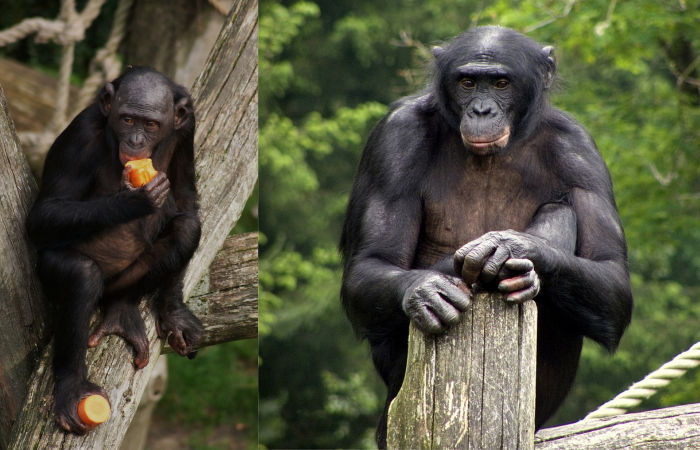
Bonobos. Credit: Left: Skitterphoto - Public Domain - Right: Credit: Natataek - CC BY-SA 3.0
So where exactly do humans stand? We seem to have incorporated the traits of both species, resulting in a tension between our aggressive and harmonious proclivities. Our tendency for conflict mirrors the competitiveness of chimpanzees, and yet the bonobos teach us that we have it in us to be altruistic and that society can be organized in more peaceful ways. This selflessness underlies the large-scale cooperation that has helped Homo sapiens share ideas, form nations, explore the universe and outlast other early humans such as Homo erectus.
And while the idea of societies built on free love may sound like a utopian fairytale, we do seem to be opening up to alternative mating practices such as consensual non-monogamy in response to a world that is getting increasingly jaded with traditional notions of gender and relationship structures. The flexibility of human behavior is after all the cornerstone of our remarkable adaptability. So it can't hurt to be open to new possibilities.
Written by Jose Yong, Assistant professor of Psychology , Northumbria University, Newcastle
Provided by The Conversation
This article is republished from The Conversation under a Creative Commons license. Read the original article.