
AncientPages.com - A village with the Old English name "Filthy Pool" wasn't an auspicious location to discover one of the most spectacular burials of the Anglo Saxon period.
Nevertheless, excavations by the Museum of London Archaeology at Harpole, Northamptonshire, in England's Midlands, have uncovered an astonishing Christian burial of the seventh century, a period when the religion was relatively new in England.
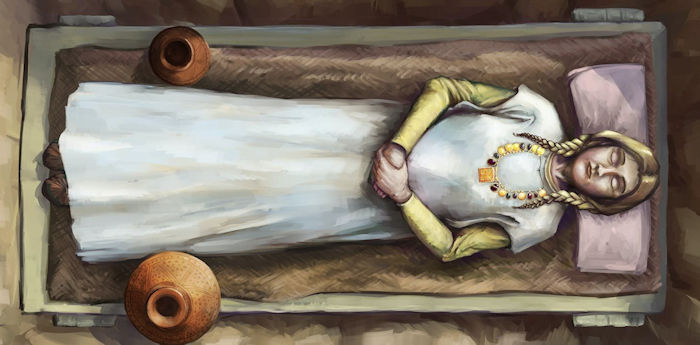
A reconstruction of the Harpole burial. Credit: MOLA / Hugh Gatt
The star find is an opulent necklace of gold, garnet and glass pendants, including a centerpiece with cruciform decoration.
More unprecedented, however, is the ghostly X-ray of an enigmatic item still in its soil block, which appears to be a large crucifix.
If so, it would be the first time an item like this has been found in a grave. Only one other example has survived from seventh-century England: the cross from the Staffordshire Hoard unearthed in 2009.
Excavators believe the deceased was buried in a wooden bed, though conditions are so poor that nearly all organic material has decomposed, leaving only fragments of teeth for analysis.

A reconstruction of the Harpole burial. Credit: MOLA / Hugh Gatt
These remains are unlikely to provide scientific evidence for the individual's sex. But the burial type and jewelry are consistent with a feminine burial between AD630 and AD670.
Wealthy women of the seventh century
While most reports have emphasized the uniqueness of the burial, it is actually just the latest—albeit among the most intriguing—in a series of wealthy female burials from this period.
Jeweled necklaces are consistent finds among this group. The Desborough necklace was found just 25 kilometers (15 miles) to the northeast of Harpole. A second strikingly similar example (the Galley Lowe necklace) was recovered from a barrow—or burial mound—in the Peak District.
All three necklaces echo Christian fashions from the Byzantine Mediterranean.
To us, the women who wore these jewels in England seem far removed from those warmer climes. But it is easy to underestimate the reach of seventh-century networks.
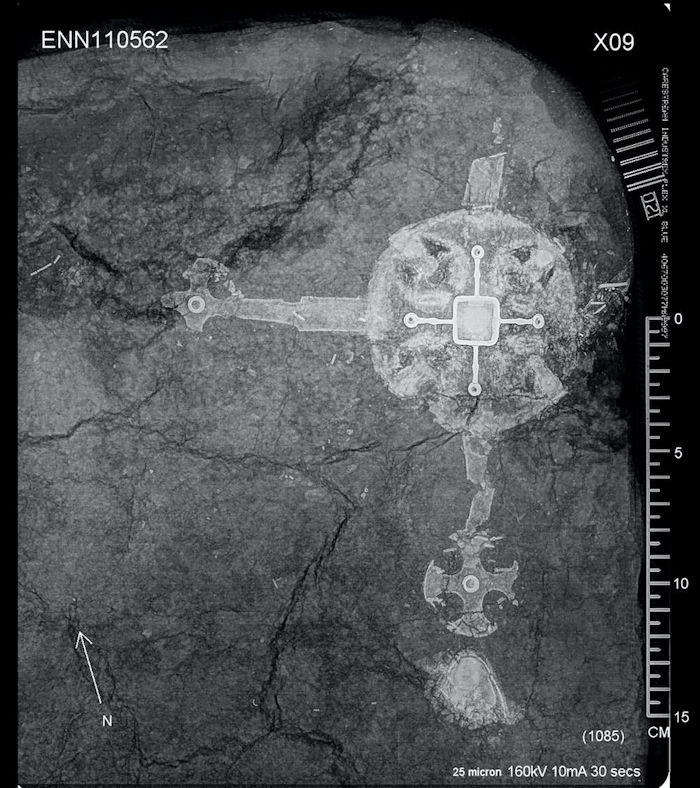
If the item in the xray turns out to be a large crucifix, it would be the first time an item like this has been found in an English grave. Credit: MOLA
Despite being an island, Britain was not insular in this period. The consolidation of the new religion was aided by missions from prominent Italian and African Christians.
With these contacts came unequal access to social advancement, influence and wealth. It is no coincidence that virtually all items bearing Christian iconography from England in this early period drip with precious metals and gems.
Why were women buried in this way?
There are plenty of wealthy masculine burials from this period, with particularly famous examples at Sutton Hoo in Suffolk and Prittlewell in Southend-on-Sea on the Essex coast. But archaeologist Helena Hamerow has shown that the burial of these important men preceded the wave of rich feminine burials by at least a couple of generations.
Burials such as the one in Harpole represent a different, specifically feminine and overtly Christian phenomenon.
Graves are more likely to reflect what the surviving community wanted to think of the deceased than what they thought about themselves. Funerals can knowingly be used to transform the dead into symbols of their community. They mark an ending but they also create ancestors.

The Galley Lowe necklace. Credit: Sheffield Museums
Those directing the Harpole funeral were aware of the memories and the monument they were creating. To mark this they apparently placed the burial in a prominent position on a slight rise.
This location could be important. At Streethouse on Teeside, in the northeast of England, a single feminine burial lay at the center of more than 100 other graves. Again, she had spectacular gemstone jewelry and was buried in a bed, underneath a barrow.
The burial of a teenage girl in Ely was also under a barrow. She too wore Christian jewelry and was surrounded by other burials.
In death these women became symbols of their community, resting under substantial monuments in important locations that stood for generations.
Who were these women?
Harpole would have been in Mercia, a kingdom then on the ascent and witness to the foundation of many rich monastic houses. One was at Weedon Bec, about six kilometers east of Harpole, where St Werburgh (daughter of the first Christian king of Mercia) resided.

Site photos show the moment the necklace was uncovered. Credit: MOLA
It was common for royal women to enjoy society's highest status—as abbesses and nuns. St Werburgh was one such woman.
That so many wealthy female burials belong to this period may not be coincidental. Some have already speculated that the woman from Harpole was an abbess or princess.
Her mourners clearly acknowledged her special status. But the fact that her grave lay outside any known monastic complex rules out any automatic argument that she was an abbess.
Speculation that she was of royal status should also be tempered.
Though extraordinary, the repurposed clasp, eight gold coins and four garnet cabochons of the Harpole necklace hardly represent royal wealth, nor the kinds of riches that monasteries of this period would have amassed.
As the discovery of the Staffordshire Hoard reminded us in 2009, it is easy to underestimate the quantity of wealth in circulation in this period.

The necklace’s central pendant. Credit: MOLA / Andy Chopping
What the burial at Harpole does tell us, however, is that it was not uncommon for women to reach considerable levels of influence in this period and in death become symbols of their communities.
Whether within or beyond a monastery, their exceptional status was associated not only with a display of their devotion to the new religion but also their femininity.
These women forged their own pathways to considerable wealth and status and in doing so, shaped what it was to be a Christian.
Provided by The Conversation
This article is republished from The Conversation under a Creative Commons license. Read the original article.