
Most Of Medieval English Heroic Or Chivalric Stories Have Been Lost
Conny Waters - AncientPages.com - New research released today finds that while the Knights of the Round Table have won global fame, most medieval English heroic or chivalric stories have been lost.
Meanwhile, more than three-quarters of medieval stories in Icelandic and Irish survive to the present, in an unusual pattern suggesting island "ecosystems" helped preserve culture.
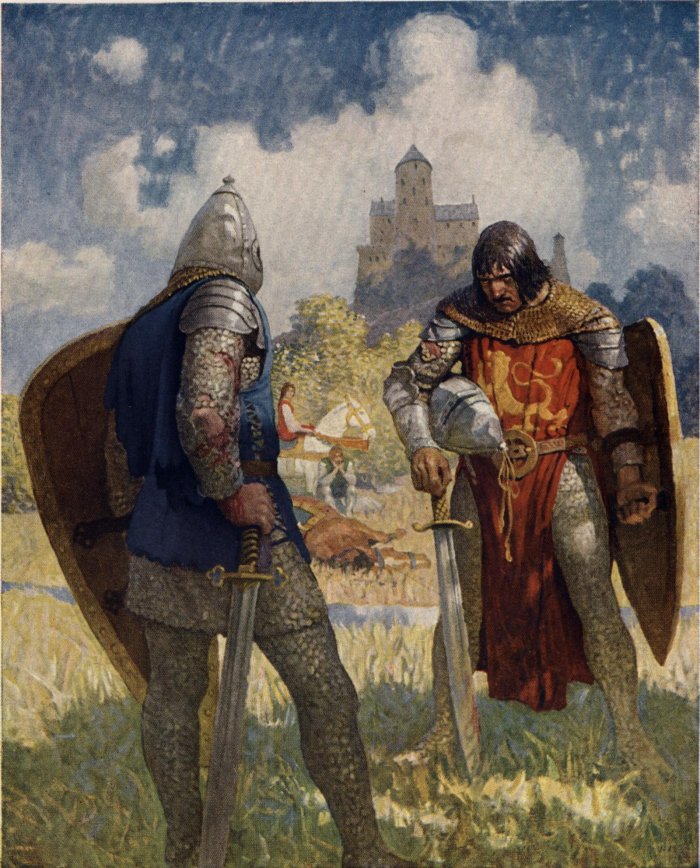
The Boy's King Arthur: Sir Thomas Malory's History of King Arthur and His Knights of the Round Table, Edited for Boys by Sidney Lanier (New York, Charles Scribner's Sons, 1922). Scanned by Dave Pape. N. by C. Wyeth (1882–1945) - Public Domain
The findings come from an international research team, including Oxford experts, which has applied statistical models used in ecology to estimate the loss and survival of precious artifacts and narratives from different parts of Europe. This ecological approach offers a new perspective on the loss of cultural heritage, complementing past research. Their findings are published in the journal Science, with Mike Kestemont (University of Antwerp) and Folgert Karsdorp (KNAW Meertens Institute) as the main authors.
Dr. Katarzyna Anna Kapitan, an Old Norse philologist and Junior Research Fellow at Linacre College, Oxford, says, "By using statistical methods borrowed from ecology, we were able to add to previous scholarship.
"We estimate that more than 90 percent of medieval manuscripts preserving chivalric and heroic narratives have been lost. This corresponds roughly to the scale of loss that book historians had estimated using different approaches. Moreover, we were able to estimate that some 32 percent of chivalric and heroic works from the Middle Ages have been lost over the centuries."
The team used 'unseen species models' from ecology to gauge the loss of narratives from medieval Europe, such as romances about King Arthur, or heroic legends about Sigurd the dragon slayer or the legendary ruler Ragnar lóðbrok, known to wider audiences from the TV series "Vikings." The estimates of loss and survival they obtained are compatible with the scant historical evidence.
The study revealed significant differences in survival rates for medieval works and manuscripts in different languages, suggesting that Irish tradition of medieval narrative fiction is best preserved, while works in English suffered the most severe losses. The team calculated that around 81 percent of medieval Irish romances and adventure tales survive today, compared to only 38 percent of similar works in English. Similarly, results suggest that around 19 percent of medieval Irish manuscript books survive, compared to only 7 percent of English examples.
Dr. Daniel Sawyer, Fitzjames Research Fellow in Medieval English Literature at Merton College, Oxford, says, "We found notably low estimated survival rates for medieval fiction in English. We might blame the dissolution of the monasteries under Henry VIII, which did scatter many libraries. But heroic stories in English rarely appear in the library catalogs of monasteries and friaries in the first place."
"Another possible explanation might be found in the limited prestige of the English language during this period," Dr. Sawyer continues. "Today, English is learned as a second language all over the world but, during the Middle Ages, it had little international significance. After the Norman Conquest, in particular, French was important in England as an international language of power and culture, and the English crown owned parts of what is now France.
"In fact, if we add fiction written in Norman French in England to the evidence in English, the survival rate for English evidence looks more like the rates for other languages. This shows the importance of Norman French to English culture, and suggests heroic stories in Norman French and in English formed a connected tradition."
Meanwhile, Dr. Kapitan explains it is a very different picture for Iceland, where, she says, "We know today around three out of four medieval Icelandic romances and adventure tales (or 77 percent), but only one out of six medieval manuscripts preserving these works (17 percent)."
Besides events such as library fires and the recycling of books, the research identifies the original 'evenness' of cultural production as an overlooked factor in the survival of ancient artifacts.
Dr. Kapitan says, "Our research has revealed interesting similarities between Icelandic and Irish evidence. Icelandic and Irish literatures both have high survival rates for medieval works and manuscripts, and also very similar "evenness profiles." This means the average number of manuscripts that preserve medieval works is more evenly distributed than in other traditions we examined."
"The similarities between Iceland and Ireland may be caused by lasting traditions of copying literary texts by hand long after the invention of print," explains Dr. Kapitan.
Dr. Sawyer adds, "The evidence might tell us about England's ties to continental Europe in the Middle Ages, and about the influence of wider European culture on English writing. England's size and its very close links to the Continent could explain why the English evidence doesn't display the evenness found in the island distributions of stories in Iceland and Ireland."
These analyses call for a wider application of these methods across the heritage sciences. The researchers agree that the collaboration between disciplines has been very stimulating. As Dr. Kapitan concludes, "This shows how trans-disciplinary research lets us step beyond anecdotal case-studies of single scribes or texts, and allows large comparisons across different places, traditions, and languages."
Written by Conny Waters - AncientPages.com Staff Writer
More From Ancient Pages
-
 Scientists Unravel Why Humans Used Tiny Flakes 300,000 Years Ago
-
 How Did Ancient Civilizations Make Sense Of The Cosmos And What Did They Get Right?
-
 Ancient Roman Funerary Ritual With Nails Placed On The Chest Encountered In The Ostiense Necropolis
-
 ‘Vampire Of Lugnano’ And Old Beliefs In Witchcraft: Eerie And Weird Discovery In Italy
-
 Archaeologist Finds Evidence Vikings Sailed Farther Than Previously Believed
-
 Wreckage From Famous Warships Explored In 3D On Anniversary Of Sinking
-
 Ancient City Was Discovered Underground In Antalya’s Demre District
-
 15,000-Year-Old Shell Beads Found Kebara Cave Are The Oldest Known Use Of Organic Red Pigments
-
 Oldest Living Culture: Research Reveals Indigenous Ritual Spanning 500 Generations
-
 Composition Of A 2,000-Year-Old Roman Perfume Identified For The First Time
-
 On This Day In History: ‘Sea King’ Ragnar Lodbrok Seizes Paris – On March 28, 845
-
 Earliest And Largest Scythian Princely Tomb Discovered In Siberia By Swiss Archaeologist
-
 Mystery Of The Coal On The Pirate Shipwreck Queen Anne’s Revenge Solved
-
 Giant Meteorite Impacts Created The Continents – Evidence Found
-
 Bizarre And Rare Finds In Viking Houses – What Was Behind This Mysterious Practice?
-
 Machu Picchu Is Older Than Previously Thought – New Study Reveals
-
 Red Paint On 1,000-Year-Old Gold Mask From Peru Contains Human Blood Proteins
-
 Ancient DNA Reveals “Completely Unexpected” Marriage Rules In Minoan Crete
-
 Bread Sack Of Saint Francesco Of Assisi: 700 Years Old Myth Confirms Authenticity Of A Relic
-
 İnkaya Cave Study Brings To Light 86,000-Year-Old Traces Of Human Life

