
Djémila – Lost City Of The Ancient Kingdom Of Numidia
Jan Bartek - AncientPages.com - When Albert Camus (1913 -1960) wrote about Djémila, a ruined Roman city in the mountains of Northern Algeria, he said this beautiful long-abandoned place is inhabited by the wind alone.
Camus wrote in Noces (Nuptials) that when you walk among the city's ancient ruins, you can hear the wind which "pounces fitfully on the remains of the houses, on the immense forum that extends from the triumphal arch to the temple." He described the ancient lost city of the Numida kingdom as a "great cry thrown out by the lugubrious and solemn stones at the mountains, the sky, and the silence."
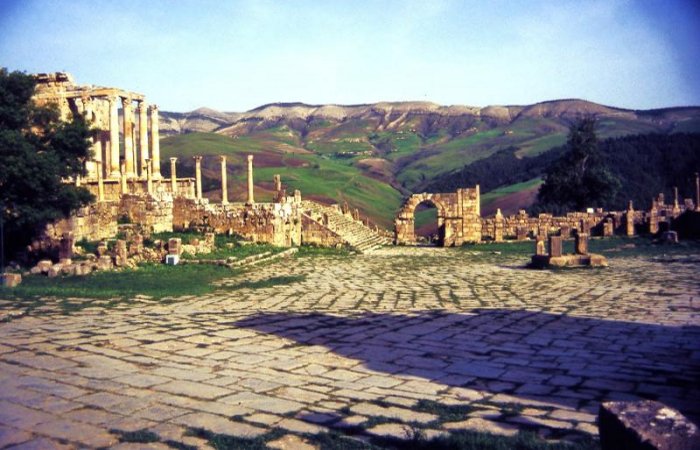
Ancient lost Roman city Djémila. Credit: Yves Jalabert - CC BY-SA 2.0
Today a dead city, Djémila was once a vivid place where people watched the theater and visited temples and basilicas. The sudden decline of Djémila remains a mystery. Still, archaeologists excavating at the site have discovered "broken statues, evidence of fire and absence of precious metals among the ruins suggest the city may have been pillaged." 1
But who could have destroyed this historical ancient city in North Africa?
Camus wrote about his experiences in Djémila in 1936, but it has taken scholars many years to learn about this place's history. Only recently have archaeologists uncovered the history of Djémila that, because of its unique adaptation of Roman architecture, became a UNESCO World Heritage Site.
The Berber City Cuicul In The Ancient Kingdom Of Numidia
Excavations revealed that Djémila was founded around 96 A.D. Its original Berber name was Cuicul.
The city, built about 900 meters (3,000 ft) above sea level, was part of the ancient Kingdom of Numidia.
"The first Algerian kingdom, Numidia, was established by Berber tribe chief Micipsa in 106 B.C. Soon after that, it fell under the rule of the Romans. For a brief period in the 5th century the Vandals, a Germanic tribe, invaded the kingdom but were pushed out by the Romans again. In the 7th century, the Arabs invaded North Africa, bringing with them a new religion, Islam. In Algeria they were resisted by a woman leader, Kahina, the high princess of a tribe supposedly converted to Judaism., but eventually the Berbers became a province of the Umayyad caliphate. The Arabs, however, remained largely an urban elite." 2
Ancient Roman Buildings Still Stand In Djémila
The structures in Djémila have withstood the test of time. When the Duke of Orléans visited the ancient city of Djémila in 1839, he found the triumphal arc so magnificent that he wanted to transport the monument to Paris. For unknown reasons, his project was abandoned, and the arch remained in the same place it has always been. Today, Djémila can boost by having some of the most extraordinary Roman architecture in North Africa.
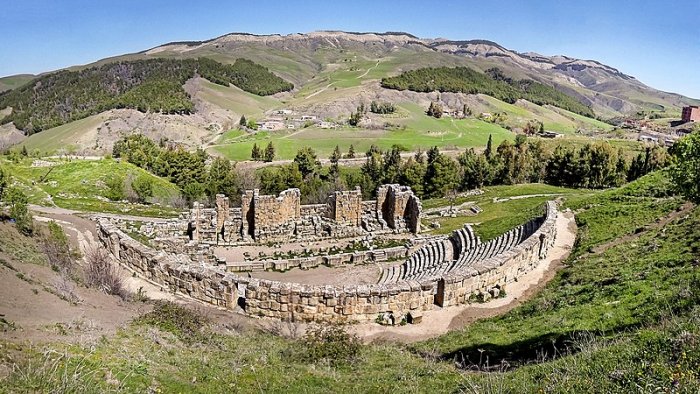
Djémila's Roman theater. Credit: habib kaki - CC BY 3.0
The ancient ruins offer evidence Djémila was a city filled with activity. The city had its own Senate and Forum. "Around the beginning of the 3rd century, it expanded beyond its ramparts with the creation of the Septimius Severus Temple, the Arch of Caracalla, the market and the civil basilica." 3
"In the third century, the city numbered some then thousand inhabitants, who can be imagined going about their business, perambulating from their domus to the temples and the two covered markets, whose counters are still in place." 1
There are many Christian buildings in Djémila. Among them are a cathedral, as well as a church and its baptistry. Archaeologists have unearthed startling mosaics at the site, many of them depicting mythological tales and scenes of daily life. The city was abandoned after the fall of the Roman Empire around the 5th century and 6th century, but as mentioned at the beginning, there are also indications it was also pillaged. Perhaps some local tribes stole whatever they could after Djémila was abandoned by its residents.
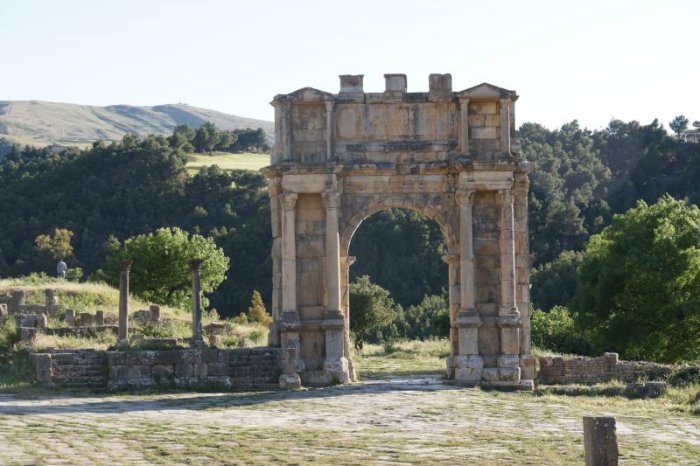
Arc of Caracalla (Djemila). Credit: Yves Jalabert - CC BY-SA 2.0
Djémila means in Arabic the 'Beautiful One', and the name is suitable because the city is truly a Roman beauty. When Muslims reached Djémila, they respectfully abstained from building there. The ancient Roman ruins were preserved for future generations. One does not need to have much imagination to picture what the city must have looked like before being abandoned.
Djémila is an ancient Roman jewel in North Africa.
Updated on August 27, 2022
Written by Jan Bartek - AncientPages.com Staff Writer
Copyright © AncientPages.com All rights reserved. This material may not be published, broadcast, rewritten or redistributed in whole or part without the express written permission of AncientPages.com
Expand for references- Aude de Tocqueville - Atlas of Lost Cities: A Travel Guide to Abandoned and Forsaken Destinations
- "Algeria: From FLN to FIS and Beyond." Insight Turkey, no. 5 (1997): 119-27.
- UNESCO - Djémila
More From Ancient Pages
-
 Emperor Caligula’s Ancient Garden Found Under Piazza Pia In Rome, Italy
-
 Previously Assumed Turkic Origin Of The European Huns – Refuted; They Had Ancient Siberian Roots
-
 Rosetta Stone – Artifact That Solves The Riddle Of Egyptian Hieroglyphics
-
 Groundbreaking Discovery Reveals High Cognitive Abilities In Humans Who Lived 170,000 Years Ago
-
 The Great Stupa At Sanchi – Oldest Stone Structure In India
-
 Ancient Roman Sarcophagus With A Female Skeleton And A Perfume Bottle Discovered In Turkey
-
 First Fossils Of Ancient Human Relatives Sent To Space – Tribute To Science And Our Ancient History
-
 Hieroglyphs Reveal The Name Of Forgotten Maya Queen Ix Ch’ak Ch’een
-
 Early Humans In Europe Were Making Fires At Least 250,000 Years Ago – New Study
-
 Was Spruce Hill In Ohio Home To An Ancient Lost Civilization? Traces Of Strong Fire Puzzle Scientists
-
 Forgotten Ancient Empire That Extended Far Beyond America To Iceland And Its Mysterious Inscriptions
-
 Blue Pigment Originating In Egypt 5000 Years Ago – Recreated By Researchers
-
 Yakhchals: Ingenious Ancient ‘Refrigerators’ Could Store Ice In The Hot Desert
-
 Dresden Codex – Probably The Oldest And Best Preserved Book Of The Maya
-
 Curious Golden Figurine Of Female Dwarf Is A Puzzle
-
 Mysterious Ancient Tully Monster Is So Weird It Cannot Be Classified
-
 North America’s Oldest Known Pterosaur – Discovered
-
 Vikings’ Encounters With Peculiar White-Dressed Humanoids And Cave Dwellers In Unknown Lands Described In Norse Sagas
-
 Who Were The First Icelanders?
-
 Dangerous Anomaly Inside Mysterious European Mountain Remains Unexplained – Unusual Ancient Connections – Part 1

