A. Sutherland - AncientPages.com - Ancient Sumer had a very complex pantheon of gods and goddesses, but four of these powerful figures played an important role because they were creators of everything.
Enlil (EN.LIL – his name meant "lord of the airspace" or “the air-god”) was the king of earth and heaven.
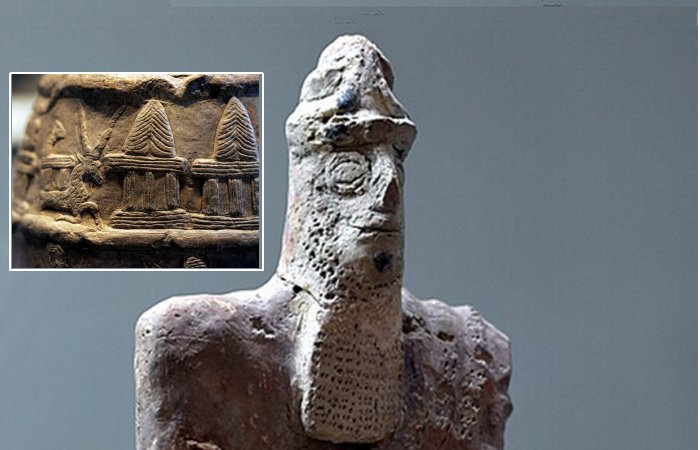
Statuette of Enlil sitting on his throne from the site of Nippur, dated to 1800–1600 BC, now on display in the Iraq Museum. The clenched left fist holds an object (now lost). From the Scribal Quarter at Nippur, Iraq. 1800- 1600 BCE. Baked clay. Traces of red and black paint are visible. Image credit: - CC BY-SA 4.0 and The horned crown on a throne, symbol of Enlil. Unfinished kudurru (boundary marker) with a horned serpent (symbol of Marduk) around the pillar at the bottom. The most prominent gods are featured as symbols. The space for the inscription was left unused—white limestone, Kassite era, found in Susa. Source: Rama - CC BY-SA 2.0 FR
According to Sumerian beliefs, Enlil arrived on Earth well before the human race was created. He was Anu's eldest son; these two share the same epithets in different ancient texts, which describe Enlil - the second in the triad of Sumerian supreme gods – as "The Great Mountain" or "King of All the Lands" (lugal-kur-kur-ra) and “Father of the Gods.
Enlil's role is based on his power and authority, which is clearly emphasized in Mesopotamian mythology; he creates and destroys and is the "decreer of fates".

This is a preview of our premium article, which is available only to members of Ancient Pages.
Become a member to read more - Click here
If you are already a member and have logged in to your account, you can access the article here
See also:
Nammu: Sumerian Goddess Who Got The Idea To Create Mankind In The Image Of Gods