AncientPages.com - Twelve skeletons have been found in a large, 2,000-year-old tomb directly in front of the Khazneh (“Treasury”) in the city of Petra in Jordan. Alongside them, excavators have discovered grave goods made of pottery, bronze, iron and ceramics. There is much excitement among archaeologists because of what the rare opportunity to investigate this site might tell us about Petra’s ancient people, the Nabataeans, and their culture.

One of the most headline-grabbing discoveries has been dubbed a “holy grail” in many reports, suggesting that the vessel is similar to the fictional cup from Indiana Jones and the Last Crusade, also discovered at the Khazneh. In fact, it’s a humble jug, not a cup offering the drinker eternal life.
The similarities between the vessels aren’t a case of art imitating life, but the result of painstaking research into Nabataean pottery carried out by Deborah Fine, who was the director of archives at Lucasfilm Ltd.
Nabataean pottery is very fine – often only 1.5mm thick – and best suited to ceremonial purposes or local use than the thicker, more robust contemporary Roman wares which could travel better. Nabataean pottery is also often painted with images such as flowers, figures and geometric motifs. These styles reflect Petra’s status as an important trading point, and the Nabataeans’ skill in creation and invention.
We do not know anything yet about the identities of those buried, although their interment in separate sarcophagi and their placement at the Khazneh suggest high status.
The work on analysing and interpreting these new finds is only beginning. The pottery, sediments, and skeletal material will hopefully narrow down construction dates for the site. Their discovery confirms that there is more to be found at the Khazneh.
The history of Petra
Petra is a Unesco World Heritage Site, and millions of people visit it each year. The city has been inhabited since 7000BC, but it really flourished in the 1st century AD.
Home to the Nabataeans (a nomadic Arab group who called it Raqmu) for around 300 years, Petra was a hub of commercial activity and a key location for trade route, connecting Egypt, the Mediterranean and the Arabian Peninsula. The site’s many still-existing structures display this unique blending of cultures.
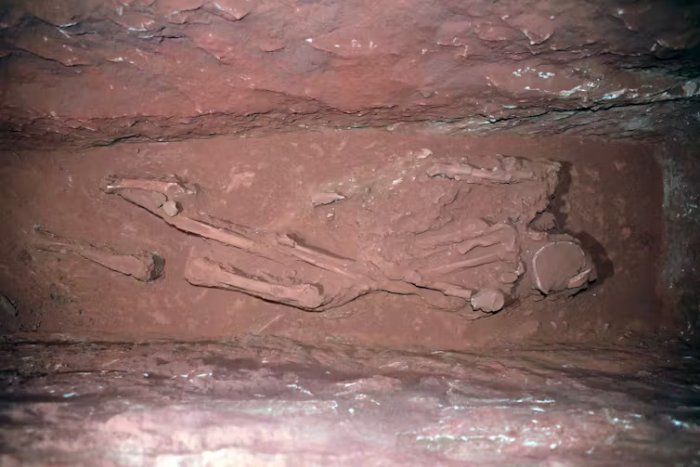
One of the Nabatean skeletons buried beneath the Treasury of Petra. Credit: Discovery’s Expedition Unknown
The decline of the city began after the Romans took it over in AD106. Its decreasing importance followed the opening of sea routes and a devastating earthquake in the 4th century, which destroyed many buildings and led to the city eventually being abandoned.
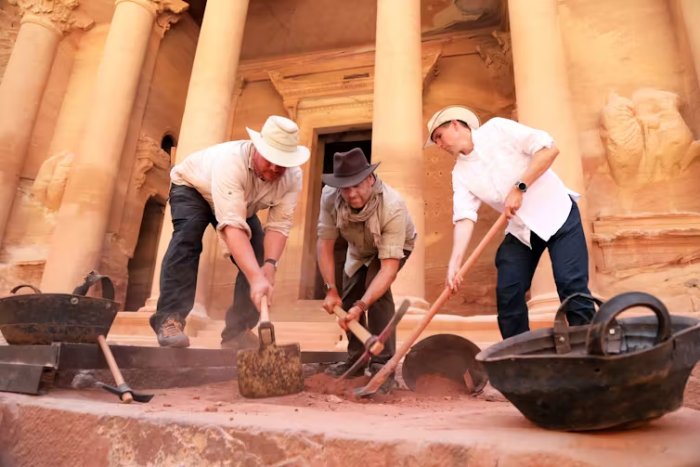
Josh Gates and Pearce Paul Creasman with archaeologist Matthew Vincent, in front of the Treasury at Petra. Credit: Discovery’s Expedition Unknown
Petra’s desert location had allowed the Nabataeans to develop an impressive and ingenious water management infrastructure to master the arid landscape. But this also meant that after the city fell into disuse, it was effectively lost. Enclosed within moutain passages and entered via a natural cleft in the rock, it was completely unknown to the west until 1812, when it was rediscovered by the Swiss geographer Johann Ludwig Burckhardt.
The Khazneh, where these burials were discovered, is the most recognisable part of the city. It is cut from the surrounding red sandstone and displays an intriguing fusion of eastern and Hellenistic architectural features. This decorated structure is a facade for the rock-cut space behind it, thought to have been built during the reign of Nabataean king Aretas IV Philopatris circa AD40, perhaps as a tomb.
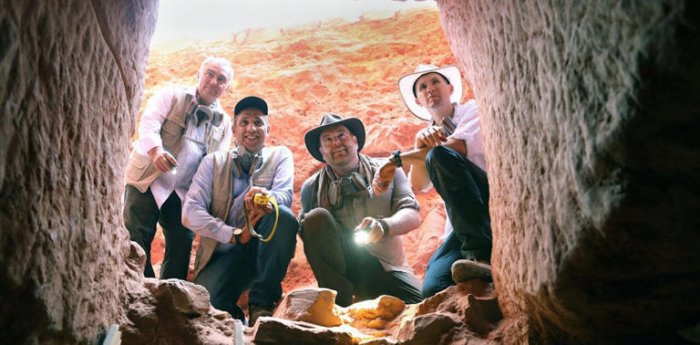
Explorer Josh Gates and academics Pearce Paul Creasman, Fares Braizat and Fadi Balawi peer into the newly discovered tomb at Petra. Credit: Discovery’s Expedition Unknown
According to myth, the front of the decorated urn over the entrance was magically created by the pharaoh for all the gold of Egypt, during his escape when Moses parted the Red Sea. It bears the marks of bullets as people have tried over the centuries to reveal the treasure.
Surveys and excavations have been conducted at Petra since the turn of the 20th century. The current US-Jordan expedition, led by Pearce Paul Creasman, is aiming to uncover further secrets of the city. One of the enduring mysteries is the true purpose of the Khazneh – these burials could help answer that question, while revising our understanding of this cosmopolitan ancient city.
Provided by The Conversation
This article is republished from The Conversation under a Creative Commons license. Read the original article.