
Europe’s Last Neandertals Were More Diverse Than Expected Before Disappearing
Jan Bartek - AncientPages.com - A new study offers the most detailed view yet of Neandertal diversity in western Europe shortly before their extinction.
By analyzing genetic data from 27 Neandertals from present-day Belgium and France, researchers found that late Neandertal populations were more genetically connected and diverse than previously believed. The study found no evidence of recent gene flow from modern humans into these groups and challenges the view that genetic decline was a primary factor in their disappearance.

A significant contribution came from the Neanderthal specimen discovered at Les Cottés in France, excavated under the direction of Professor Marie Soressi of Leiden University’s Faculty of Archaeology. Earlier genetic analyses of this individual revealed an unexpected profile, indicating connections to Neandertal populations beyond western Europe.
"The Neanderthals studied here are some of the last known individuals from northwestern Europe, who lived shortly before the disappearance of Neanderthals. Compared with modern humans, Neanderthals had a much lower effective population size, with weaker purifying selection and possibly reduced fitness. It has been suggested that a loss of genetic diversity may have contributed to their disappearance," the researchers write in their science paper.
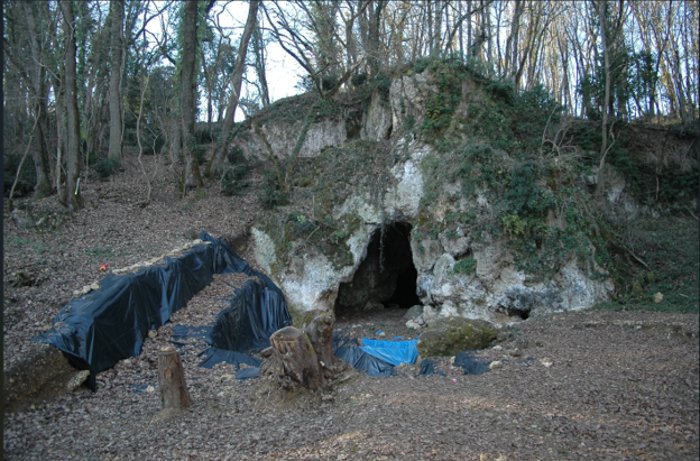
Les Cottés cave in France. Photo credit: M. Soressi
In this study, the Les Cottés specimen served as a key reference for interpreting new genomes from Belgium and France and for reconstructing the population history of the last Neandertals. The data show that these final populations were not a single homogeneous group but a network of interconnected communities that retained traces of diverse ancestral lineages until shortly before extinction.
'Each additional high-quality Neandertal genome provides an extraordinary amount of new information,' says Professor Marie Soressi. 'The discoveries reported in this study show how much we can learn when more individuals become available for genetic analysis.'
See also: More Archaeology News
Soressi notes that these findings underscore how much is still unknown about Neandertal populations and their social connections.
'We are only beginning to uncover the diversity and complexity of Neandertal populations,' she says. 'As more genomes become available from sites across Europe and beyond, we can move from studying isolated individuals to reconstructing entire communities, their relationships, and the social networks that connected them.'
The study was published in the journal Nature
Written by Jan Bartek - AncientPages.com Staff Writer
More From Ancient Pages
-
 Is The Mystery Of Controversial Phaistos Disk Solved?
-
 Beautiful Terracotta Figurine Collection Discovered In Myra, Antalya
-
 12,000-Year-Old Camel Rock Art In Arabia’s Desert Served As Ancient Signs To Water Sources
-
 Researchers Record And Interpret Sacred Cherokee Inscriptions In Alabama’s Manitou Cave
-
 Unique Medieval Perfectly Preserved Sword Found In The Odra River, Poland
-
 Cyprus’s Copper Deposits Created One Of The Most Important Trade Hubs Of The Bronze Age
-
 Wreckage From Famous Warships Explored In 3D On Anniversary Of Sinking
-
 One Of The Earliest Human Settlements Yet Known In Scotland – Discovered
-
 Face-To-Face Encounter With Young Scottish Soldier Who Lived And Died Over 300 Years Ago
-
 Amazing Restoration Of Ancient Roman Vineyard Buried Underneath The Ash Of Mount Vesuvius For 2,000 Years
-
 1,800-Year-Old Richly Painted Tomb Unearthed In Northern Jordan
-
 Remarkable Skill Of Ancient Peru’s Cranial Surgeons
-
 Beautiful Mosaic Dated To Graeco-Roman Times Discovered In Alexandria, Egypt
-
 Stone Age Europe Had Nine Distinct Cultures – Ancient Jewelry Reveals
-
 Incredible Discovery Of A Poem By Virgil On A Roman Oil Amphora
-
 Treasure Trove Of Assyrian Kings Found In Tunnels Excavated And Plundered By Terrorists
-
 LIDAR Discovers Giant Ancient Mesoamerican Calendar – Structures Were Aligned To The Stars
-
 500-Year-Old Transylvanian Diaries Reveal How The Little Ice Age Transformed Life And Death In The Region
-
 Giant Thousand-Year-Old Urns Discovered In The Amazon City Of Fonte Boa
-
 First People To Inhabit Malta Arrived 700 Years Earlier Than Previously Thought

