
What Was The Linguistic ‘Golden Age’ And Why Did It End?
Jan Bartek - AncientPages.com - Today, people use about 7,500 languages to communicate. However, this number only captures a moment in a long and changing history.
How many languages were spoken before people started keeping written records? Did the rise of farming reduce language diversity by letting larger farming groups replace smaller hunter-gatherer communities? Or did growing populations first lead to more languages being created?

A team of researchers from Spain, the USA, and Germany has traced how global language diversity changed over the past 12,000 years. Their study, published in Science, shows that language diversity grew for most of the Holocene, peaked between about 1,000 and 3,000 years ago, and then dropped quickly after that.
Reconstructing A History Without Written Records
“This paper presents an innovative approach to understanding the dynamics of human cultural diversity in the past, addressing one of the central yet least accessible questions in the human sciences. Progress has been limited not by a lack of theoretical interest but by the exceptional difficulty of observing the relevant dynamics empirically”, says Marcus Hamilton of the University of Texas at San Antonio.
Direct evidence for the number of languages before the advent of writing about 6,000 years ago is almost nonexistent and remains limited until recent times. To address this, the researchers combined ethnographic data, prehistoric population estimates, and statistical and social-computational modeling.
The study began with ethnographic data from 171 hunter-gatherer and fisher societies whose traditional ways of life had not been significantly altered by contact with food-producing populations. This information enabled the researchers to estimate the distribution of ethnolinguistic group sizes at the start of the Holocene.
The team combined these estimates with reconstructions indicating that the global human population 12,000 years ago ranged from about 4.4 to 7 million. Assuming each ethnolinguistic group represented a distinct language, their models estimated that there were approximately 4,500 to 6,200 languages in the early Holocene, with broader estimates ranging from 3,300 to 7,800.
“One of the first surprises was that the world immediately before agriculture was probably not exceptionally rich in languages. There were most likely fewer languages than there are today. Linguistic diversity then grew alongside the human population for thousands of years”, says Russell Gray, Director of the Department of Linguistic and Cultural Evolution at the Max Planck Institute for Evolutionary Anthropology in Leipzig.
Tens Of Thousands Of Languages
Improvements in farming, technology, and food production caused the world’s population to grow. As societies grew, more people began to use the same languages.
To study these trends, researchers created thousands of possible scenarios connecting early Holocene estimates to today. Their models included more people per language and used separate studies of global population growth.
Although the exact path is unclear, the models show a clear trend. Language diversity grew during most of the Holocene and usually peaked between 1,000 and 3,000 years ago. Many scenarios show a tenfold increase from early Holocene times, with the highest number of languages reaching tens of thousands.
“The most unexpected result is how recent the peak appears to have been. The period of greatest linguistic diversity may have occurred not in the remote Paleolithic, but during the era of expanding states and early empires”, says Claire Bowern of Yale University.
The authors call this time a linguistic “golden age.” It has not been studied much before, since most historical records were made by growing societies whose languages later became dominant.
Language Loss Before Modern Colonialism
The linguistic golden age was followed by a rapid decline, especially over the past two millennia. These findings challenge the belief that the current language-endangerment crisis began solely with European colonial expansion 500 years ago.
European colonialism greatly accelerated language replacement. However, new models indicate that this process began earlier, rooted in the expansion of multinational states and empires. These expansions brought previously isolated populations into contact and spread dominant languages along with political institutions, technologies, cultural practices, and pathogens.
The model does not specify which empires, regions, or events caused the global decline. Instead, it demonstrates that a significant reduction in linguistic diversity occurred prior to the present.
Today’s Languages Passed Through A Bottleneck
Because of this loss, the languages we speak today do not fully represent all the languages that once existed. Languages spoken by growing populations were more likely to survive, while those of smaller or declining groups often disappeared.
This historical bottleneck may have changed how often certain grammatical structures, speech sounds, and other language features appear around the world. Researchers usually say that common features are easy to learn, efficient to use, or fit well with how people think. However, the new study suggests we should also consider the effects of population growth and language extinction.
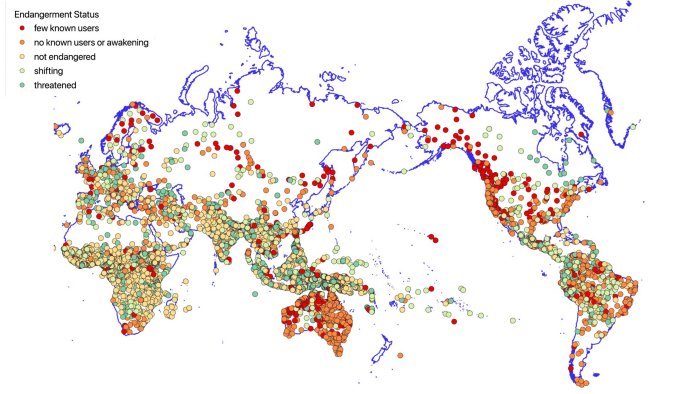
Contemporary languages and endangerment status. Made with a Natural Earth base map using data from Glottolog 5.3 and information adapted from GlottoScope. Credit: Claire Bowern
“The languages we see today are the survivors of a massive and highly selective historical bottleneck. A linguistic feature may be common not because it is inherently superior, but because it happened to be carried by populations that expanded. Extinction may have shaped linguistic diversity much more profoundly than we previously appreciated”, says Damian Blasi, lead author of the study and researcher at the Catalan Institution for Research and Advanced Studies (ICREA) and Harvard University.
Languages are often passed down along with religious practices, family systems, social structures, and other cultural knowledge. The authors believe this bottleneck affected more than just language. Many cultural traditions may have disappeared without leaving any direct historical record.
The researchers point out that this study offers only a rough global overview, not an exact count of prehistoric languages. Their estimates rely on assumptions about the size of early ethnolinguistic groups and how population and language numbers were linked over time. Regional histories were different, and the model cannot track short-term declines caused by war, disease, or environmental changes.
See also: More Archaeology News
Still, the main pattern held true under many different modeling conditions and assumptions. The findings show that language diversity did not just steadily decline from a very diverse Paleolithic world. Instead, as the human population grew, language diversity increased, hit a remarkable but brief peak, and then dropped sharply worldwide.
The study was published in the journal Science
Written by Jan Bartek - AncientPages.com Staff Writer
More From Ancient Pages
-
 Height Differences Among Neolithic People Was Caused By Environmental Stress Not Genetics
-
 Discovered 2000-Year-Old Mauryan Structure May Lead To The Lost Ashoka Pillar Site
-
 Ancient Gymnasium Discovered In Egypt
-
 Adaptable And Flexible Neanderthals May Have Inhabited Danish Island 120,000 Years Ago
-
 Opium Use Was Widespread In Ancient Egypt – Study Of Alabaster Vase Reveals
-
 Archaeologists Solve A 1,000-Year-Old Mystery Mentioned In Norse Sagas
-
 Ancient Ruins Of Tiwanaku Palaspata Temple – Discovered In Andes
-
 Secret Writing On Mummy Papyrus Revealed – Scan Technique Will Shed Light On Daily Life In Ancient Egypt
-
 Surprising Evidence Of Prehistoric Human Activity In Falkland Islands – Europeans Were Not The First Settlers
-
 Massive Ancient Fortifications Reveal Poznan Was Poland’s First Capital
-
 First Discovery Of 60,000-Year-Old Quina Technology In East Asia Challenges Understanding Of Ancient Human Evolution
-
 Ancient ‘Refrigerator’ And Unique Coins Discovered In Roman Military Camp In Bulgaria
-
 Cosmic Message Of The Zapotec Glyphs In The Valley Of Oaxaca – Deciphered!
-
 Gold Earring Found In Ruins Of Ancient Roman Colony Deultum In Bulgaria
-
 16 Meters Long Ancient Papyrus With Spells From The Book Of The Dead Found In Saqqara
-
 4,000-Year-Old Tomb Of Titi Nab Fu, Pharaoh’s Doctor and ‘Magician’ Unearthed In Saqqara
-
 Surprising Diversity Of Ethnic Groups In The US Virgin Islands Before Columbus – New Study
-
 Graeco-Roman Era Rock-Cut Tomb Unearthed In Aswan West Bank, Upper Egypt
-
 Unique Metal Ingot Dated To Iron Age Found For The First Time In Sweden
-
 Identity Of Anti-Christ And Number 666 Revealed By Ancient History Professor

