Eddie Gonzales Jr. - AncientPages.com - A remarkable discovery was made on Skye, Scotland's second-largest island.
Researchers unearthed the skeleton of a new pterosaur species, a flying dinosaur that could have soared the skies 168 million years ago during the Middle Jurassic period.
Reconstruction of Ceoptera evansae. Image credit: © NHM & Witton 2021
The unveiling of the new pterosaur, a member of the Darwinoptera clade, is a stunning discovery
discovery that illuminates the diversity that once existed on pur planet within this group.
It is far beyond what we had previously imagined, according to researchers from the Natural
History Museum, University of Bristol, University of Leicester, and University of Liverpool.
These magnificent creatures were present on Earth for over 25 million years, from the late Early
Jurassic to the latest Jurassic era, spreading their wings across every corner of our globe.
This discovery paves the way for a more intricate and fascinating understanding of early pterosaur
evolution. At the same time, it is another piece of evidence of nature's boundless creativity
and adaptability.
The recent finding supports a more complex model for the initial evolution of pterosaurs.
The scarcity and partial nature of Middle Jurassic pterosaur fossils have historically
prevented efforts to comprehend early pterosaur evolution.
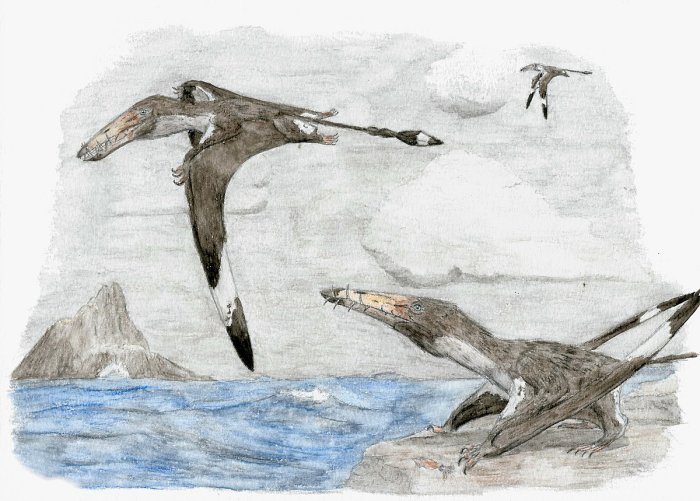
Life restoration of Dearc sgiathanach, a pterosaur from Jurassic Scotland. Image credit: El fosilmaníaco - CC BY-SA 4.0 DEED
However, this new discovery reveals that all main Jurassic pterosaur groups developed
much earlier than previously understood, specifically before the conclusion of the Early
Jurassic period.
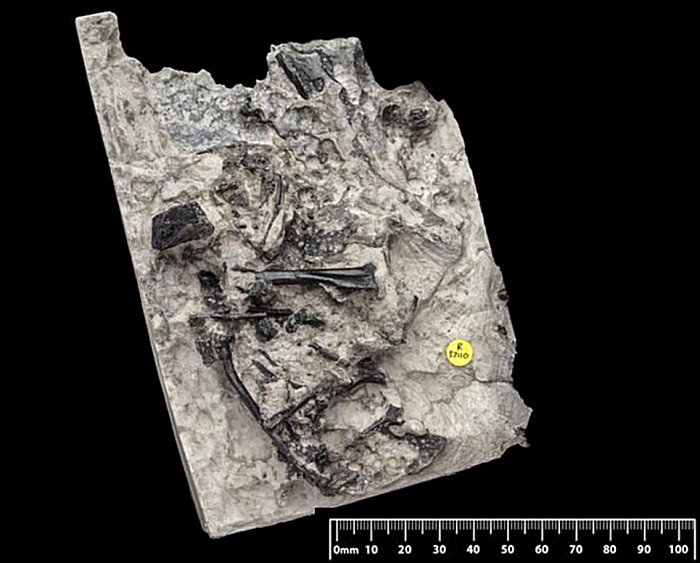
Additionally, it indicates that pterosaurs continued to exist into the latest Jurassic period, co-existing with avialans - dinosaurs that eventually evolved into today's birds. The remains of the flying dinosaur include a partial skeleton of a single entity, encompassing sections of the shoulders, legs, wings, and spine. These bones are still fully encased in rock and can only be examined through the use of CT-scanning technology.
“Ceoptera helps to narrow down the timing of several major events in the evolution of flying reptiles.
Its appearance in the Middle Jurassic of the UK was a complete surprise, as most of its close relatives are from China. It shows that the advanced group of flying reptiles to which it belongs appeared earlier than we thought and quickly gained an almost worldwide distribution,” said Professor Paul Barrett, Merit Researcher at the Natural History Museum and senior author on the paper.
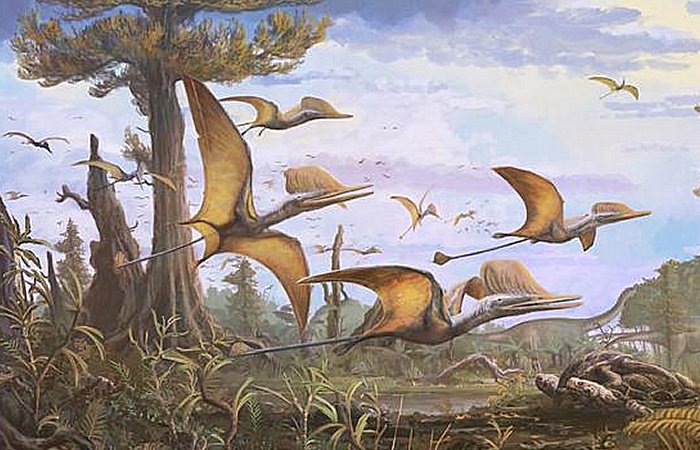
Reconstruction of Ceoptera evansae. Image credit: © NHM & Witton 2021
Lead author Dr Liz Martin-Silverstone, a palaeobiologist from the University of Bristol, said: "The time period that Ceoptera is from is one of the most important periods of pterosaur evolution, and is also one in which we have some of the fewest specimens, indicating its significance. To find that there were more bones embedded within the rock, some of which were integral in identifying what kind of pterosaur Ceoptera is, made this an even better find than initially thought. It brings us one step closer to understanding where and when the more advanced pterosaurs evolved."
Pterosaurs are the earliest vertebrates capable of active flight and are recognized as the largest flying creatures ever discovered.
They ruled in the skies for an amazingly long period of 150 million years before their extinction, spreading across all continents and evolving into an array of forms and sizes.
To date, about 60 genera and 120 species of pterosaurs have been identified, with sizes varying from that of a small sparrow to those boasting wingspans exceeding 12 meters.
Written by Eddie Gonzales Jr. - AncientPages.com - MessageToEagle.com Staff Writer